

Product
Product Details
Aluminum Manifold Blocks (Milled)
Aluminum Manifold Blocks (Milled) — CNC Machined Hydraulic, Pneumatic, and Electrical Manifold Blocks
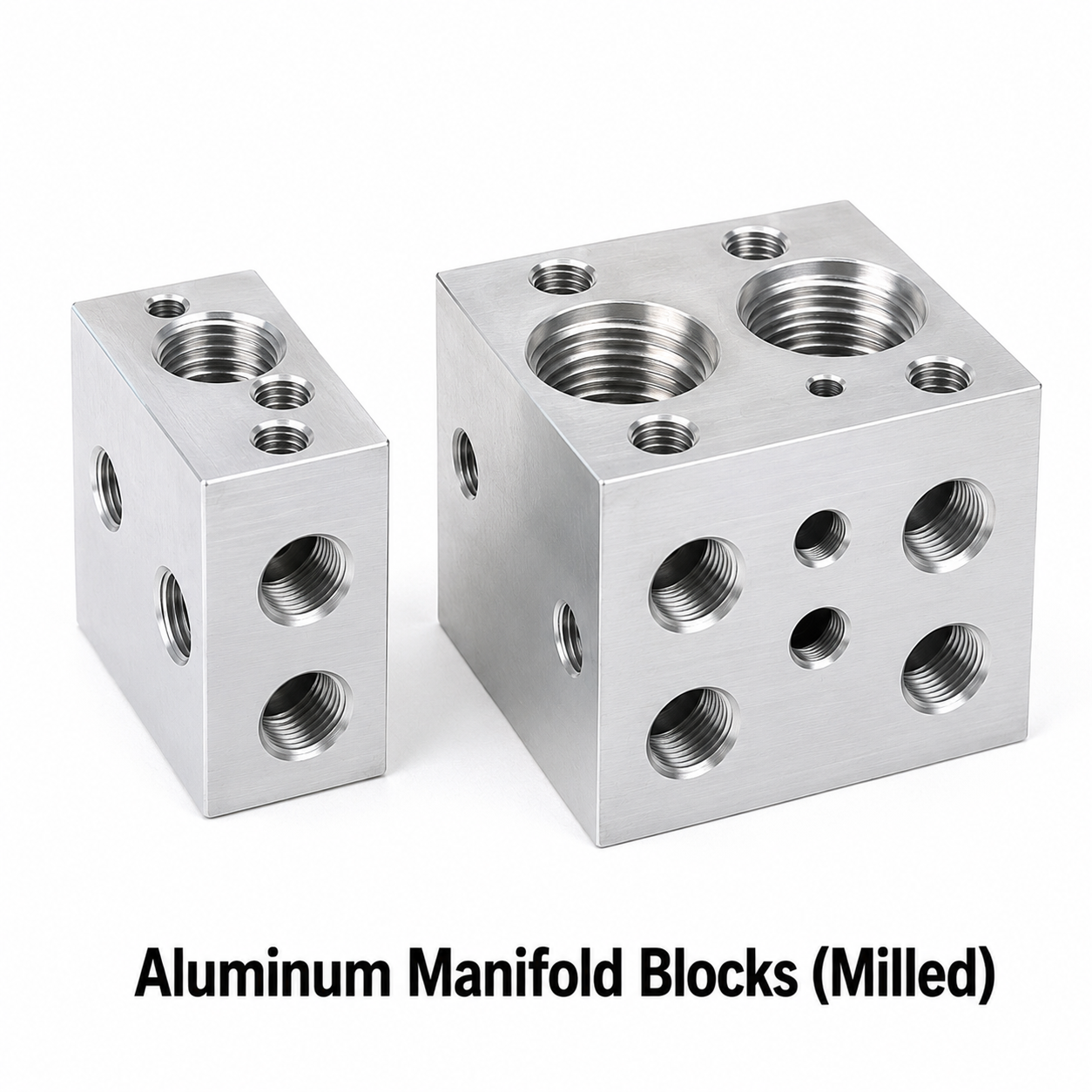
Aluminum Manifold Blocks (Milled) are precision CNC-machined aluminum components with internal ported channels, threaded ports, and mounting holes, used for fluid distribution (hydraulic and pneumatic), electrical bus bar connection distribution, and multi-circuit switching in industrial, electrical, and process control applications. Also referenced as aluminum hydraulic manifold blocks, aluminum pneumatic manifold blocks, aluminum valve manifold plates, ported aluminum blocks, or aluminum distribution manifolds, these components are produced by multi-axis CNC milling from solid aluminum billet or plate, enabling complex internal geometries, precision port placement, and tight dimensional tolerances not achievable by casting or extrusion alone. Electrical Accessories India manufactures aluminum manifold blocks to customer engineering drawings, application-specific port standards (SAE, BSP, NPT, ISO 4401, CETOP), and custom OEM specifications for electrical OEM manufacturers, hydraulic system integrators, EPC contractors, and industrial equipment builders. Price: US$ 9.80/Kilogram
Product Overview
Design and Construction of CNC Milled Aluminum Manifold Blocks
An aluminum manifold block is a monolithic or multi-piece machined aluminum body with a network of precisely drilled and milled internal passages (ports) that interconnect fluid inlet, outlet, and working ports to eliminate external tube and fitting assemblies. The block is designed using 3D CAD with fluid flow simulation to minimize pressure drop, eliminate dead zones, and ensure adequate channel cross-section for required flow rates. CNC milling on 3-, 4-, and 5-axis machining centres creates the external faces, mounting patterns, valve cavities (for solenoid or directional valve mounting), port threads, and identification features. Deep-hole drilling (gun drilling) on dedicated CNC drilling machines creates the internal longitudinal and cross passages with diameters from 3 mm to 30 mm and depth-to-diameter ratios up to 40:1. Intersecting bores are sealed at open ends using port plugs (threaded steel or aluminum plugs), NPT/BSP/SAE plugs, or O-ring-sealed plug inserts. The finished manifold integrates the function of multiple valves, connectors, tees, and fittings into a single precision block, improving system reliability, reducing leak points, and enabling compact installation.
Aluminum Alloy Selection for Manifold Blocks
The alloy selection for aluminum manifold blocks determines machinability, strength under operating pressure, anodizing response, and corrosion resistance. Al 6061-T6 (UNS A96061) is the most widely specified aluminum manifold alloy, offering tensile strength 310 MPa, yield 276 MPa, machinability rating B (good with carbide tooling), and excellent anodizing response. It is the standard choice for hydraulic manifolds up to 250 bar (3,600 psi), pneumatic manifolds up to 16 bar (230 psi), and all electrical distribution manifold applications. Al 6082-T6 (EN AW-6082, tensile 340 MPa) is specified for European-standard projects and provides 10% higher strength than 6061, useful for high-pressure manifolds (up to 350 bar). Al 7075-T6 (UNS A97075, tensile 570 MPa) is used for high-pressure hydraulic manifolds (350–500 bar), aerospace-grade pneumatic systems, and applications where weight-to-pressure rating is critical. Al 2024-T4 (UNS A92024) offers high fatigue resistance for cyclic pressure applications (hydraulic presses, pulsating flow systems). For electrical bus bar manifold blocks where conductivity matters, EC Grade 1350 or Al 1350 is used for bus connection blocks, though strength is lower (95 MPa) and port threads require helicoil inserts.
Port Standards and Connection Types
Aluminum manifold blocks are produced with threaded ports to all major international port standards for fluid power and electrical connections. BSP (British Standard Pipe, ISO 228-1) parallel and tapered threads — G1/8 to G2, most common in European, Asian, and Indian industrial hydraulic/pneumatic systems. NPT (National Pipe Thread, ASME B1.20.1) — 1/8–27 to 2–11.5, used in North American and export systems. SAE (Society of Automotive Engineers) straight thread O-ring boss (SAE J1926, SAE J514) — 7/16-20 UNF to 1-5/8-12 UN, used in mobile hydraulic and precision hydraulic systems for zero-leak connections. ISO 6149 metric straight thread O-ring face seal (ORFS) — M8×1 to M52×2, used in high-pressure manifolds. CETOP 3 and CETOP 5 valve mounting faces (ISO 4401 D03/D05) — standardised valve cavity patterns for D03 and D05 directional control valves, allowing interchangeable valve mounting on the manifold. For electrical manifold/distribution blocks, threaded ports use M4 to M24 metric thread forms for cable terminations, bus bar studs, and earthing connections.
Electrical Bus Distribution Manifold Blocks
In the electrical segment, aluminum manifold blocks serve as multi-circuit bus bar distribution nodes, terminal distribution blocks, and earthing connection manifolds. An electrical aluminum manifold block has multiple threaded ports or studs on a common aluminum body, enabling radial distribution from one cable entry to multiple circuits — analogous to a hydraulic manifold but for current distribution. These blocks are machined from Al 6061-T6 or EC Grade 1350, with contact faces tin-plated or silver-plated for low contact resistance, and feature M4 to M24 cable lug connection ports. Applications include: distribution bus bars for low-voltage (LV) switchgear panels (typically 400A–6,300A); earthing/grounding manifold blocks for electrical substations; neutral link blocks in low-voltage distribution boards; and bus duct tap-off blocks. Cross-sectional area of the manifold body is sized for the total rated current with maximum 65°C temperature rise per IEC 61439-1.
Surface Treatment: Hard Anodizing and Sealing for Manifold Blocks
Aluminum manifold blocks for hydraulic and pneumatic service require specific surface treatments to resist oil, water, and chemical attack while maintaining dimensional stability of precision bores and threads. Hard anodizing (Type III, MIL-A-8625 Type III, 25–75 µm) increases surface hardness (400–600 HV) and provides excellent hydraulic fluid resistance. Hard anodize is applied to external surfaces; threaded ports and precision bores are masked to maintain dimensional tolerance on threads and O-ring sealing faces. For pneumatic manifolds with cyclic oil-mist lubrication, Type II anodize with PTFE impregnation provides both corrosion resistance and dry-film lubrication. Electroless nickel plating (EN, 25–75 µm, ASTM B733) is specified for corrosive hydraulic fluids (water-glycol, phosphate ester) and food-grade pneumatic applications where anodize pore structure could harbor contamination. Bare (as-machined) aluminum manifold blocks are used in clean-room pneumatic systems (semiconductor, pharmaceutical) where no surface coating is acceptable.
Pressure Ratings and Safety Standards for Hydraulic Manifolds
The working pressure rating of an aluminum manifold block is determined by the minimum wall thickness between adjacent passages, the alloy yield strength, and the safety factor applied per system standard. Aluminum hydraulic manifold blocks in Al 6061-T6 are typically rated to: 350 bar (5,000 psi) for passages ≥4 mm wall, general hydraulic machinery per ISO 4413; 250 bar (3,600 psi) for manifolds with complex close-pitch passage patterns. Higher pressure ratings (500+ bar) require Al 7075-T6 or steel manifolds. Pressure test (hydrostatic) at 1.5× working pressure is performed on each manifold before delivery per ISO 4413 and customer QA requirements. Manifolds are clearly marked with maximum working pressure, alloy, and lot number per customer traceability requirements.
CNC Manifold Block Manufacturing Tolerances
Precision tolerances are critical for aluminum manifold blocks: valve mounting face flatness ≤0.012 mm (ISO 4401 requirement for D03/D05 valve mounting to prevent bypass leakage); port thread gauging per BS 2779, ASME B1.20.1, or SAE J1926; intersecting bore positional tolerance ±0.05 mm to ensure clean cross-bore intersection; O-ring groove dimensions per ISO 3601-2 (radial width and depth) for seal integrity; surface finish of valve mounting face ≤0.8 µm Ra (ISO 4401 requirement). These tolerances are achieved and verified on CNC machining centres with tool wear monitoring, CMM inspection, and thread gauge verification of every port on every manifold.
Manifold Block Configuration Options
Aluminum manifold blocks are configured in multiple formats to suit installation space and circuit requirements. Single-body monolithic manifold: all circuits in one block from a single billet — compact, zero leak between circuits, limited to moderate complexity. Modular manifold system: individual circuit slices bolted together on tie rods (ISO 4401 CETOP modular system) — allows circuit changes without replacing the entire manifold. Sub-plate manifold: a flat aluminum plate with one valve mounting pattern and two to four working ports — the simplest manifold form for single-valve sub-plate mounting. Custom multi-function manifold: CNC-machined block integrating check valves, flow controls, pressure relief, and directional control valve mounting in a single block per OEM system drawing.
Key Features
- Multi-axis CNC milling from 6061-T6, 6082-T6, 7075-T6, 2024-T4, and EC 1350 billet
- All port standards: BSP, NPT, SAE, ISO 6149, CETOP D03/D05 (ISO 4401)
- Pressure rating: up to 350 bar (Al 6061-T6); up to 500 bar (Al 7075-T6)
- Deep-hole gun drilling: passage diameters 3–30 mm, L/D up to 40:1
- Hard anodize, electroless nickel, PTFE impregnation — fluid-compatible surface treatments
- Hydrostatic pressure test at 1.5× working pressure on every manifold
- ISO 4401 CETOP 3/5 valve mounting faces — flatness ≤0.012 mm
- Electrical bus distribution blocks in EC 1350 and 6061 with tin/silver plating
Custom Design and Engineering Support
Electrical Accessories India provides manifold block design support: customer provides system schematic, pressure/flow requirements, and space envelope; our engineering team proposes manifold design with CAD model, pressure drop calculation, and passage layout. Design review and DFM (Design for Manufacturability) feedback provided before production.
Modular Manifold Systems
Modular CETOP manifolds allow individual circuit slices to be added or removed without redesigning the whole block. Each slice has ISO 4401 valve mounting on top face, and inter-slice passages aligned by precision dowel pins and O-ring face seals. Used in machine tool hydraulics, injection moulding machines, and press brake systems.
Leak Testing and Quality Assurance
Every aluminum manifold block undergoes internal leak testing: (1) port plug seating check — torque-verified plug installation; (2) hydrostatic pressure test — filled with hydraulic oil at 1.5× MWP for 5 minutes, zero leakage accepted; (3) air leak test (for pneumatic manifolds) — submerged bubble test at 1.5× MWP. Test records maintained per ISO 9001:2015.
Electrical Distribution Block Applications in Switchgear
For LV switchgear applications, aluminum manifold distribution blocks with multiple bus bar tapping points are used as neutral bus bars, PE (protective earth) bus bars, and multi-circuit distribution nodes. These electrical manifold blocks are machined from 6061-T6 or EC 1350 billet with silver-plated or tin-plated contact surfaces, providing low-resistance (<0.1 mΩ) multi-circuit bus connections in panels rated up to 6,300A per IEC 61439-1.
Gun Drilling for Deep Internal Passages
Deep internal passages (L/D > 10:1) are produced by gun drilling on dedicated deep-hole drilling machines. Single-flute gun drills produce straight, concentric bores to IT8 tolerance with Ra 0.8–1.6 µm surface finish inside the bore — critical for clean O-ring sealing and minimal pressure-drop passages. Gun drilling capability: 3 mm to 30 mm diameter, up to 600 mm deep.
Technical Specifications
| Parameter | Specification |
|---|---|
| Material Grades | Al 6061-T6, Al 6082-T6, Al 7075-T6, Al 2024-T4, EC 1350 |
| Block Size Range | 25 mm × 25 mm × 25 mm to 500 mm × 300 mm × 200 mm |
| Passage Diameter Range | 3 mm to 30 mm |
| Max Passage Depth (gun drill) | 600 mm (L/D ≤ 40:1) |
| Port Thread Standards | BSP (G), NPT, SAE J1926, ISO 6149, M (metric) |
| Valve Mounting Standard | ISO 4401 D03, D05, D07 (CETOP 3, 5, 7) |
| Working Pressure (Al 6061-T6) | Up to 350 bar (5,000 psi) |
| Working Pressure (Al 7075-T6) | Up to 500 bar (7,250 psi) |
| Valve Face Flatness | ≤0.012 mm (ISO 4401) |
| Surface Treatment | Hard Anodize Type III, Electroless Nickel, PTFE, As-Machined |
| Surface Finish (Ra) | 0.8–1.6 µm (machined faces); 0.8 µm (valve mounting faces) |
| Test Pressure | 1.5× Maximum Working Pressure (hydrostatic) |
| Price | US$ 9.80/Kilogram |
Alloy Comparison Table for Manifold Blocks
| Alloy | Tensile (MPa) | Yield (MPa) | Machinability | Max Pressure Rating | Best For |
|---|---|---|---|---|---|
| Al 6061-T6 | 310 | 276 | Good | 350 bar | General hydraulic/pneumatic/electrical |
| Al 6082-T6 | 340 | 290 | Good | 380 bar | European-spec hydraulic systems |
| Al 7075-T6 | 570 | 503 | Very Good | 500 bar | High-pressure, aerospace, defence |
| Al 2024-T4 | 470 | 325 | Excellent | 420 bar | Fatigue-critical cyclic pressure |
| EC 1350 | 95 | 85 | Good | N/A (electrical) | Electrical bus distribution blocks |
Product Types and Variants
| Type | Port Standard | Alloy | Application |
|---|---|---|---|
| Hydraulic Manifold Block | BSP / SAE / NPT | 6061-T6, 7075-T6 | Industrial hydraulic machinery |
| Pneumatic Manifold Block | BSP / NPT | 6061-T6 | Pneumatic automation, compressor systems |
| CETOP D03 Valve Manifold | ISO 4401 D03 | 6061-T6 | Directional control valve mounting |
| CETOP D05 Valve Manifold | ISO 4401 D05 | 6061-T6, 6082-T6 | Heavy-duty directional valve mounting |
| Modular Manifold Slice | ISO 4401 modular | 6061-T6 | Flexible circuit hydraulic systems |
| Sub-Plate Manifold | BSP / SAE | 6061-T6 | Single valve sub-plate mounting |
| Electrical Bus Manifold | M4–M24 threaded | 6061-T6 / EC 1350 | LV switchgear bus distribution |
| Custom Multi-Port Manifold | Per OEM drawing | Any alloy | OEM-specific system integration |
Applications in Industry
| Industry | Application | Manifold Type |
|---|---|---|
| Hydraulic Machinery | Valve bank manifold in presses, cranes, forklifts | Hydraulic D03/D05 |
| Pneumatic Automation | Valve island manifold for solenoid valve banks | Pneumatic BSP/NPT |
| Machine Tools | Coolant and lubrication distribution manifolds | Custom CNC milled |
| Oil and Gas | Instrumentation manifold for pressure tapping | High-pressure NPT |
| Power Generation | Turbine governing hydraulic manifold | High-pressure SAE |
| LV Switchgear OEM | Neutral bus bar and earth bus manifold | Electrical EC 1350 |
| Process Industry | Chemical dosing manifold in ATEX Zone 2 | EN-plated 6061-T6 |
| Aerospace / Defence | Hydraulic power unit manifold (MIL-H-5606) | Al 7075-T6 |
Manufacturing Process
Aluminum manifold blocks are manufactured from certified aluminum billet or plate with full material traceability. Process flow: (1) Material receipt — billet/plate incoming inspection per alloy specification (ASTM B221 for extrusion, ASTM B209 for plate), including hardness test (Rockwell B or Brinell), dimensional check, and visual inspection; (2) CNC milling — 3- or 5-axis CNC machining centre produces all external faces, valve mounting surfaces (flatness ≤0.012 mm), counterbores, and shallow passage openings; (3) Gun drilling — deep internal passages drilled on CNC gun drilling machine with single-flute gun drills, precise coolant flow, and depth monitoring to ±0.1 mm; (4) Thread milling/tapping — port threads produced by CNC thread milling (for accuracy) or tapping with thread gauging verification of every port; (5) Cross-bore plug machining — plug seat bores faced and drilled for port plugs at passage intersections; (6) Plug installation — port plugs installed and torqued to specification, sealed with PTFE tape or anaerobic sealant per design; (7) CMM inspection — 100% or AQL-based dimensional inspection on CMM covering critical dimensions, port positions, and face flatness; (8) Pressure testing — hydrostatic test at 1.5× MWP, 5-minute hold, zero leakage; (9) Surface treatment — hard anodize, electroless nickel, or as per order; (10) Marking and packaging — engraved or stamped part number, pressure rating, alloy, and lot number; protective packaging with plugged ports.
Quality Standards and Certifications
| Standard | Scope |
|---|---|
| ISO 9001:2015 | Quality Management System |
| ISO 4413 | Hydraulic fluid power safety requirements |
| ISO 4401 | Hydraulic directional valve mounting dimensions (CETOP) |
| MIL-A-8625 Type III | Hard anodizing specification |
| ASTM B733 | Electroless nickel plating |
| ASTM B221 / IS 733 | Aluminum extruded billet specification |
| IEC 61439-1 | LV switchgear assemblies (for electrical bus manifolds) |
| ISO 3601-2 | O-ring groove dimensions for sealing faces |
Why Choose Electrical Accessories India?
- Multi-Axis CNC Capability — 3-, 4-, and 5-axis machining for complex manifold geometries
- Gun Drilling In-House — deep-hole drilling to L/D 40:1 for long internal passages
- All Port Standards — BSP, NPT, SAE, ISO 4401 D03/D05 from same facility
- 100% Pressure Testing — hydrostatic test at 1.5× MWP on every manifold
- Engineering Support — manifold design review and DFM feedback included
- Dual-Use Capability — hydraulic/pneumatic manifolds AND electrical bus distribution blocks
- Price: US$ 9.80/Kilogram — competitive for machined billet manifold components
Frequently Asked Questions
Q1. What is the maximum working pressure for your aluminum manifold blocks?
For Al 6061-T6: 350 bar (5,000 psi). For Al 7075-T6: 500 bar (7,250 psi). These ratings apply to standard passage geometries with minimum 4 mm wall thickness. Higher pressure or unusual geometries require engineering review and FEA pressure simulation before committing to a design.
Q2. Do you supply CETOP D03 and D05 (ISO 4401) standard valve mounting patterns?
Yes. CETOP D03 (NG6) and D05 (NG10) valve mounting faces in accordance with ISO 4401 are standard offerings in Al 6061-T6. Flatness of valve mounting faces: ≤0.012 mm, which is ISO 4401 series requirement to prevent valve spool bypass leakage. BSP or SAE working port threads are available with D03/D05 faces.
Q3. Can you integrate check valves, relief valves, and flow controls into the manifold?
Yes. Custom manifold blocks can include: cartridge valve cavities (Cavity No. 08 to T-21A per Sun Hydraulics / Parker standard cartridge dimensions); pilot-operated check valve passages; integral flow-control orifice inserts; and sequence valve cartridge pockets. Customer provides system schematic and functional requirements; we provide manifold design and production.
Q4. What is the delivery lead time for custom manifold blocks?
First-article (prototype) lead time: 3–5 weeks from approved drawing. Repeat production: 2–3 weeks. For standard sub-plate manifolds (single valve mounting, 4 working ports), ex-stock or 1-week production in 6061-T6 as-machined or hard anodized. Complex multi-circuit custom manifolds: 4–6 weeks including design review, production, and testing.
Q5. Do you supply manifold blocks with hard anodizing?
Yes. Hard anodizing (Type III, 25–50 µm) is standard for hydraulic manifolds. Valve mounting faces and precision bores are masked before anodizing to maintain ISO 4401 dimensional compliance. Hard anodize provides hydraulic oil, water, and corrosion resistance and is compatible with all hydraulic fluids (mineral oil, HFA, HFB, HFC water-glycol, and HFD phosphate ester).
Q6. Can you supply manifold blocks for electrical bus distribution (not hydraulic)?
Yes. Aluminum electrical bus manifold blocks in 6061-T6 or EC Grade 1350 with tin-plated or silver-plated contact surfaces for low-voltage bus distribution (400A–6,300A) are manufactured to customer drawing or IEC 61439-1 panel design requirements. These blocks are used as neutral bus bars, earth bus bars, and multi-circuit distribution nodes in LV switchgear panels.
Q7. What quality documentation do you provide with manifold blocks?
Standard documentation package: material test certificate (MTC) for aluminum billet, dimensional inspection report (CMM), pressure test certificate, surface treatment certificate (anodize thickness or electroless nickel plating report), and certificate of conformance. FAI (First Article Inspection) reports for new part numbers.
Q8. What is the minimum order quantity for custom manifold blocks?
For custom CNC milled manifold blocks: MOQ 1 piece (prototype) with appropriate unit pricing. For production quantities: MOQ varies by complexity — typically 5–25 pieces for complex manifolds, 25–50 pieces for simpler sub-plate types. Volume pricing applies from 10 pieces upward.
Equivalent Terms in Other Languages
| Language | Term 1 | Term 2 | Term 3 |
|---|---|---|---|
| Spanish | Bloques colectores de aluminio fresados | Manifold hidráulico de aluminio | Bloque distribuidor aluminio mecanizado |
| Russian | Алюминиевые блоки-коллекторы (фрезерованные) | Гидравлический коллектор алюминиевый | Распределительный блок из алюминия |
| French | Blocs collecteurs en aluminium fraisés | Collecteur hydraulique aluminium | Bloc distributeur aluminium usiné |
| Portuguese | Blocos coletores de alumínio fresados | Manifold hidráulico alumínio | Bloco distribuidor alumínio usinado |
| Italian | Blocchi collettori in alluminio fresati | Collettore idraulico in alluminio | Blocco distributore alluminio lavorato |
Related Aluminum Products
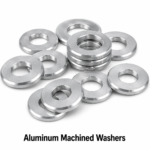
- Aluminum Machined Washers
- Aluminum CNC Machined Components
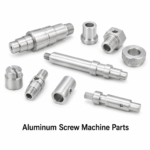
- Aluminum Screw Machine Parts
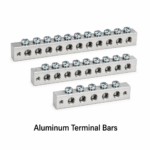
- Aluminum Terminal Bars
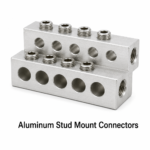
- Aluminum Stud Mount Connectors
- Aluminum Transformer Lugs (Tubular)
- Aluminum Cable Lugs
- Aluminum Deep Drawn Parts
Get a Quote — Aluminum Manifold Blocks (Milled)
Provide system schematic or CAD drawing, port standards (BSP/NPT/SAE/ISO 4401), alloy preference, maximum working pressure, surface treatment requirement, and quantity. Our engineering team will review and provide a DFM proposal within 48 hours.
Price: US$ 9.80/Kilogram | MOQ: 1 piece (prototype) | Gujarat, India | Global Export