

Product
Product Details
Copper Cable Connectors
Copper Cable Connectors
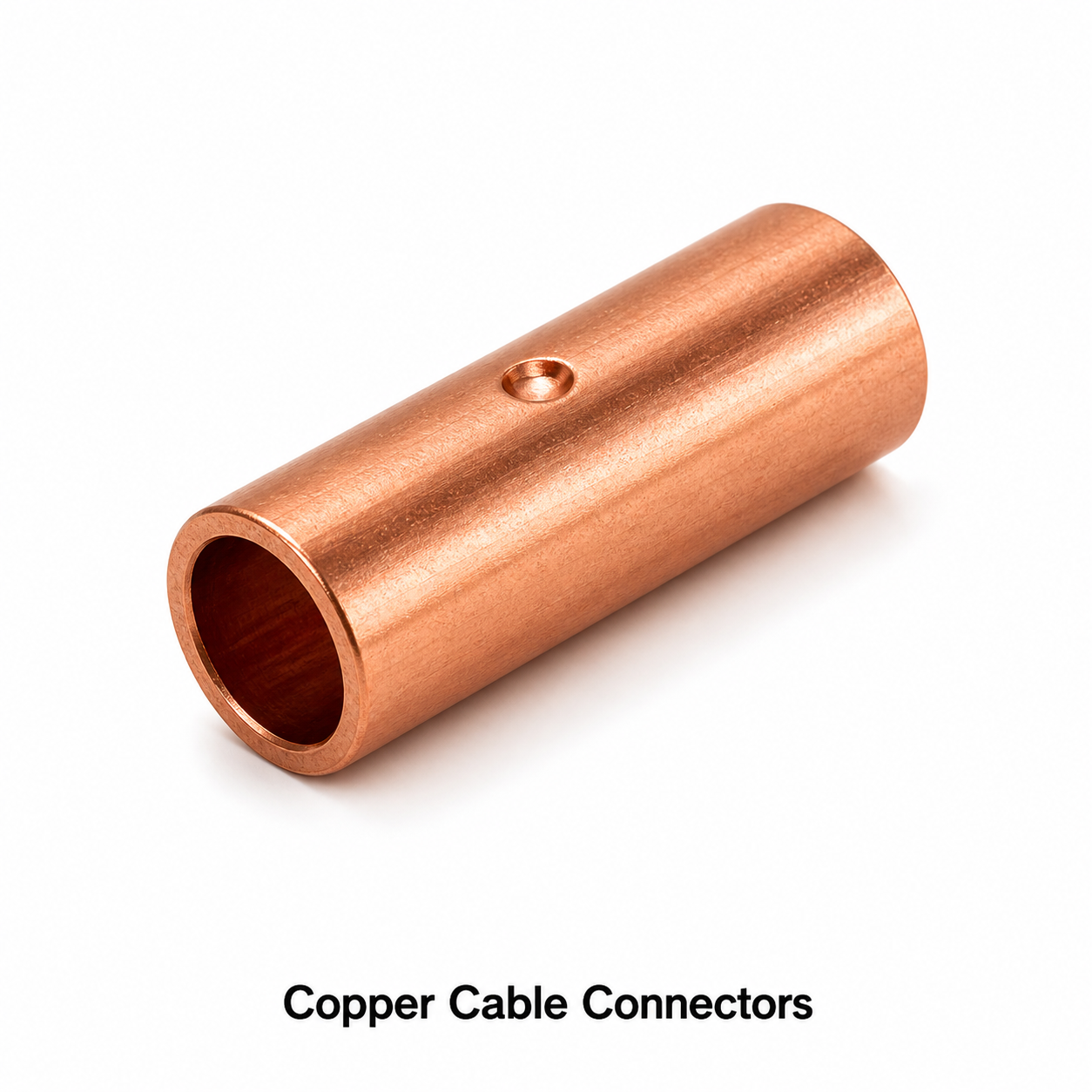
Copper Cable Connectors – Ring and Fork Type are precision-stamped and formed electrical termination devices fabricated from electrolytic-grade copper sheets for reliable, low-resistance bolted cable-to-equipment connections. Ring type connectors (also called ring tongue terminals, ring cable lugs, or O-type terminals) provide 360° contact retention for high-vibration applications. Fork type connectors (also called spade terminals, U-type cable lugs, or fork tongue terminals) allow fast disconnection without completely removing the stud or bolt. Electrical Accessories India manufactures both types from IS 1897 / ASTM B187 / BS EN 13601 copper sheet, offering the highest conductivity termination solution for LV switchgear, motor terminations, grounding systems, and power distribution panels.
Product Overview
What Are Copper Ring and Fork Type Connectors?
Copper ring and fork type cable connectors, also known as copper cable lugs, copper tongue terminals, copper compression terminals, or copper solderless connectors, are stamped and formed sheet copper components that provide the mechanical and electrical interface between a stranded or solid copper conductor and a bolted stud, busbar, or equipment terminal. The ring type forms a complete circle (closed eye) around the stud, ensuring connection integrity even under significant vibration or mechanical shock. The fork type (open-barrel spade lug) allows the conductor to be attached and detached from the stud without fully removing the nut, offering faster field installation and maintenance. Both types are available as bare copper, tin-plated copper, and silver-plated copper variants.
Material and Sheet Grade
Connectors are stamped from electrolytic tough pitch (ETP) copper sheet conforming to IS 1897, BS EN 13601, ASTM B187, or DIN EN 13601 with copper purity ≥99.9% Cu+Ag. ETP copper provides electrical conductivity ≥98% IACS, ensuring negligible voltage drop and heat generation at terminations under full rated current. Oxygen-free copper (OFC) variants – conforming to ASTM B170 / IS 8130 – are available for applications requiring superior resistance to hydrogen embrittlement in elevated-temperature or hydrogen-rich environments such as power station generator connections. Sheet thickness ranges from 0.8 mm to 4.0 mm depending on conductor cross-section and current rating.
Stamping and Forming Process
Copper sheet is precision-blanked on progressive dies to produce the tongue (connecting flat) and barrel (conductor crimp zone) in a single die stroke, maintaining dimensional consistency with tolerances of ±0.1 mm on critical dimensions. Ring eyes are formed by punching to produce stud hole diameters from M4 to M20 clearance. Fork jaw widths accommodate standard metric stud sizes (M4 to M16) and imperial stud sizes (3/16″ to 5/8″) for North American markets. Crimping barrel geometry follows DIN 46234 / BS 4579 standards for compatibility with hydraulic indent crimping tools. The barrel is seamed or seamless depending on the conductor cross-section range and specified crimp tooling.
Crimp Barrel Design and Conductor Compatibility
The crimp barrel (conductor socket) accepts stranded copper conductors from 0.5 mm² to 630 mm² (AWG 20 to 1250 kcmil). Barrel lengths are dimensioned to provide ≥1.5× conductor diameter grip length, ensuring adequate conductor retention per IEC 61238-1 pull-out force requirements. Dual-crimp barrel designs are available for extra-large cross-sections (240–630 mm²), requiring two independent crimp indents per barrel for certified joint compression. Oversized barrels for flexible stranded conductors (Class 5/6 per IEC 60228) accommodate slightly larger fill diameters without conductor deformation. Pre-insulated variants with PVC or nylon shrink-tube barrel insulation are available for colour-coded phase identification and IP20 finger safety.
Tongue (Lug) Geometry and Stud Compatibility
Ring tongue geometry conforms to DIN 46235 (ring cable lugs) with standard stud hole diameters and tongue widths for M4 to M20 studs. Fork tongue jaw widths are designed with 0.5 mm clearance on each side of the stud diameter, allowing single-turn nut removal for conductor withdrawal. Long-barrel variants provide extended grip for fine-strand flexible conductors. 90° angle palm lugs (right-angle ring terminals) are available where terminal boards require conductor routing parallel to the connection plane. Tunnel-type ring lugs (insulated with fully enclosed barrel) are produced for switchgear applications requiring IP20 live-part protection.
Plating and Surface Finish
Standard finish is bare ETP copper (bright). Tin-plating (electrodeposited, 3–5 µm minimum) is the most common option – preventing surface oxidation, improving solderability for inspection connections, and reducing galvanic corrosion in mixed-metal assemblies. Silver-plating (5–15 µm) is specified for high-temperature applications (generator terminals, transformer connections) where operating temperatures exceed 85°C and contact resistance stability under heat cycling is critical. All plating is applied after forming and sizing to ensure complete coverage of barrel interior surfaces – the most critical contact zone. Tin-plated connectors carry RoHS compliance declarations (lead-free Sn, no Cd, no Hg).
Colour Coding and Identification
Pre-insulated ring and fork connectors are colour-coded per IEC 60228 and DIN VDE 0295 conductor cross-section ranges: red (0.5–1.5 mm²), blue (1.5–2.5 mm²), yellow (4–6 mm²), grey (6–16 mm²). Colour insulation materials include PVC (standard), nylon (superior abrasion resistance), and polyolefin dual-wall heat-shrink (for sealed, moisture-resistant connections). Non-insulated connectors in large cross-sections (16–630 mm²) are identified by etched or embossed marking of nominal cross-section and stud size on the tongue face.
Key Features
- Fabricated from ETP copper sheet – ≥99.9% Cu+Ag, ≥98% IACS conductivity
- Ring type (O-lug) and Fork type (U-spade) configurations
- Conductor range: 0.5 mm² to 630 mm² (standard); custom larger sizes on request
- Stud hole range: M4 to M20 (ring); M4 to M16 (fork)
- Finish: bare copper, tin-plated, silver-plated
- Crimp barrel: seamed or seamless, DIN 46234 / BS 4579 compatible
- Temperature rating: −40°C to +105°C (bare/tin-plated); +150°C (silver-plated)
- Compliant with IEC 61238-1, BS 4579, DIN 46235, IS 8309
- RoHS compliant – lead-free, halogen-free options
Superior Conductivity – Copper vs. Brass
ETP copper provides electrical conductivity of ≥98% IACS, significantly higher than brass (26% IACS) or aluminium (61% IACS). For high-current applications such as main feeder cable terminations, transformer LV bushings, motor terminal box connections, and earthing conductors, copper ring and fork connectors minimise resistive losses and temperature rise at termination points. This ensures compliance with IEC 60364-5-54 earthing requirements and IEC 61238-1 connector performance criteria for the operating life of the installation.
Mechanical Retention and Vibration Resistance
Ring type connectors provide 360° stud contact, making them the preferred choice for compressor motor terminals, genset panels, traction control panels, and marine switchgear where sustained vibration could loosen fork-type connections. Crimp retention force per IEC 61238-1 Type Test exceeds 1.5× rated conductor tensile strength. Silver or tin-plated contact surfaces resist fretting corrosion – the primary failure mode of bolted copper connections under low-amplitude vibration. Double-crimped connections for 240–630 mm² conductors provide certified joint performance per IEC 61238-1 compression class A or B.
Fast-Disconnect Fork Type Connectors
Fork type (spade/U-type) connectors reduce field installation and maintenance time by up to 50% compared to ring type, as the nut does not need to be fully removed to change the conductor. They are widely used in motor control panel wiring, busbar tap-off connections, and field junction boxes where frequent conductor changes occur during commissioning and testing. Fork connectors are available with closed-end spade jaws (to prevent accidental stud release) and open-end jaws (for rapid installation). Nylon-insulated fork connectors provide IP20 live-part protection for safe touch even when connected.
Pre-Insulated Variants for Phase Identification
Pre-insulated ring and fork connectors with colour-coded PVC or nylon barrels comply with IEC 60445 (identification of terminals) and IEC 60446 (identification of conductors). Red, blue, black, yellow-green, and grey colour variants enable accurate phase, neutral, and protective earth conductor identification throughout LV wiring installations. The insulation barrel provides strain relief, reducing flex fatigue at the conductor-connector interface in environments subject to thermal cycling or mechanical movement.
Conformity with International Standards
Products conform to IEC 61238-1 (compression and mechanical connectors for power cables up to 30 kV), BS 4579 (crimp connectors for copper conductors), DIN 46234 (compression connectors for aluminium conductors – applicable sizing methodology), IS 8309 (flat copper connectors for switchgear), and ANSI/NEMA CC 1 (electric power connectors). Type test reports per IEC 61238-1 covering current cycle test, short-circuit test, pull-out test, and resistance ratio test are available for standard cross-section ranges.
Export Standards and Market Compliance
Products are exported with documentation compliant with CE (LVD 2014/35/EU), RoHS 2, REACH, and conflict minerals reporting. Market-specific certifications for Saudi Arabia (SASO), Gulf states (GCC), South Africa (SANS), Australia (AS/NZS), and the United States (UL/NEMA) are available on request. All export shipments include material test certificates, dimensional reports, and country of origin certificates (Form A / GSP for preferential tariff access).
Technical Specifications
| Parameter | Specification |
|---|---|
| Material | ETP Copper – IS 1897 / BS EN 13601 / ASTM B187 (≥99.9% Cu+Ag) |
| Conductivity | ≥ 98% IACS (bulk material) |
| Conductor Range | 0.5 mm² to 630 mm² (AWG 20 to 1250 kcmil) |
| Stud Hole Size (Ring) | M4 to M20 (metric); 3/16″ to 3/4″ (imperial) |
| Fork Jaw Width | M4 to M16 compatible |
| Sheet Thickness | 0.8 mm to 4.0 mm (per cross-section) |
| Temperature Rating | −40°C to +105°C (Sn-plated); up to +150°C (Ag-plated) |
| Surface Finish | Bare copper / Sn-plated (3–5 µm) / Ag-plated (5–15 µm) |
| Crimp Standard | DIN 46234 / BS 4579 / IEC 61238-1 |
| Hardness | 55–85 HV (ETP copper, annealed) |
| RoHS | Compliant (Pb ≤ 0.1%, Cd ≤ 0.01%) |
| Country of Origin | India |
Raw Material Grades – International Equivalents
| Standard | Grade | Description |
|---|---|---|
| IS (India) | IS 1897 / IS 613 | ETP copper sheet and strip – standard grade |
| EN / DIN (Europe) | Cu-ETP / EN 13601 | Electrolytic tough pitch copper for connectors |
| BS (UK) | C101 / BS EN 13601 | High-conductivity copper for electrical purposes |
| ASTM (USA) | C11000 / ASTM B187 | ETP copper bus bar / sheet |
| JIS (Japan) | C1100 | Japanese ETP copper sheet |
| OFC variant | C10200 / ASTM B170 | Oxygen-free copper for elevated-temp use |
Product Types and Variants
- Copper Ring Type Connectors (O-Lug) – Closed eye, M4–M20 stud, 0.5–630 mm²
- Copper Fork Type Connectors (U-Spade Lug) – Open jaw, M4–M16 stud, 0.5–240 mm²
- Pre-Insulated Ring Connectors – PVC/nylon barrel, colour-coded, 0.5–10 mm²
- Pre-Insulated Fork Connectors – PVC/nylon barrel, colour-coded, 0.5–10 mm²
- Tin-Plated Ring Connectors – Sn 3–5 µm, corrosion-resistant, 1.5–630 mm²
- Silver-Plated Ring Connectors – Ag 5–15 µm, high-temp rated, 10–630 mm²
- Double-Crimp Ring Connectors – For 240–630 mm² conductors, IEC 61238-1 compliant
- 90° Angle Palm Lugs – Right-angle tongue, for space-constrained panel boards
- Long Barrel Connectors – Extended crimp barrel for fine-strand Class 6 conductors
Applications
- LV Switchgear and Panel Boards: Main cable terminations, MCCB/ACB busbar connections, outgoing feeder lug connections
- Motor Terminal Boxes: Ring lug connections at motor terminals for DOL and star-delta starters
- Transformer Connections: LV winding bushing terminations, tap changer connections
- Earthing and Grounding: Earthing conductor terminations, equipment grounding, lightning protection system connections
- Power Distribution Panels: Distribution board incoming and outgoing cable lugs
- Solar and Renewable Energy: DC cable terminations at combiner boxes, inverter DC inputs, battery bank connections
- Railways: Traction return cable terminations, train earth connections, signalling cable joints
- Marine and Offshore: Deck equipment power connections, bilge pump wiring, shore power inlet terminations
Manufacturing Process
Copper ring and fork type connectors are fabricated through a multi-stage precision sheet metal stamping and forming process. ETP copper sheet (IS 1897 / Cu-ETP) is received and tested for chemical purity (Cu+Ag ≥99.9%), conductivity, hardness, and dimensional thickness before release to production. Coils are slit to blank width on precision slitting lines, then fed into progressive stamping dies on high-speed mechanical presses. The progressive die performs blanking (cutting the tongue and barrel profile), piercing (punching the stud hole or fork opening), bending (forming the barrel from flat to cylindrical or U-profile), and coining (calibrating tongue thickness and hole diameter) in a single progressive die pass at rates of 200–600 strokes per minute. Barrels are seam-rolled and sized for conductor fit per DIN 46234. Parts are deburred in vibratory finishers, then plated (barrel plating for small sizes; rack plating for large sizes) with tin or silver as specified. Final inspection covers stud hole diameter, barrel ID, tongue thickness, plating thickness (XRF), and pull-out force (sample testing per IEC 61238-1).
Quality Standards and Certifications
- Material: IS 1897 / EN 13601 / ASTM B187 – Material test certificates per EN 10204 3.1
- Connector performance: IEC 61238-1 Type Test (current cycle, short-circuit, pull-out, resistance ratio)
- Crimp compatibility: DIN 46234 / BS 4579 – hydraulic and mechanical crimping tool compatibility
- Dimensional standard: IS 8309 (flat copper connectors), DIN 46235 (ring cable lugs)
- Salt spray: ISO 9227 (Sn-plated: ≥200 hours; Ag-plated: ≥480 hours)
- RoHS: EU Directive 2011/65/EU – Lead-free tin plating verified by XRF
- REACH: SVHC declaration available
- ISO 9001:2015 – Quality management system certified
Why Choose Electrical Accessories India
Electrical Accessories India produces copper ring and fork type cable connectors using in-house progressive die tooling and controlled copper sheet procurement from certified ETP copper mills. Our tooling capability spans 0.5 mm² to 630 mm² conductor sizes across metric and imperial stud configurations without reliance on third-party stamping subcontractors. Each production lot is traceable to incoming copper coil material certificates. Our dedicated quality laboratory performs conductivity verification, plating thickness measurement, and mechanical pull-out testing on every batch. We supply under OEM labelling to international panel builders, switchgear manufacturers, EPC contractors, and electrical distributors across 40+ countries with consistent lead times and competitive pricing.
Pricing
Indicative Export Price: US$ 15.80 per kilogram (FOB Indian Port)
Applicable to standard ETP copper ring and fork type connectors – bare copper or tin-plated finish, bulk packed.
Silver-plated variants, custom sizes, pre-insulated types, and small-quantity orders attract additional charges. Contact us for firm quotation based on conductor cross-section range and annual volume.
Frequently Asked Questions
Q1: What is the difference between ring type and fork type copper cable connectors?
Ring type (O-lug) connectors have a closed circular eye that encircles the stud completely. They cannot be removed without fully unthreading the nut, making them more secure in high-vibration environments. Fork type (U-spade) connectors have an open U-shaped jaw that slides off the stud sideways with only partial nut loosening. Fork type is preferred where frequent conductor changes are required during testing, commissioning, or maintenance.
Q2: Why use copper sheet connectors instead of cast or machined brass connectors?
Copper sheet connectors offer significantly higher electrical conductivity (≥98% IACS vs. 26% IACS for brass) and lower contact resistance, which is critical for main feeder cable terminations and earthing connections where current density and power loss are primary design concerns. Brass connectors are preferred for small-signal applications where machinability, thread integrity, and mixed-metal compatibility are more important than absolute conductivity.
Q3: What is the maximum conductor size you manufacture?
Standard catalogue range is up to 630 mm² for ring type and up to 240 mm² for fork type connectors. For conductor sizes above 630 mm² (up to 1600 mm² for submarine cable and generator connections), we produce custom tooled connectors per customer specification and drawings.
Q4: What crimp tools are compatible with your copper connectors?
Connectors are dimensionally compatible with standard hydraulic hexagonal and oval crimp die sets from Cembre, Klauke, Burndy, and Panduit for the relevant conductor cross-section. Die codes and crimping specifications are provided with each product. For smaller cross-sections (0.5–10 mm²), ratchet hand crimping tools with appropriate die inserts are used. Consult our technical data sheet for specific die code recommendations per connector cross-section.
Q5: Are tin-plated copper connectors compatible with aluminium conductors?
Tin-plated copper ring and fork connectors can be used with aluminium conductors with appropriate precautions: anti-oxidant inhibiting paste must be applied to the aluminium conductor before crimping, conductor should be wire-brushed to remove the oxide layer, and the aluminium conductor must be oversized to account for lower conductivity (approx. 1.5× equivalent copper cross-section). For high-current applications with aluminium conductors, bi-metal (Al-Cu) transition connectors are the preferred solution.
Q6: What is the operating temperature limit for copper cable connectors?
Bare ETP copper connectors are rated to +105°C continuous. Tin-plated connectors maintain integrity to +105°C with stable contact resistance. Silver-plated copper connectors are rated to +150°C continuous, making them suitable for transformer terminal connections, generator bus connections, and furnace power connections where ambient and conductor temperatures are high.
Q7: Do you supply pre-insulated variants in bulk quantities?
Yes. Pre-insulated ring and fork connectors with PVC or nylon colour-coded barrels are available in bulk packs of 100–1000 pieces per size for distributor inventory. Dual-wall heat-shrink insulated variants for sealed, moisture-resistant connections in outdoor and marine applications are also available in standard cross-section sizes.
Q8: Can IEC 61238-1 type test reports be provided?
Yes. IEC 61238-1 type test reports covering Class A compression connectors (current cycle test, short-circuit withstand test, pull-out force test, initial resistance ratio test) are available for the standard cross-section range of 16 mm² to 630 mm².
Q9: What documentation is needed for Gulf/Middle East export?
For GCC countries, we provide: SASO certificate of conformity (for Saudi Arabia), GSO-compliant test documentation, material test certificates, commercial invoice, packing list, certificate of origin, and REACH/RoHS declarations. ECAS (Emirates Conformity Assessment Scheme) documentation for UAE is available on request.
Q10: Are custom tongue widths and stud hole sizes available?
Yes. Custom tongue dimensions, stud hole diameters (including imperial sizes), barrel lengths, and special plating combinations are produced to customer drawings. MOQ for custom tooled items starts from 2,000 pieces per variant. Tooling lead time is 3–4 weeks; production samples available within 2 weeks thereafter.
Equivalent Terms in Other Languages
| Language | Term 1 | Term 2 | Term 3 |
|---|---|---|---|
| Spanish | Conector de cable de cobre tipo anillo | Terminal horquilla de cobre | Zapata de cable de cobre |
| Russian | Медный кабельный наконечник кольцевой | Медный вилочный кабельный наконечник | Медный обжимной наконечник |
| French | Cosse câble cuivre type anneau | Terminal fourche en cuivre | Cosse de câble en cuivre |
| Portuguese | Conector de cabo de cobre tipo anel | Terminal garfo de cobre | Olhal de cabo de cobre |
| Italian | Capocorda in rame tipo anello | Capicorda a forcella in rame | Connettore cavo in rame |
Related Products and Linked Terms
Copper Grounding Ferrule Connectors | Brass Tunnel Connectors | Brass PCB Connectors | Copper Cable Lugs | Copper Compression Terminals | Copper Earth Clamps | Ring Type Cable Lugs | Fork Type Cable Terminals | Copper Busbar Connectors | Tin-Plated Copper Lugs | Silver-Plated Copper Connectors | Bi-Metal Cable Lugs | Copper Crimp Connectors | Pre-Insulated Cable Lugs | Copper Earthing Strips
Request a Quote
Electrical Accessories India supplies copper ring and fork type cable connectors to switchgear OEMs, EPC contractors, panel builders, electrical distributors, and power utilities globally. Contact our export team for technical specifications, samples, or volume pricing.
Email: info@elecaccs.com | Website: www.elecaccs.com