

Product
Product Details
Aluminum Transformer Spade Terminals
Aluminum Transformer Spade Terminals — Flat Blade Winding Connectors
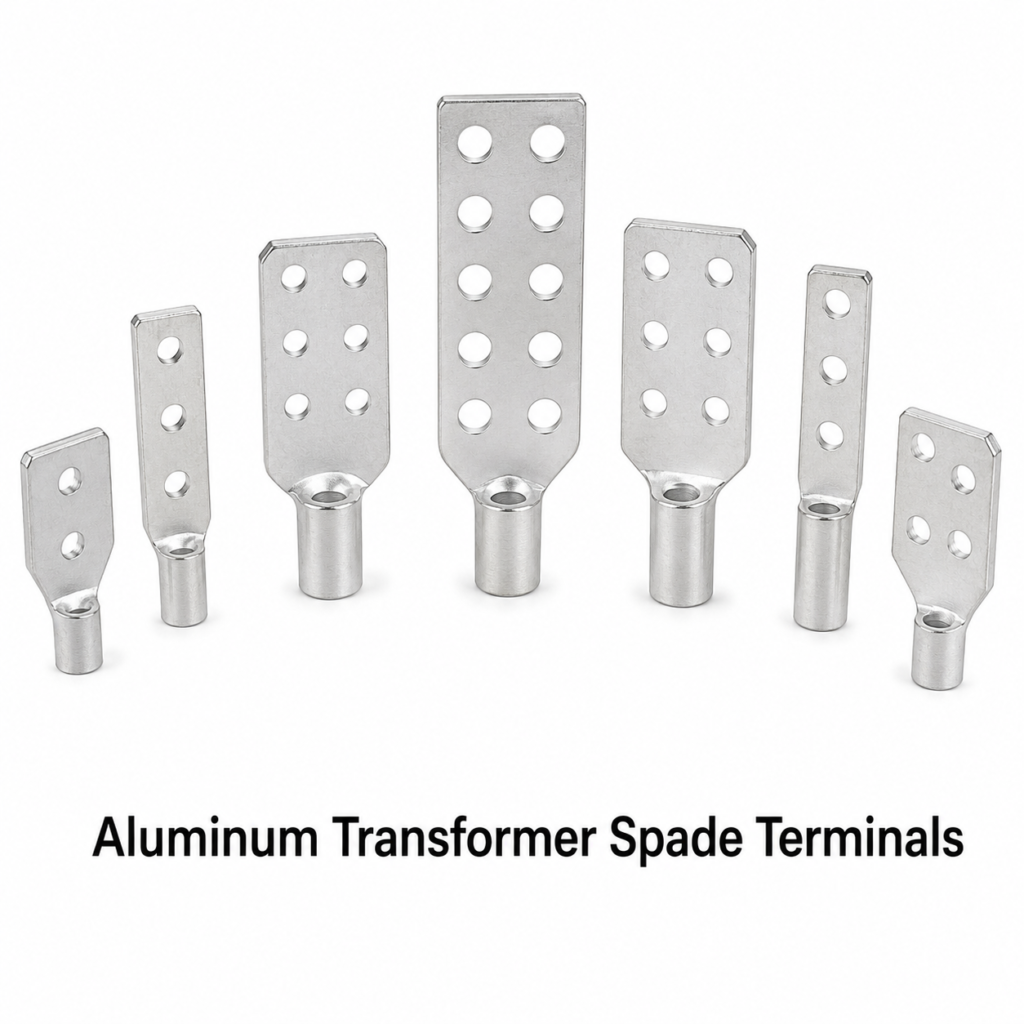
Aluminum Transformer Spade Terminals are precision-manufactured flat blade electrical connectors used for connecting transformer winding ends to external bushing studs, cable lugs, and bus bar systems in distribution transformers, power transformers, voltage regulators, and autotransformers. Electrical Accessories India manufactures aluminum spade terminals from EC-grade aluminum (1350 alloy, minimum 61% IACS conductivity) and 6061-T6 alloy, ensuring low contact resistance, high current-carrying capacity, and long-term joint integrity in transformer applications. Price: US$ 8.80/Kilogram
Product Overview
What Are Transformer Spade Terminals?
A spade terminal (also called a fork terminal, flat blade connector, or spade lug) is an electrical connector with a flat, forked or tongue-shaped contact blade that slides under or around a binding post, bolt, or stud. In transformer applications, spade terminals connect the ends of HV and LV winding wires/bus bars to the external tap changer contacts, bushing terminations, or bus bar risers inside the transformer tank or on the terminal board. The spade design allows quick installation and removal during transformer maintenance and servicing without completely disassembling the connection hardware. Aluminum spade terminals are used on the LV (low-voltage) winding output side of distribution transformers, where large conductor cross-sections and high current density make aluminum the preferred material due to its lower cost per unit conductance compared to copper.
Material Specifications for Transformer Spade Terminals
The primary material for transformer spade terminals is EC (Electrical Conductor) grade aluminum, specifically AA 1350 alloy, which contains minimum 99.5% aluminum and achieves ≥61% IACS (International Annealed Copper Standard) electrical conductivity. This high-conductivity grade minimizes resistive losses and temperature rise at the winding-to-bushing interface, which is a critical joint in transformer thermal design. For higher mechanical strength requirements — in LV bus bar or connection plate applications where the terminal experiences vibration, thermal cycling, or mechanical handling loads — 6061-T6 (conductivity: ~40% IACS but tensile strength 310 MPa) is used. The choice between 1350 and 6061 is determined by the transformer OEM’s design requirements for joint temperature rise vs. mechanical robustness.
Dimensional Standards and Current Ratings
Aluminum transformer spade terminals are manufactured to match transformer winding wire cross-sections from 25 mm² to 1,200 mm² and bolt hole diameters from M6 to M24. The spade blade width, thickness, and tongue length are dimensioned to the OEM drawing or national/international standards for the specific transformer rating. Typical blade cross-section areas are matched to the current-carrying capacity requirement: for a 250A connection, the minimum aluminum cross-section is 120 mm² (per IEC 61238-1 temperature-rise criteria); for 630A, minimum 300 mm² is required. Hole diameter is typically the bolt OD + 0.5 mm (clearance fit) for M8 through M16, and bolt OD + 1 mm for M20 and above, allowing easy assembly while minimizing contact area loss.
Manufacturing Methods for Spade Terminals
Aluminum transformer spade terminals are produced by two primary manufacturing methods depending on design geometry and volume. For flat-profile spade terminals with simple rectangular or U-fork shapes, CNC turret punch press or hydraulic press with compound progressive dies is used on flat aluminum sheet or strip (thickness: 3–20 mm), followed by deburring, drilling, and surface treatment. For three-dimensional spade terminals with a tubular (barrel) transition section merging into a flat blade — similar to a compression lug with a spade end — the barrel section is produced by rolling/forming or extruding the transition from round tube to flat blade, followed by CNC machining to final dimensions. Both methods are available at Electrical Accessories India depending on the design specification and order volume.
Contact Resistance and Joint Performance
The electrical performance of a transformer spade terminal joint is characterized by contact resistance (milliohm-level) and temperature rise under rated current. Per IEC 61238-1, the joint temperature rise must not exceed 5°C above the bulk conductor temperature under rated current, and contact resistance must not exceed 1.2× the resistance of the equivalent straight conductor length. Our aluminum spade terminals are designed and tested to meet these criteria, with typical initial contact resistance of 0.02–0.1 mΩ depending on contact area and clamping force. Tin plating (5–15 µm) or bi-metal transition (aluminum-to-copper) inserts are available to reduce galvanic corrosion risk when connecting aluminum terminals to copper winding ends or copper bus bars.
Anti-Oxidation Treatment for Aluminum Contacts
Aluminum naturally forms a thin, hard oxide layer (Al₂O₃, hardness ~9 on Mohs scale) that acts as an electrical insulator even though the underlying aluminum is highly conductive. This oxide layer must be removed or prevented from forming on electrical contact surfaces to achieve low contact resistance joints in transformer terminals. Methods used include: (1) Contact grease/inhibitor compound applied during assembly to exclude oxygen and prevent oxide regrowth, (2) Tin plating (5–15 µm) over the contact surfaces to provide a stable, oxide-free interface, (3) Silver plating (3–8 µm) for higher-performance contacts in power transformer bushing connections, and (4) Aluminum oxide abrasion during crimping (for compression-type barrel-to-spade terminals) which breaks the oxide layer mechanically at the joint interface. Our spade terminals are supplied with tin plating or plain (with inhibitor grease) as specified by the customer.
Specialized Applications in Transformer Construction
In distribution transformers (100 kVA to 2,500 kVA, 11/0.433 kV), aluminum spade terminals appear at: LV winding output connections to bushing studs, tap changer lead connections to tapping terminals on the HV winding, neutral point connection to the earthing bushing, and bus bar riser connections in the LV terminal compartment. In auto-transformers and reactor assemblies, spade terminals connect the series and common winding sections to the common bus bar. In instrument transformer (CT and PT) assemblies, smaller spade terminals are used for secondary winding connections to the terminal block. Our manufacturing capability covers all these application dimensions in aluminum, ranging from miniature terminals for 5A CT secondary connections to large-format spades for 2,500A LV bus bar connections.
Key Features
- Material: EC Grade Al 1350 (≥61% IACS) and 6061-T6
- Current range: 25A to 2,500A (matched to conductor cross-section)
- Conductor cross-section: 25 mm² to 1,200 mm²
- Bolt hole diameter: M6 to M24
- Surface finish: Tin plated, silver plated, or plain with inhibitor
- Contact resistance: meets IEC 61238-1 temperature-rise criteria
- Manufacturing: CNC punching, pressing, or forging + machining
- Bi-metal Al/Cu versions available for Al-to-Cu joints
- Custom dimensions per transformer OEM drawing
- ISO 9001:2015 certified; full material traceability
EC Grade vs. Structural Grade Aluminum
The decision between EC grade aluminum (1350 alloy) and structural grade (6061-T6) for transformer spade terminals requires balancing conductivity vs. mechanical performance. EC grade 1350 offers 61% IACS conductivity (vs. 40% IACS for 6061) but lower yield strength (55–105 MPa vs. 276 MPa for 6061-T6). For most distribution transformer LV connections, the thermal-hydraulic design requires minimum conductor cross-section based on the 61% IACS conductivity of 1350 aluminum. Using 6061 would require a larger cross-section to achieve the same current rating, increasing terminal weight and cost. However, where mechanical robustness is paramount — e.g., terminals subject to bus bar vibration, frequent assembly/disassembly, or high-fault-current mechanical forces — 6061-T6 is the correct specification.
Bi-Metal Aluminum-to-Copper Transition Terminals
When aluminum spade terminals connect to copper bus bars, transformer winding copper wire, or copper bushing hardware, galvanic corrosion at the aluminum-copper interface becomes a significant reliability concern, particularly in humid or outdoor environments. Bi-metal transition spade terminals — consisting of a copper contact face friction-welded, explosion-welded, or induction-brazed to an aluminum body — eliminate the aluminum-copper galvanic cell by presenting the correct metal at each interface: copper at the copper bus bar side, aluminum at the aluminum conductor side. These bi-metal terminals are specified by leading transformer OEMs for outdoor and tropical-climate installations and are increasingly required by utilities in coastal and high-humidity regions as part of transformer asset life-extension programs.
Custom Dimensions and OEM Drawing Manufacturing
Transformer spade terminals are inherently application-specific components: each transformer design uses a particular combination of LV current rating, winding conductor cross-section, bushing stud diameter, and spatial constraints inside the transformer tank or terminal compartment. Electrical Accessories India manufactures aluminum transformer spade terminals to customer-supplied drawings (2D PDF, DXF, or 3D STEP) with no restriction on geometry within our manufacturing process capabilities. The key dimensions specified on OEM drawings include: tongue length, tongue width, tongue thickness, hole diameter, hole position (distance from tongue end), radius between tongue and body, overall body length, and conductor attachment method (crimping, welding, bolting). We review OEM drawings for manufacturing feasibility and advise on any DFM (Design for Manufacturability) improvements before committing to production.
Testing and Qualification of Transformer Terminals
Aluminum transformer spade terminals for power utility and OEM applications are subject to qualification testing that includes: temperature rise test per IEC 61238-1 (terminal at rated current, temperature rise ≤5°C above adjacent conductor), contact resistance measurement before and after 50 thermal cycles (cycling between -25°C and +100°C), short-circuit current withstand (rated fault current × 1 second), mechanical endurance (100 connect/disconnect cycles), and salt spray corrosion test (per IEC 60068-2-11, 96 hours, no unacceptable corrosion). Type test reports are available for our standard terminal range; witnessed testing at an independent NABL-accredited laboratory is available for OEM-specific qualification programs.
Technical Specifications
| Parameter | Specification |
|---|---|
| Material Grade | Al 1350 (EC Grade, ≥61% IACS) / 6061-T6 / Bi-metal Al-Cu |
| Conductor Range | 25 mm² to 1,200 mm² |
| Current Rating | 25A to 2,500A (matched to cross-section) |
| Bolt Hole Diameter | M6 to M24 (clearance ±0.5 mm) |
| Tongue Thickness | 3 mm to 20 mm (per drawing) |
| Contact Resistance | <0.1 mΩ (per IEC 61238-1) |
| Conductivity (1350) | ≥61% IACS |
| Tensile Strength (6061-T6) | 310 MPa |
| Surface Finish Options | Tin Plated (5–15 µm), Silver Plated (3–8 µm), Plain + Inhibitor |
| Plating Standard | Tin: ASTM B545; Silver: ASTM B700 |
| Temperature Range | -40°C to +130°C (continuous); +150°C (short-term) |
| Test Standard | IEC 61238-1; IEEE 837 |
| Price | US$ 8.80/Kilogram |
International Material Equivalents
| Grade | Indian Standard | AA (USA) | EN (Europe) | JIS (Japan) |
|---|---|---|---|---|
| EC Grade | IS 8130 Grade EC | AA 1350 | EN AW-1350 | JIS A1350 |
| Structural | IS 64430 / HE-9 | AA 6061-T6 | EN AW-6061 | JIS A6061 |
| Bi-Metal (Cu side) | IS 613 ETP Copper | ASTM B187 C11000 | EN CW003A (Cu-ETP) | JIS C1100 |
Product Types and Variants
| Type | Description | Application |
|---|---|---|
| Flat Spade Terminal | Single hole, flat tongue, plain aluminum | Transformer LV winding to bushing stud |
| Fork / U-Spade Terminal | U-notch opening, slides onto existing bolt | Quick-disconnect, maintenance access |
| Double-Hole Spade | Two bolt holes, wider tongue | High-current (>1,000A) bus bar connections |
| Tin-Plated Spade | 5–15 µm tin plating over Al body | All applications requiring stable contact resistance |
| Silver-Plated Spade | 3–8 µm silver plating over Al body | Power transformer HV bushing connections |
| Bi-Metal Al/Cu Spade | Aluminum body, copper contact face | Aluminum conductor to copper bus bar |
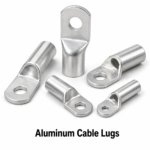
| Barrel-to-Spade (Compression) | Round barrel + flat spade, compression crimped | Cable termination with spade output |
| Custom OEM Spade | Per transformer manufacturer drawing | OEM-specific designs, any current rating |
Applications in Industry
| Application Area | Transformer Type / Rating |
|---|---|
| Distribution Transformer LV Connections | 25 kVA to 2,500 kVA, 11/0.433 kV |
| Power Transformer Terminal Boards | 5 MVA to 315 MVA, 33/11 kV to 400/220 kV |
| Auto-Transformer Winding Connections | Voltage regulation, traction transformers |
| Instrument Transformer (CT/PT) Secondary | Metering and protection applications |
| Voltage Regulator Internal Connections | On-load tap changers, step-up regulators |
| Reactor and Inductor Terminals | Harmonic filter reactors, current-limiting reactors |
| LV Switchgear Bus Bar Risers | MDB, PDB, PMCC panels |
| Transformer Service and Rewinding | Repair workshops, field refurbishment |
Manufacturing Process
Raw aluminum sheet, plate, or extruded bar of the specified alloy (1350 EC grade or 6061-T6) is procured with mill certification. For flat spade terminals: material is cut to width strips, punched to outline profile and hole positions on CNC turret punch press, deburred on vibratory finishing machines, and sent for surface treatment (tin plating, anodizing, or plain degreasing). For barrel-to-spade compound terminals: the barrel section is machined on CNC lathe, the blade is forged or machined, and the transition is produced by forging or machining from solid billet. All terminals undergo: dimensional inspection, electrical resistance measurement (spot-check), surface finish verification, and salt spray testing as required. Completed terminals are coated in inhibitor grease (for plain aluminum) or left dry (for plated versions) and packed for shipment.
Quality Standards
| Standard | Scope |
|---|---|
| IEC 61238-1 | Compression and mechanical connectors for power cables |
| IEEE 837 | Qualifying permanent connections for grounding |
| IS 8130 | Indian Standard conductors for insulated electric cables |
| ASTM B545 | Electrodeposited coatings of tin |
| ASTM B700 | Electrodeposited coatings of silver |
| ISO 9001:2015 | Quality Management System |
| IEC 60068-2-11 | Salt spray (corrosion) testing |
Why Choose Electrical Accessories India?
- Transformer Industry Specialist — dedicated manufacturing capability for transformer terminal hardware
- EC Grade Aluminum Available — Al 1350, ≥61% IACS, with full material certification
- Bi-Metal Capability — aluminum-to-copper friction/explosion/braze welded terminals
- Custom Dimensions — manufactured to OEM drawing, no catalog restriction
- Competitive Price: US$ 8.80/Kilogram — significant cost advantage vs. copper terminals
- Test Reports Available — IEC 61238-1 type test reports for standard terminal ranges
- Global Supply — export to transformer manufacturers in India, Middle East, Africa, SE Asia, Europe
Frequently Asked Questions
Q1. What is the difference between a spade terminal and a compression lug for transformers?
A spade terminal is a flat blade connector mechanically bolted or clamped to a winding end or bus bar. A compression lug crimps or presses around the conductor end. In transformer applications, spade terminals are used where the winding conductor ends in a flat copper or aluminum bar/foil that can be bolted directly, while compression lugs are used to terminate round wire or cable conductors with a spade or pin output for connection to busbars.
Q2. Why is aluminum preferred over copper for transformer spade terminals?
Aluminum (EC grade 1350) delivers 61% of copper’s conductivity at 30% of copper’s weight and significantly lower cost per kilogram. For large transformer LV connections (100A–2,500A), the cost savings from aluminum vs. copper terminals can be substantial, and the slightly larger cross-section required (aluminum conductor ≈1.6× copper cross-section for same conductance) is easily accommodated in transformer design. Aluminum also eliminates the risk of copper theft in substations and transformer service locations.
Q3. How do you prevent galvanic corrosion between aluminum spade and copper bushing?
Options: (1) Tin plating on the aluminum spade presents a noble metal at the contact interface, reducing galvanic potential, (2) Bi-metal terminal with copper face plate at the bushing interface, (3) Liberal application of contact inhibitor grease at the joint, (4) Use of stainless steel bolts with aluminum/stainless washers to avoid creating a copper-aluminum galvanic cell via the fastener. For outdoor and humid environments, bi-metal terminals are the recommended long-term solution.
Q4. What current ratings are available for aluminum spade terminals?
We manufacture aluminum transformer spade terminals for current ratings from 25A (instrument transformer secondary) to 2,500A (large distribution transformer LV output). Current rating is determined by the aluminum cross-section area and the temperature rise limit (max 5°C above adjacent conductor per IEC 61238-1). Specify the current rating and we calculate the required minimum cross-section for the selected alloy.
Q5. Can you supply tin-plated aluminum transformer spade terminals?
Yes. Electrodeposited tin plating (5–15 µm, per ASTM B545) is our most common surface treatment for transformer spade terminals. Tin plating eliminates surface oxidation, reduces contact resistance, improves solderability for winding wire terminations, and provides a stable contact interface for the life of the transformer. Tin-plated terminals require no contact inhibitor grease during assembly.
Q6. What is your minimum order quantity for transformer spade terminals?
For standard flat spade terminals: MOQ 100 pieces. For complex barrel-to-spade compound terminals: MOQ 500 pieces. For custom bi-metal terminals: MOQ 200 pieces (due to tooling and fixturing for bi-metal joining process). Sample quantities (5–20 pieces) are available for customer qualification and type testing.
Q7. Can you manufacture to transformer OEM drawings?
Yes. All our transformer spade terminal production is to customer-supplied drawings. We do not have a fixed catalog range — every terminal is made to the OEM’s specific dimensional requirements, material specification, and surface finish. Submit your drawing with quantity and delivery requirements for a quotation.
Q8. What is the temperature rating of aluminum transformer spade terminals?
Aluminum transformer spade terminals rated for continuous operation at -40°C to +130°C ambient. For transformer hot-spot temperatures (top oil temperature up to 105°C for ONAN-cooled transformers), the terminal is designed for long-term service at 130°C. Short-term (fault current, 1 second) temperature rise to 150°C is permissible. Tin plating re-crystallizes at temperatures above 150°C, so silver plating is specified for applications with continuous service above 130°C.
Equivalent Terms in Other Languages
| Language | Term 1 | Term 2 | Term 3 |
|---|---|---|---|
| Spanish | Terminales de pala de aluminio para transformador | Conectores de lengüeta plana aluminio | Terminales en espada de aluminio |
| Russian | Алюминиевые клеммы типа «лопатка» для трансформатора | Плоские алюминиевые клеммы трансформатора | Алюминиевые лопаточные наконечники |
| French | Cosses à fourche aluminium pour transformateur | Terminaux à lame plate en aluminium | Connecteurs en spatule aluminium transformateur |
| Portuguese | Terminais pá de alumínio para transformador | Conectores lâmina plana alumínio | Terminais espada de alumínio |
| Italian | Terminali a spatola in alluminio per trasformatore | Connettori a lama piatta alluminio | Terminali forchetta alluminio trasformatore |
Related Aluminum Products
- Aluminum Screw Machine Parts
- Aluminum CNC Machined Components
- Aluminum Stud Mount Connectors
- Aluminum Terminal Bars
- Aluminum Transformer Lugs (Tubular)
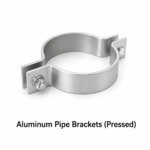
- Aluminum Pipe Brackets (Pressed)
- Aluminum Sheet Metal Parts
- Aluminum Lay-In Lugs and Connectors
Get a Quote — Aluminum Transformer Spade Terminals
Submit your transformer terminal drawing with current rating, conductor cross-section, material grade, surface finish, quantity, and delivery requirement. Our technical team will respond within 24 hours.
Price: US$ 8.80/Kilogram | MOQ: 100–500 pcs | Gujarat, India | Global Export