

Product
Product Details
Aluminum Pipe Brackets (Pressed)
Aluminum Pipe Brackets (Pressed) — Conduit Clamps, Cable Support Brackets, Saddle Clamps
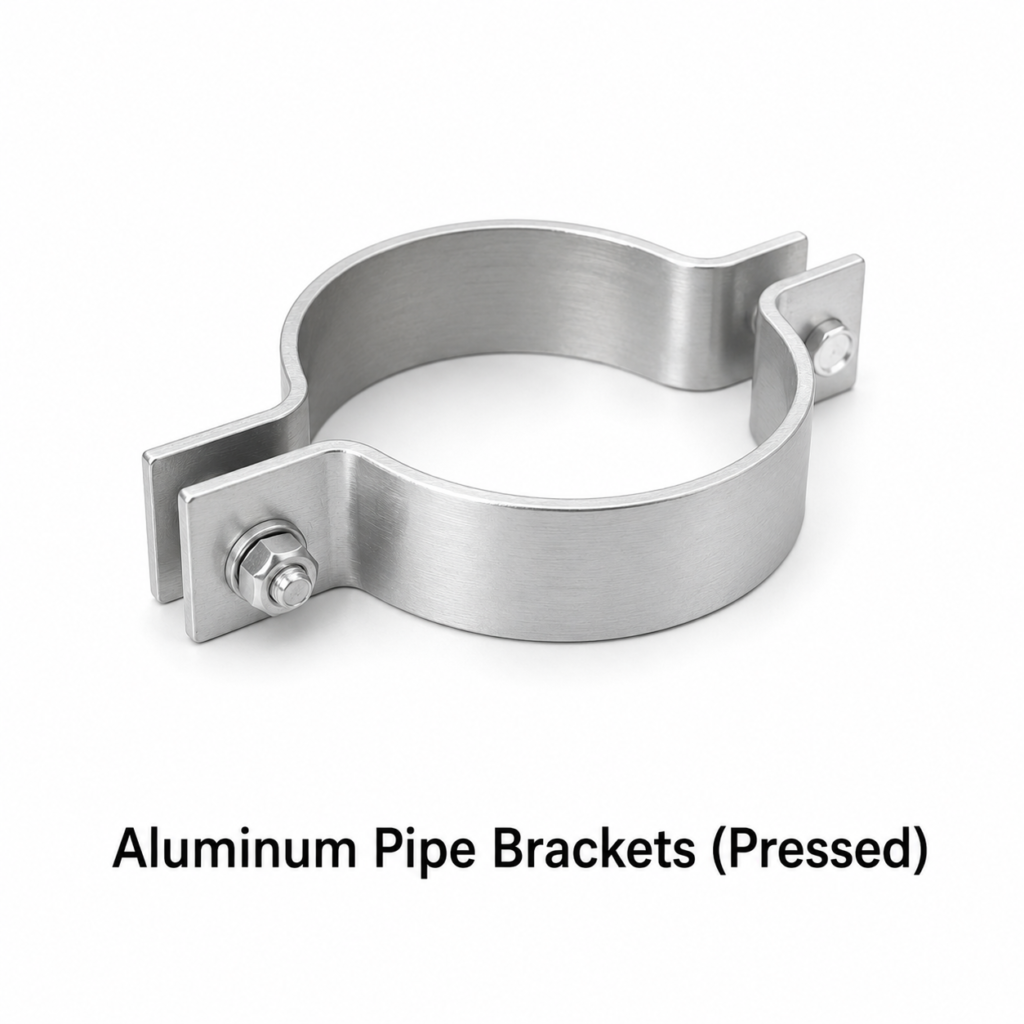
Aluminum Pipe Brackets (Pressed) are sheet metal stamped, press-formed, and CNC-punched aluminum support brackets and clamps for conduit pipes, cable trays, electrical conduit runs, instrumentation tubing, and structural supports in electrical, mechanical, and process installations. Electrical Accessories India manufactures these pressed aluminum brackets from 5052-H32, 6061-T6, and 3003-H14 aluminum alloys in thicknesses from 1.5 mm to 6 mm, covering pipe sizes from 16 mm to 150 mm nominal bore (NB). Applications range from cable management in electrical substations and panel buildings to conduit support in process plants, offshore platforms, and railway installations. Price: US$ 8.80/Kilogram
Product Overview
Types of Pressed Aluminum Pipe Brackets
Pressed aluminum pipe brackets encompass several product forms. Pipe saddles (also called pipe clamps or conduit clips) are U-shaped or semi-circular pressed brackets that grip around the pipe and bolt to a structural backing surface (wall, ceiling, cable tray, or strut channel). Back plate brackets are flat or angle-formed backing pieces that mount to structure and support the saddle or conduit body. Trapeze brackets are horizontal bars suspended on threaded rods from ceiling or overhead structure, supporting multiple conduits or cable trays. Spacer bars are straight or angled bars with punched hole patterns for spacing and securing multiple parallel conduit runs. Offset brackets are pressed to create an offset between the mounting surface and the conduit centerline, accommodating obstructions or maintaining required clearances. All these variants are produced from the same aluminum sheet stamping process, differentiated by die tooling for the specific bracket profile.
Material Selection for Pressed Aluminum Brackets
The most commonly used alloys for pressed aluminum pipe brackets are: 5052-H32 (UTS: 228 MPa, Yield: 193 MPa) — the preferred alloy for formed sheet metal brackets due to its excellent formability, high corrosion resistance (especially in marine and coastal environments), and adequate strength for most support bracket applications; 3003-H14 (UTS: 152 MPa) — used for lighter-duty brackets where maximum formability and lowest cost are priorities (3003 is pure aluminum with manganese addition, easy to form but lower strength than 5052); 6061-T6 (UTS: 310 MPa) — used for heavy-duty structural brackets, cable tray hangers, and high-load applications where greater stiffness and strength are needed; and 5083-H111 (UTS: 275 MPa) — for offshore, marine, and chemical plant pipe bracket applications requiring maximum seawater and H₂S corrosion resistance. The choice is driven by the load requirement, forming geometry (tight bends may crack 6061), and environmental exposure conditions.
Press Forming and Stamping Process
Aluminum pipe brackets are manufactured on mechanical presses (50–200 ton capacity) and hydraulic presses (100–500 ton capacity) using precision-machined steel dies. The press forming sequence for a typical pipe saddle bracket: (1) blanking — punching the flat bracket outline from aluminum sheet coil or plate; (2) piercing — punching bolt holes, slot holes, and any internal cutouts simultaneously with blanking in a progressive die; (3) forming — bending the blank to the required bracket profile using form dies (U-bends, V-bends, radiused forms for pipe saddle curves); (4) coining — restrike of formed bends to sharpen radii and eliminate springback; (5) deburring and edge finishing — removing press-cut burrs from edges and hole perimeters. Tight bend radii (inner radius ≤1× material thickness) may require annealing of 6061-T6 before bending, followed by re-heat treatment (or using O-temper material for severe forming, then aging to T4/T6 temper).
Dimensional Range and Tolerances
Pressed aluminum pipe brackets are manufactured for conduit and pipe sizes from 16 mm NB to 150 mm NB (equivalent to ½” to 6″ NPS nominal pipe sizes). Bracket material thickness from 1.5 mm (for small conduit clips, 16–25 mm NB) to 6 mm (for heavy-duty structural brackets and large-diameter conduit saddles, 100–150 mm NB). Dimensional tolerances for pressed brackets: ±0.5 mm on flat dimensions, ±1.0 mm on formed/bent dimensions, ±0.3 mm on punched hole diameters, ±1.0 mm on hole positions relative to bent features. These tolerances are adequate for installation hardware where fit-up with structural components and conduit OD variation allows some assembly tolerance. Tighter tolerances (±0.1 mm on critical dimensions) are achievable with secondary CNC machining operations after forming.
Surface Treatment for Corrosion Protection
Pressed aluminum pipe brackets are offered with: Natural (degreased and bright — suitable for dry indoor installations and standard indoor electrical environments); Type II Anodize (12–18 µm, clear — for indoor and light outdoor applications, significantly improves corrosion resistance vs. bare aluminum); Hard Anodize Type III (25–50 µm — for outdoor, coastal, and chemically aggressive environments); Powder Coating (60–80 µm polyester or epoxy — for corrosion protection plus aesthetic color-coding of cable/conduit systems; RAL colors available); and Stainless steel hardware (bolts, nuts, washers) for bracket-to-structure connections in corrosive environments. 5052-H32 alloy brackets typically do not require anodizing for most indoor electrical installations, as the natural oxide film on 5052 provides adequate protection in normal atmospheric environments.
Load and Deflection Calculations
Pipe bracket selection requires consideration of the supported load (pipe/conduit weight + fluid/cable weight) and the span between brackets to ensure acceptable deflection and stress in the bracket and its mounting hardware. For aluminum pipe brackets, allowable stress is the lower of yield strength/1.5 (safety factor) or 140 MPa for 6061-T6 and 95 MPa for 5052-H32, per structural design standards. We provide load tables for standard bracket sizes, showing the maximum pipe/conduit weight per meter and maximum bracket spacing for accepted deflection limits (typically L/200 to L/360 of bracket cantilever or span). For non-standard loading conditions — heavy cable bundles, seismic zones, offshore dynamic loads — custom bracket calculations (hand calculations or FEA for complex geometries) are available from our engineering team.
Conduit Management in Electrical Substations and Panel Buildings
In electrical substation buildings, panel rooms, control rooms, and cable basements, aluminum conduit pipe brackets and saddle clamps secure the dense conduit and cable routing required for instrument cables, control cables, power cables, and fiber optic runs. The advantages of aluminum over galvanized steel brackets in these environments: (a) lighter weight — reduces structural load on cable tray supports and suspended ceilings; (b) no corrosion — aluminum brackets do not rust even in humid and condensation-prone environments; (c) EMC compliance — aluminum is non-magnetic and provides good electrical shielding when metallic conduit and fittings are used in a continuous bonded system; (d) lower life-cycle cost — no need for paint maintenance over the 25–40 year substation lifetime. We supply aluminum pipe brackets for substation construction as complete kits (bracket + hardware + installation instructions) for project-specific conduit designs.
Key Features
- Alloys: 5052-H32 (marine, general), 6061-T6 (structural, heavy), 3003-H14 (light-duty)
- Pipe size range: 16 mm to 150 mm NB (½” to 6″ NPS)
- Material thickness: 1.5 mm to 6 mm
- Surface: Natural, Anodize Type II/III, Powder Coat, Stainless hardware
- Types: Pipe saddle, back plate, trapeze, spacer bar, offset bracket
- Press forming on 50–500 ton presses with progressive dies
- Custom profiles per customer drawing
- Load tables and engineering data available
- ISO 9001:2015 certified manufacturing
- Export to substation, process plant, and offshore projects worldwide
Technical Specifications
| Parameter | Specification |
|---|---|
| Material Grades | 5052-H32, 6061-T6, 3003-H14, 5083-H111 (marine) |
| Material Thickness | 1.5 mm – 6 mm (standard); 8–10 mm custom |
| Pipe/Conduit Range | 16 mm NB to 150 mm NB (½” to 6″ NPS) |
| Flat Dimension Tolerance | ±0.5 mm |
| Bend Dimension Tolerance | ±1.0 mm |
| Hole Diameter Tolerance | ±0.3 mm |
| Tensile Strength (5052-H32) | 228 MPa |
| Tensile Strength (6061-T6) | 310 MPa |
| Surface Finish | Natural, Type II Anodize, Hard Anodize, Powder Coat |
| Bolt Hole Sizes | M6 to M16 clearance |
| Price | US$ 8.80/Kilogram |
International Alloy Equivalents
| Indian Standard | AA (USA) | EN (Europe) | JIS (Japan) | Application |
|---|---|---|---|---|
| IS 737 / HE-20 | AA 5052 | EN AW-5052 | JIS A5052 | General-purpose brackets |
| IS 64430 / HE-9 | AA 6061 | EN AW-6061 | JIS A6061 | Heavy-duty structural brackets |
| IS 737 / NS3 | AA 3003 | EN AW-3003 | JIS A3003 | Light-duty indoor brackets |
| IS 54300 | AA 5083 | EN AW-5083 | JIS A5083 | Marine and offshore brackets |
Product Types and Variants
| Bracket Type | Pipe/Conduit Size | Application |
|---|---|---|
| Back Plate Pipe Saddle | 16–100 mm NB | Wall-mounted conduit runs, instrument lines |
| U-Bolt Pipe Clamp | 25–150 mm NB | Overhead and structural mounting |
| Single-Hole Conduit Clip | 16–32 mm NB | Lightweight surface-mount conduit |
| Trapeze Bracket | Spans 200–1,200 mm | Multi-conduit overhead routing |
| Spacer Bar (with holes) | For 20–100 mm NB bundles | Parallel conduit spacing and support |
| Offset Bracket | Custom offset 25–150 mm | Avoiding obstructions, wall offset |
| DIN Rail Conduit Mount | 20–40 mm NB conduit | Panel box conduit entry support |
| Heavy-Duty Structural Hanger | 50–150 mm NB | Heavy cable trays, large conduit runs |
Applications in Industry
| Industry | Application |
|---|---|
| Electrical Substations | Instrument cable conduit, control cable runs, cable basements |
| Process Plants (Chemical, Petrochemical) | Instrument tubing support, signal cable conduit |
| Offshore Platforms | Marine-grade (5052/5083) conduit and pipe supports |
| Railway and Metro | Train conduit wiring, platform cable management |
| Industrial Panel Buildings | Control room conduit runs, cable management |
| Power Stations | Cable basement trays, turbine hall conduit |
| Telecom Infrastructure | Tower cable routing, equipment room conduit |
| Solar and Wind Energy | DC cable conduit supports, inverter room cable management |
Manufacturing Process
Raw aluminum coil or sheet is procured from IS/ASTM certified mills with material traceability. Blanks are cut to size on guillotine shear or CNC laser/waterjet (for complex outlines). Blanks are loaded into progressive press tool stations: blanking + piercing in one hit, then forming in subsequent stations. Press tools are maintained with dimensional inspection records and regular reconditioning of cutting edges and forming surfaces to maintain dimensional repeatability. After pressing, edges are deburred on vibratory deburring machines or belt sanders. Surface treatment (anodizing, powder coating) is applied as specified. Final QC includes: dimensional check against drawing, visual inspection for cracks, tears, and surface defects, and corrosion resistance test (salt spray on request).
Quality Standards
| Standard | Scope |
|---|---|
| ISO 9001:2015 | Quality Management System |
| ASTM B209 | Aluminum alloy sheet and plate |
| IS 737 | Indian Standard wrought aluminum alloy sheet |
| IEC 60300-3-4 | Dependability for power installation hardware |
| MIL-A-8625F | Anodic coatings for aluminum alloys |
| RoHS / REACH | Restriction of hazardous substances |
Why Choose Electrical Accessories India?
- Custom Bracket Production — any profile pressed to customer drawing with short tooling lead time
- Marine-Grade Alloys Available — 5052-H32 and 5083-H111 for offshore and coastal projects
- Complete Hardware Kits — bracket + bolts + nuts + washers + installation guide in one SKU
- Price: US$ 8.80/Kilogram — cost-competitive for project-specific quantities
- Project BOM Support — we help prepare bracket schedule and quantities from project drawings
- Export Documentation — for global project procurement including HAC (Hazardous Area Classification) data
FAQ — Aluminum Pipe Brackets (Pressed)
Q1. What is the load capacity of your aluminum pipe brackets?
Load capacity depends on bracket profile, material thickness, alloy, and mounting method. Typical 5052-H32, 3 mm thick back plate saddle for 25 mm NB conduit: safe working load 15 kg per bracket at 0.5 m cantilever. For 6061-T6, 5 mm thick heavy-duty bracket: up to 50 kg. Full load tables are available for all standard bracket sizes. Custom FEA analysis provided for non-standard loading conditions.
Q2. Can you powder coat aluminum pipe brackets in custom colors?
Yes. Powder coating is available in all RAL colors. Standard electrical installation colors: RAL 7035 (light grey), RAL 5012 (signal blue for instrument lines), RAL 3000 (fire red for sprinkler), RAL 9005 (black for structural). Minimum order for custom RAL colors: 50 kg per color run.
Q3. Do you supply aluminum pipe brackets for offshore platforms?
Yes. 5052-H32 and 5083-H111 alloy brackets with hard anodize or polyurethane powder coat are specified for offshore platforms (Zone 0, Zone 1, Zone 2, Safe Area). We supply documentation complying with DNV (Det Norske Veritas) material requirements and offshore project specifications. ATEX-compatible designs (non-sparking aluminum, within composition limits of IEC 60079-0) are available.
Q4. What is the minimum order quantity for pressed aluminum brackets?
For standard bracket profiles from existing tool sets: MOQ 100 pieces. For custom bracket profiles requiring new tooling: MOQ 500 pieces (to amortize die making cost). Tooling cost is not charged for standard profiles. Custom tooling charges are quoted separately and amortized over the production quantity.
Q5. Can pressed aluminum brackets be hot-dip galvanized?
Aluminum brackets are NOT hot-dip galvanized — the zinc/flux process is incompatible with aluminum and would severely damage the aluminum surface. Instead, aluminum achieves similar corrosion protection through anodizing, powder coating, or chromate conversion coating. For bracket-to-structure connections where galvanized steel structure mates with aluminum brackets, use zinc-plated or stainless steel bolts and neoprene/EPDM isolation washers to prevent galvanic contact between aluminum and zinc-coated steel.
Equivalent Terms in Other Languages
| Language | Term 1 | Term 2 | Term 3 |
|---|---|---|---|
| Spanish | Abrazaderas de tubería de aluminio prensado | Soportes de conduit aluminio estampado | Soportes de tubo aluminio |
| Russian | Алюминиевые скобы для труб (штампованные) | Кронштейны для кабельного канала алюминий | Хомуты для труб алюминий прессованный |
| French | Colliers de tuyau en aluminium emboutis | Supports conduit aluminium pressé | Équerres de tube aluminium |
| Portuguese | Suportes de tubo de alumínio prensado | Abraçadeiras de eletroduto alumínio prensado | Colchetes de tubo alumínio |
| Italian | Staffe per tubi in alluminio pressato | Supporti cavidotto alluminio stampato | Staffe per tubi alluminio |
Related Aluminum Products
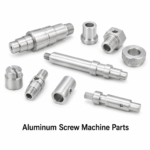
- Aluminum Screw Machine Parts
- Aluminum CNC Machined Components
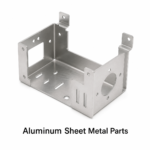
- Aluminum Sheet Metal Parts
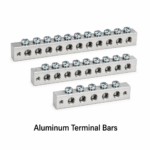
- Aluminum Terminal Bars
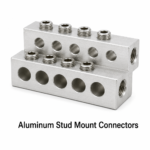
- Aluminum Stud Mount Connectors
- Aluminum Transformer Lugs (Tubular)
- Aluminum Transformer Spade Terminals
Get a Quote — Aluminum Pipe Brackets (Pressed)
Provide pipe/conduit size, bracket type, material and finish, quantity, and project specifications. Send drawing to info@elecaccs.com. Engineering quotation within 24–48 hours.
Price: US$ 8.80/Kilogram | MOQ: 100–500 pcs | Gujarat, India | Global Export