

Product
Product Details
Brass Castings
Brass Castings
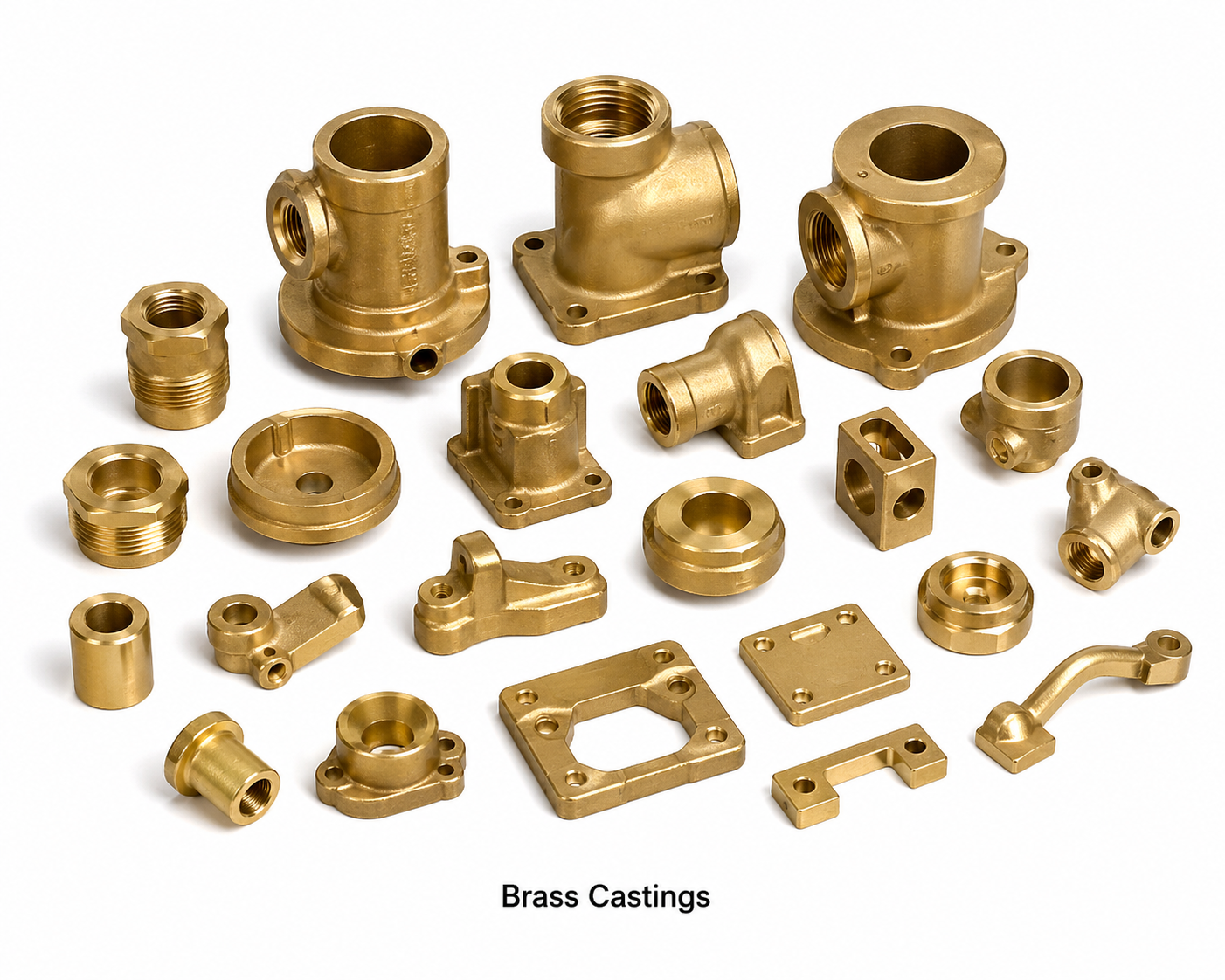
Brass castings are copper-zinc alloy components produced by sand casting, gravity die casting, pressure die casting, or investment casting processes, delivering the combination of good electrical conductivity, excellent machinability, attractive appearance, moderate corrosion resistance, and cost-effectiveness that makes brass the most widely used non-ferrous casting material in global manufacturing. Electrical Accessories India manufactures precision brass castings in all major international grades – from the leaded red brass (C83600/LG2/CC491K) to high-tensile manganese brass (C86500) and yellow brass alloys – for electrical OEMs, EPC contractors, plumbing manufacturers, marine engineers, automotive OEMs, HVAC equipment manufacturers, architectural hardware manufacturers, and industrial distributors. With over 40 years of brass foundry experience at the India manufacturing center, Electrical Accessories India produces brass castings from prototype to high-volume production, exporting to 30+ countries with full material documentation and certification.
Product Overview
Brass Casting Alloy System – Copper-Zinc Metallurgy
Brass alloys span a wide composition range from copper-rich red brass (Cu 83–90%, Zn 10–17%) through yellow brass (Cu 60–67%, Zn 30–38%) to high-zinc brass (Cu 55–60%, Zn 38–43%). Within this range, the copper:zinc ratio determines fundamental properties: higher copper content increases corrosion resistance, electrical conductivity, and ductility; higher zinc content increases strength, hardness, and castability while reducing cost. Lead additions (0.5–3.5%) in free-machining brass grades dramatically improve machinability and chip control – a critical property for high-volume CNC production of valve bodies, fittings, and connector components. Tin additions stabilize the alloy against dezincification (naval brass, admiralty brass), while manganese and aluminium additions (in high-tensile brass/manganese bronze) produce tensile strengths approaching 600 MPa – comparable to medium carbon steel. Electrical Accessories India maintains separate induction furnaces for each alloy family to prevent cross-contamination, with dedicated ladles and tools per alloy.
Red Brass and Gunmetal Castings (C83600, LG2, CC491K)
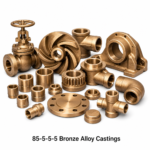
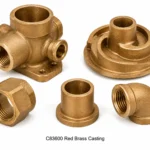
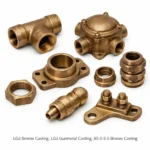
Red brass castings (LG2 / C83600 / CC491K – approximately Cu 85%, Sn 5%, Pb 5%, Zn 5%) are the workhorse of the general brass foundry, providing excellent corrosion resistance in fresh water and mildly corrosive environments, good pressure tightness, and adequate strength for valve bodies, pipe fittings, pump housings, and water meter bodies. Often classified as gunmetal rather than brass due to the tin content, LG2/C83600 is the standard grade for water service fittings in many international markets. Electrical Accessories India produces LG2 sand castings and gravity die castings for plumbing, water utility, and general engineering customers, with WRAS-compatible material specification and dezincification resistance inherent in the red brass composition. For electrical applications, LG2/CC491K is used for connector bodies, cable gland bodies, and terminal housings where the tin content provides superior corrosion resistance versus standard yellow brass in humid industrial environments.
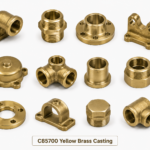
Yellow Brass Castings (C85700, C84400, CC750S)
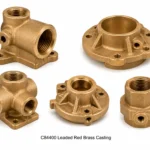
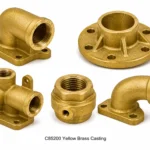
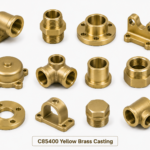
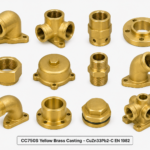
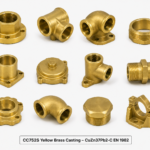
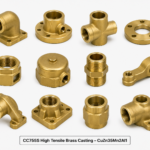
Yellow brass castings (Cu 60–67%, Zn 30–38%, Pb 1–3%) are the highest-volume commercial brass casting grade, used for decorative hardware, architectural fittings, door hardware, plumbing trim, lamp fittings, and general engineering components where moderate corrosion resistance and attractive golden appearance are required. Yellow brass has excellent castability due to its wide freezing range, good fluidity, and moderate pouring temperature (950–1050°C). Electrical Accessories India produces yellow brass sand castings, gravity die castings, and pressure die castings in C85700, C84400, and equivalent grades (CC750S, CC752S per EN 1982) for architectural hardware, decorative fittings, and general engineering applications. Surface finishing options include bright nickel plating, satin nickel, chrome plating, gold plating, and clear lacquering over polished or satin-brushed surface.
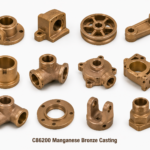
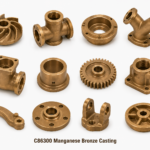
High-Tensile Brass and Manganese Bronze (C86500, CuZn37Mn3Al2)
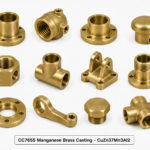
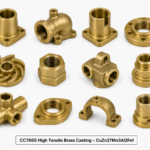
High-tensile brass (manganese bronze / C86500 / CuZn37Mn3Al2Fe2) achieves tensile strengths of 450–600 MPa through additions of manganese (0.5–3.5%), aluminium (0.5–2%), iron (0.5–2%), and nickel (up to 1%), producing a two-phase alpha-beta microstructure with excellent strength-to-weight ratio. C86500 is specified for marine propellers, pump impellers, slide bearings for moderate loads, worm wheels, structural marine hardware, and heavy-duty valve bodies where strength beyond the capability of standard yellow or red brass is required. High-tensile brass is not suitable for dezincification-sensitive environments (seawater at elevated temperature, chlorinated water above 60°C) without specific DZR treatment – for those applications, aluminum bronze (C95400) or DZR brass (CW602N) is preferred. Electrical Accessories India produces C86500 sand castings for marine propellers, pump casings, and structural components, heat-treated and machined to drawing.
Gravity Die and Pressure Die Casting of Brass
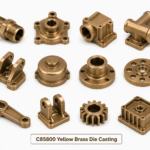
Gravity die (permanent mould) casting of brass produces components with significantly better dimensional repeatability, surface finish, and mechanical properties than sand casting, due to the rapid chilling effect of the metal die. Electrical Accessories India operates brass gravity die casting cells for medium-volume production of plumbing fittings, valve bodies, and electrical hardware (100–50,000 pieces per month). Pressure die casting of brass (hot chamber and cold chamber processes) is used for high-volume thin-wall components: buckles, decorative hardware, instrument bezels, and connector shells. Gravity die casting achieves wall thickness down to 3 mm; pressure die casting achieves wall thickness down to 1.5 mm with tight dimensional tolerances (±0.1 mm on cast features).
Electrical Applications of Brass Castings
Brass is the dominant material for cast electrical hardware components due to its combination of electrical conductivity (26–28% IACS), excellent machinability enabling precision threaded and precision-bore components, corrosion resistance in industrial atmospheres, and non-magnetic properties. Electrical Accessories India supplies brass castings for: cable gland bodies (all types – A1, A2, BW, CW, SWA), cable gland accessories (locknuts, backplates, shrouds), terminal block bodies, busbar connector blocks, conduit fitting bodies, junction box castings, neutral link bodies, earth terminal blocks, panel board hinge castings, and plug pin and socket bodies. All electrical brass castings are available in standard brass (CZ121 / CW614N), DZR brass (CW602N) for moisture-exposed locations, and red brass (LG2/CC491K) for maximum corrosion resistance.
Plumbing and Water Service Brass Castings
Plumbing and water service brass castings require material compliance with potable water regulations: WRAS (UK), NSF/ANSI 61 (USA), DVGW (Germany), and IS 319 (India). Electrical Accessories India supplies leaded red brass (LG2/C83600) and DZR brass castings for compression fittings, ball valve bodies, gate valve bodies, check valve bodies, strainer bodies, manifold bodies, water meter bodies, and pressure gauge connections. The range covers screwed BSP fittings (1/8″ to 4″), flanged valve bodies (DN15 to DN100), and OEM-designed custom castings to customer drawings. Dezincification testing per ISO 6509 is performed on selected heats for WRAS-applicable products, with test certificates issued with each order.
Key Features
- Full grade range: red brass (LG2/C83600) through yellow brass to high-tensile brass (C86500)
- Casting processes: sand casting, gravity die, pressure die, investment casting – all in-house
- Electrical conductivity 26–28% IACS (standard brass) – ideal for cable glands and terminals
- Machinability 70–100% (relative to free-cutting brass = 100%) – highly productive CNC processing
- DZR grade available (CW602N, ISO 6509 tested) – for potable water and moisture-exposed service
- Surface finishes: as-cast, machined, nickel, chrome, tin, silver, gold plating, clear lacquer
- Compliant with ASTM B62, B584, BS EN 1982, IS 318, DIN 1709, JIS H5111
- WRAS-compatible material for potable water fittings
- Full traceability: EN 10204 3.1 Mill certificates, spectrometric analysis per heat
- RoHS 3, REACH, and CA Prop 65 (low-lead grades available) compliant
Material Grades and International Equivalents
| Grade / Name | India (IS) | USA (ASTM/UNS) | UK (BS EN) | Germany (DIN) | Europe (EN) | Japan (JIS) | ISO | Cu% | Zn% | Pb% | UTS (MPa) |
|---|---|---|---|---|---|---|---|---|---|---|---|
| Red Brass / LG2 / Gunmetal | IS 318 LTB1 | C83600 / UNS C83600 | BS EN 1982 CC491K | DIN 1709 CuSn5Pb5Zn5 | EN CC491K | JIS H5111 BC1 | ISO CuSn5Pb5Zn5 | 84–86 | 4–6 | 4–6 | 240 |
| Yellow Brass (Casting) | IS 318 LTB3 | C85700 / UNS C85700 | BS EN 1982 CC750S | DIN 1709 CuZn33Pb2-C | EN CC750S | JIS H5111 YBsC2 | ISO CuZn33Pb2-C | 58–64 | Bal. | 1.0–2.5 | 270 |
| Leaded Yellow Brass | IS 318 LTB4 | C84400 / UNS C84400 | BS EN 1982 CC752S | DIN CuZn37Pb2-C | EN CC752S | — | ISO CuZn37Pb2-C | 57–61 | Bal. | 1.5–2.5 | 250 |
| Naval Brass Casting | IS 318 HTB2 | C46400 / UNS C46400 | BS EN 12163 CW712R | DIN CuZn38Sn1-C | EN CC768S | JIS C4622 | ISO CuZn38Sn1 | 59–62 | Bal. | <0.3 | 380 |
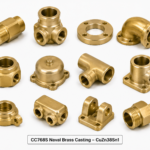
| High-Tensile Brass / Manganese Bronze | IS 318 HTB1 | C86500 / UNS C86500 | BS EN 1982 CC765S | DIN 1709 CuZn37Mn3Al2 | EN CC765S | JIS H5111 HBsC3 | ISO CuZn37Mn3Al2 | 55–60 | Bal. | <0.4 | 490 |
| Aluminium Brass (Casting) | IS 318 HTB3 | C87200 / UNS C87200 | — | DIN CuZn22Al3 | — | — | — | 62–66 | Bal. | <0.5 | 420 |
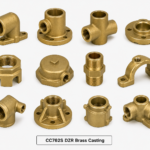
| DZR Brass Casting | IS 318 DZR | C35330 / UNS C35330 | BS EN 1982 CC762S | DIN CuZn35Pb2As-C | EN CC762S | — | ISO CuZn35Pb2As | 62–64 | Bal. | 1.0–2.5 | 260 |
| Silicon Brass (Casting) | — | C87800 / UNS C87800 | BS EN 1982 CC212A | DIN CuZn15Si4 | EN CC212A | — | — | 80–84 | 12–16 | <0.1 | 520 |
Technical Specifications
| Property | C83600 / LG2 | C85700 (Yellow Brass) | C86500 (Mn Bronze) | C46400 (Naval Brass) |
|---|---|---|---|---|
| Density (g/cm³) | 8.8 | 8.5 | 8.3 | 8.5 |
| Tensile Strength (MPa) | 240 min | 270 min | 490 min | 380 min |
| 0.2% Yield Strength (MPa) | 80 min | 90 min | 180 min | 140 min |
| Elongation (%) | 20 min | 20 min | 18 min | 20 min |
| Hardness (HB) | 55–80 | 60–85 | 100–130 | 80–110 |
| Electrical Conductivity (%IACS) | 15–17 | 26–28 | 7–10 | 22–25 |
| Thermal Conductivity (W/m·K) | 72 | 109 | 60 | 109 |
| Max. Service Temp. (°C) | 200 | 180 | 200 | 180 |
| Machinability Rating (%) | 70 | 80–90 | 26 | 40–50 |
| Corrosion Resistance (Water) | Excellent | Good | Moderate | Good |
Product Types and Variants
- Sand Castings – Complex geometry, all brass grades, weight 0.05 kg to 200 kg
- Gravity Die Castings – High repeatability, plumbing fittings, electrical hardware, 0.05–10 kg
- Pressure Die Castings – High-volume thin-wall components, decorative hardware, <2 kg
- Investment Castings – Precision architectural and electrical hardware, ±0.15 mm tolerance
- CNC Machined Castings – Fully machined to drawing from any casting blank
- DZR Brass Castings – ISO 6509 dezincification tested for potable water applications
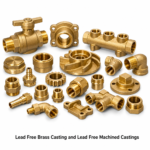
- Low-Lead Brass Castings – Pb <0.25% for NSF 61 / California Prop 65 compliance
Applications in Industry
- Electrical & Power: Cable gland bodies (A1, A2, BW, CW), terminal blocks, busbar connectors, panel board fittings, conduit bodies, neutral links, earth terminal blocks, plug pins and sockets
- Plumbing & Water: Ball valve bodies, gate valve bodies, compression fittings, meter bodies, manifold blocks, tap bodies, stopcock bodies (LG2 and DZR grades)
- Marine: Deck fittings, sea cocks, through-hull fittings, propeller shaft nuts (naval brass and high-tensile brass)
- Architectural: Door handles, hinges, window furniture, builders hardware, decorative trim, signage (yellow brass and silicon brass)
- HVAC & Gas: Gas valve bodies, pressure regulator bodies, refrigerant fitting bodies, HVAC balancing valve bodies
- Automotive: Fuel system fittings, pneumatic connector bodies, instrument fittings, hydraulic valve blocks
Manufacturing Process
1. Ingot Selection: Grade-specific brass ingots (IS 318 / BS EN 1982 composition) verified by incoming spectrometric analysis. Leaded grades checked for Pb 1.5–3.5%, yellow brass for Cu/Zn ratio ±0.5%.
2. Melting: Channel or coreless induction furnace at 950–1100°C depending on alloy. Charcoal flux cover to minimize zinc fuming. Zinc loss corrected by addition of zinc sticks.
3. Chemistry Verification: OES spectrometric analysis before tapping. Reject criteria per ASTM B62/B584 or BS EN 1982 as applicable.
4. Casting: Sand mould: furan resin-bonded, cast at controlled rate. Gravity die: steel mould at 200–250°C, fill time controlled. Pressure die: cold chamber at 350–500 bar injection pressure.
5. Fettling: Gates and risers removed, burrs dressed, shot blasted to Sa 2.5.
6. Machining: CNC turning and milling at high cutting speeds (brass is excellent for high-speed machining). No coolant required for standard leaded brass grades. Tolerances to ±0.01 mm achievable.
7. Plating / Finishing: As specified: nickel, chrome, tin, silver, or gold plating; chemical brightening; clear lacquer.
8. Inspection: 100% visual; dimensional on critical features; pressure test (1.5× WP) for valve and plumbing castings; ISO 6509 dezincification test (DZR grade).
Quality Standards and Certifications
- ASTM B62 – Red Brass Castings (C83600 / LG2)
- ASTM B584 – Copper Alloy Sand Castings (multiple brass grades)
- BS EN 1982 – Copper Alloy Ingots and Castings (CC491K, CC750S, CC752S, CC765S)
- IS 318 – Indian Standard for Copper Alloy Ingots and Castings
- DIN 1709 – Copper-Zinc Casting Alloys
- JIS H5111 – Brass and Bronze Castings
- ISO 6509 – Dezincification Test (DZR grades, plug depth <200 µm)
- WRAS (Water Regulations Advisory Scheme) – Compatible material for potable water service
- NSF/ANSI 61 – Drinking Water System Components (low-lead grades)
- ISO 9001:2015 Quality Management System
- RoHS 3, REACH, California Proposition 65 low-lead compliance available
Why Choose Electrical Accessories India
- Complete Brass Grade Range: Red brass through high-tensile brass – all grades in-house, no sub-contracting
- Multiple Casting Processes: Sand, gravity die, pressure die, and investment casting under one roof
- Electrical Sector Leadership: Dominant supplier of brass cable gland, terminal, and conduit body castings to Indian electrical OEMs
- Plumbing and Water Expertise: WRAS-compatible and DZR-grade castings with ISO 6509 dezincification certificates
- Surface Finishing In-House: Nickel, chrome, tin, silver, and gold plating without sub-contracting delays
- High-Volume Capability: Pressure die casting cells producing 50,000+ pieces/month for decorative and electrical hardware
- Export Documentation: EN 10204 3.1 Mill certificates, REACH/RoHS declarations, ISO 6509 DZR certificates
Frequently Asked Questions (FAQ)
Q1: What is the difference between brass casting and gunmetal (LG2)?
Gunmetal (LG2/C83600/CC491K) is technically a tin-containing brass (Cu 85%, Sn 5%, Pb 5%, Zn 5%) rather than a pure copper-zinc brass. LG2 offers better corrosion resistance in water and seawater than standard yellow brass (Cu 63%, Zn 35%, Pb 2%) due to the tin content, which stabilizes the alloy against dezincification and improves pressure tightness. Yellow brass is lower cost, has better machinability, and is preferred for dry or mildly corrosive environments. LG2/gunmetal is preferred for water service, plumbing, and marine applications.
Q2: Which brass grade is best for electrical cable gland bodies?
For standard indoor electrical installations: CW614N (free-cutting brass rod, machined) or CuZn39Pb3 equivalent die cast. For moisture-exposed or coastal locations: CW602N (DZR brass). For marine and offshore electrical installations: LG2 (C83600/CC491K) or silicon brass. For ATEX hazardous area cable glands: any brass grade is inherently non-sparking; DZR brass (CW602N) is most commonly certified. Electrical Accessories India supplies all variants with appropriate material certificates.
Q3: Can brass castings be supplied with low-lead content for California Prop 65 compliance?
Yes. Electrical Accessories India produces low-lead brass castings with Pb <0.25% (sometimes termed “no-lead” or “eco-brass”) using bismuth or silicon substitution for lead as the machinability-enhancing agent. These comply with California AB 1953 / Prop 65, NSF/ANSI 61 for potable water contact, and EU Drinking Water Directive requirements. Note that low-lead brass has slightly reduced machinability (approximately 60–70% of standard leaded grade) and requires adjusted CNC parameters.
Q4: What is the minimum order quantity for brass castings?
No minimum for prototype and sample castings. For production gravity die castings: MOQ 50–200 pieces depending on part size and complexity. For pressure die castings: MOQ 500–1000 pieces for high-volume hardware. For sand castings: MOQ 1 piece (prototype) to 10 pieces (production run minimum). Tooling cost (die/pattern) is quoted separately and amortized over production quantities above minimum threshold.
Q5: Do you supply BS 143 / EN 10226 screwed brass fittings?
Yes. Electrical Accessories India produces screwed brass fittings to BSP (G thread per ISO 228), NPT, and metric thread standards in LG2 (CC491K) and DZR brass. Sizes from 1/8″ BSP to 4″ BSP. Fitting types: elbows, tees, couplings, reducers, unions, nipples, and hex bushes. Threading is CNC-machined to class A (BS EN 10226) tolerance with thread gauging 100%.
Q6: Are your brass castings suitable for high-pressure applications?
LG2 (C83600/CC491K) castings are rated to PN25 (25 bar) for valve and fitting bodies in standard sizes. High-tensile brass (C86500) castings achieve PN40 and above in appropriate wall thickness designs. All pressure castings are hydrostatically pressure tested to 1.5× working pressure before dispatch, with test certificates. Pressure calculations per EN 13480 or ASME B16.34 are available on request for critical applications.
Q7: What is the difference between sand casting and gravity die casting for brass?
Sand casting: lower tooling cost (pattern vs. metal die), suitable for complex geometry, larger sizes, and small quantities; surface finish Ra 6.3–12.5 µm as-cast; dimensional tolerance CT7–CT9. Gravity die casting: higher tooling cost, limited to simpler geometry; produces denser castings (less porosity) with better surface finish Ra 3.2–6.3 µm and tighter tolerances CT5–CT7; preferred for medium to high volumes (500+ pieces) of standardized components.
Q8: Can you supply fully machined brass castings to final dimensions?
Yes. Electrical Accessories India supplies fully CNC-machined brass castings to customer drawing, ready for assembly. Machined features include precision bores (H7 tolerance standard), threaded holes and external threads (6H tolerance), sealing faces (Ra 0.8 µm), and complex profiled surfaces. Complete sub-assemblies with O-rings, inserts, and pressed-in components are also available.
Q9: What NDT is available for brass castings?
Liquid Penetrant Testing (LPT) per ASTM E165 – detects surface-breaking defects on machined surfaces. Radiographic Testing (RT) – for internal soundness on pressure castings. Hydrostatic pressure testing – for valve bodies and fittings. Spectrometric PMI (positive material identification) – verifies alloy grade. ISO 6509 dezincification test for DZR-grade castings. All NDT is available as standard or optional per customer specification.
Q10: Do you produce brass castings for automotive applications?
Yes. Electrical Accessories India supplies brass castings for automotive fluid system fittings, pneumatic connector bodies, instrument panel fittings, and sensor housing bodies. Automotive supply requires PPAP (Production Part Approval Process) documentation, IATF 16949-aligned quality records, and SPC (Statistical Process Control) data for critical dimensions. Automotive-standard packaging and kanban delivery scheduling are available for approved programs.
Equivalent Terms – Multilingual Reference
| Language | Term 1 | Term 2 | Term 3 |
|---|---|---|---|
| Spanish | Fundición de latón | Piezas fundidas en latón | Aleación cobre-zinc fundida |
| Russian | Латунное литьё | Отливки из латуни | Медно-цинковый сплав литой |
| French | Pièces moulées en laiton | Laiton coulé de précision | Alliage cuivre-zinc moulé |
| Portuguese | Fundição em latão | Peças fundidas em latão | Liga cobre-zinco fundida |
| Italian | Fusione in ottone | Getti in ottone di precisione | Lega rame-zinco fusa |
Brass Casting Grade Sub-Pages
Dedicated pages for each brass casting grade – covering full material composition, mechanical properties, international equivalents, applications, and pricing. All pages linked from this page only.
US Grades (ASTM B62 / B584 / B176)
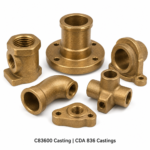
- C83600 Red Brass Casting – LG2 Gunmetal
- C84400 Leaded Red Brass Casting
- C85200 Yellow Brass Casting
- C85400 Yellow Brass Casting
- C85700 Yellow Brass Casting
- C85800 Yellow Brass Die Casting
- C86200 Manganese Bronze Casting – High Tensile Brass
- C86300 Manganese Bronze Casting – Highest Strength Brass
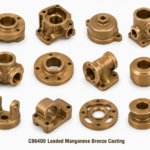
- C86400 Leaded Manganese Bronze Casting
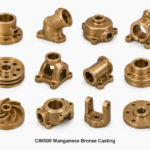
- C86500 Manganese Bronze Casting – High Tensile Brass
- C87200 Silicon Brass Casting – Lead-Free
- C87600 Silicon Brass Casting – High Silicon
- C87800 Silicon Brass Casting – Everdur
- C87900 Silicon Brass Casting – Lead-Free Yellow Brass
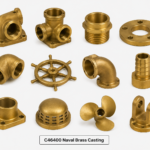
- C46400 Naval Brass Casting
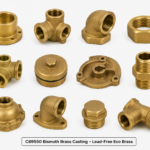
- C89550 Bismuth Brass Casting – Lead-Free Eco Brass
European Grades (EN 1982)
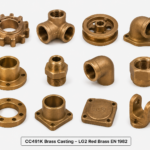
- CC491K Brass Casting – LG2 Red Brass (CuSn5Pb5Zn5-C)
- CC750S Yellow Brass Casting – CuZn33Pb2-C
- CC752S Yellow Brass Casting – CuZn37Pb2-C
- CC753S Brass Casting – CuZn37Pb0.5 (Low-Lead)
- CC754S Brass Die Casting – CuZn38Al
- CC755S High Tensile Brass Casting – CuZn35Mn2Al1
- CC762S DZR Brass Casting – Dezincification Resistant (CuZn35Pb2As)
- CC765S Manganese Bronze Casting – CuZn37Mn3Al2
- CC766S High Tensile Brass Casting – CuZn37Mn3Al2Fe1
- CC768S Naval Brass Casting – CuZn38Sn1
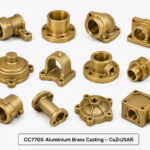
- CC770S Aluminium Brass Casting – CuZn25Al5
Indian Standard Grades (IS 318)
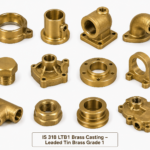
- IS 318 LTB1 Brass Casting – Leaded Tin Brass Grade 1 (equiv. LG2/C83600)
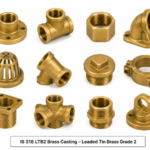
- IS 318 LTB2 Brass Casting – Leaded Tin Brass Grade 2 (equiv. C84400)
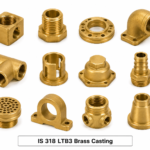
- IS 318 LTB3 Brass Casting – Yellow Brass Grade 3 (equiv. C85700/CC750S)
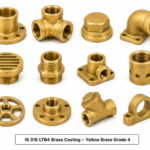
- IS 318 LTB4 Brass Casting – Yellow Brass Grade 4 (equiv. C85400/CC752S)
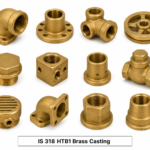
- IS 318 HTB1 High Tensile Brass Casting – Grade 1 (equiv. C86500/CC765S)
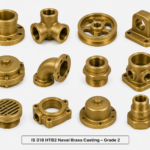
- IS 318 HTB2 Naval Brass Casting – Grade 2 (equiv. C46400/CC768S)
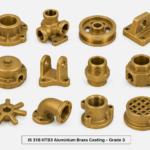
- IS 318 HTB3 Aluminium Brass Casting – Grade 3 (equiv. C87200/CC770S)
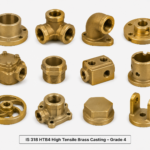
- IS 318 HTB4 High Tensile Brass Casting – Grade 4 (equiv. C86300/CC766S)
Related Products and Linked Terms
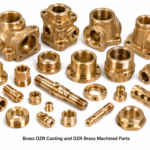
- Brass DZR Casting and DZR Brass Machined Parts
- Aluminum Bronze Casting (C95400, NAB, AB2)
- Phosphor Bronze Casting and Phosphor Bronze Machined Parts
- Silicon Bronze Castings
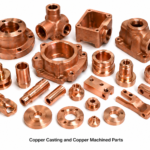
- Copper Casting and Copper Machined Parts
- Brass A2 Cable Glands
- Brass BW Cable Glands
- Brass CW Cable Glands
- Brass Terminal Blocks
- Neutral Terminals Earth Terminals
- Brass Panel Board Hinges
- Conduit Bushes Brass
- Brass Earth Blocks
Request a Quote
Electrical Accessories India engineers respond to all brass casting enquiries within 24 hours. Submit your drawing (PDF/DXF/STEP), brass grade specification, quantity, casting process preference (sand / gravity die / pressure die / investment), surface finishing requirement, and delivery destination. We provide a detailed technical and commercial proposal including DFM recommendations, casting method selection rationale, and lead time commitment. Export to 30+ countries with full EN 10204 3.1 Mill certificates, spectrometric analysis reports, ISO 6509 dezincification certificates (DZR grades), and hydrostatic test certificates.
Contact us today for your brass casting requirements – electrical, plumbing, marine, architectural, or general engineering.
Indicative Pricing
Brass Items: US$ 11.50 per kilogram, CIF US Port
Prices are indicative and subject to change based on quantity, specification, alloy grade, and market conditions. Contact us with your RFQ for a firm quotation.