

Product
Product Details
Phosphor Bronze Casting and Phosphor Bronze Machined Parts
Phosphor Bronze Casting and Phosphor Bronze Machined Parts
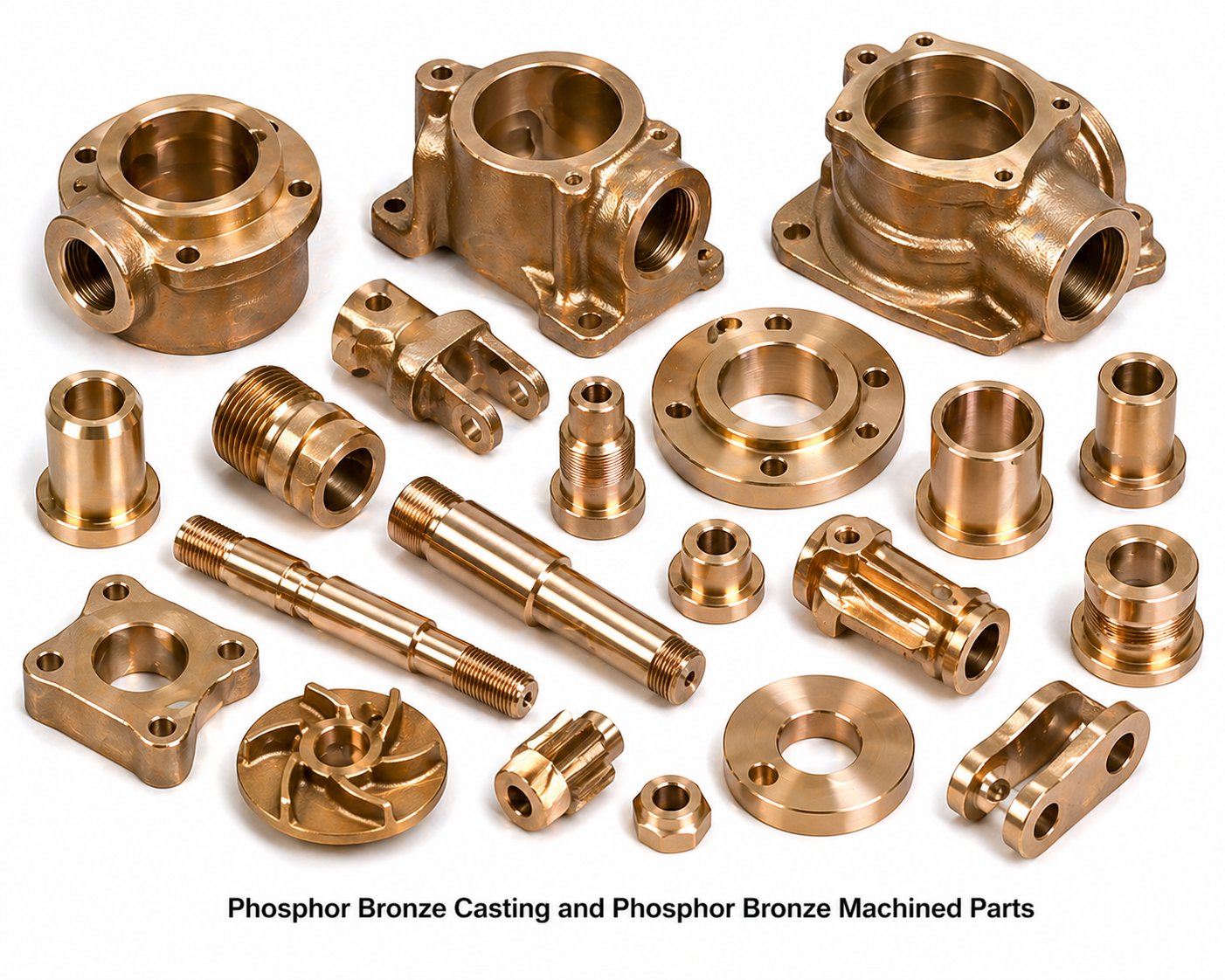
Phosphor bronze is a copper-tin-phosphorus alloy where tin (3.5–11%) increases tensile strength and hardness, and phosphorus (0.01–0.35%) serves as a powerful deoxidizer and hardener that significantly improves wear resistance, fatigue strength, and spring properties. Electrical Accessories India manufactures precision phosphor bronze castings and CNC-machined parts for electrical contact manufacturers, spring manufacturers, bearing manufacturers, gear manufacturers, electrical OEMs, EPC contractors, power utilities, and industrial distributors. Phosphor bronze is the material of choice wherever the combination of good electrical conductivity, excellent fatigue resistance, high wear resistance, and superior corrosion resistance in atmospheric and marine environments is required – applications that define the boundaries of standard brass or plain tin bronze performance.
Product Overview
Phosphorus Addition – The Defining Element
The phosphorus content in phosphor bronze serves two critical metallurgical functions. First, as a deoxidizer during melting: phosphorus reacts with dissolved oxygen in the copper melt, forming phosphorus pentoxide (P₂O₅) slag that floats clear of the melt, producing a clean, sound casting free of gas porosity and oxide inclusions. Second, as a solid-solution hardener: residual phosphorus in the matrix (above 0.01%) dramatically increases the elastic limit and fatigue strength of the alloy – a phenomenon exploited in spring strip, electrical connector springs, and diaphragm springs. Without phosphorus deoxidation, tin bronzes contain oxide films along grain boundaries that cause brittle fracture – a reason why phosphor bronze consistently outperforms undeoxidized tin bronze in fatigue and impact testing. Electrical Accessories India controls phosphorus content to ±0.01% in all production heats.
Tin Content and Alloy Property Range
The tin content of phosphor bronze alloys ranges from 3.5% to 11% across the engineering grades, with each range targeting specific application properties. Low-tin grades (CuSn4–CuSn6 / C51000–C52100) are primarily wrought alloys used for strip, sheet, rod, and tube – the classic spring, electrical connector, and bearing alloy. Medium-tin grades (CuSn8–CuSn10 / C52400–C90700) are optimal for both wrought and cast applications: bearings, bushings, worm wheels, gears, and structural castings. High-tin grades (CuSn12–CuSn14 / C91100–C91700) are casting-only alloys, extremely hard and wear-resistant, used for heavily loaded slide bearings, piston rings, and slow-speed, high-load gear applications. Electrical Accessories India covers the full range, with the medium and high-tin casting grades as core products.
Bearing and Wear Applications
Phosphor bronze castings, particularly the 10–12% tin grades (PB1, C90700, CuSn10P, CuSn12), are the benchmark bearing and bushing material for medium to heavy loads and moderate to low sliding speeds. The wear performance arises from a hard Cu₃Sn intermetallic phase dispersed in a tough copper matrix, providing excellent conformability to the mating shaft, embeddability for foreign particles (preventing scoring), and compatibility with both steel and cast iron shafts without seizure risk. Phosphor bronze bearings are used in electric motors, alternators, pumps, gearboxes, hydraulic cylinders, agricultural equipment, mining machinery, rail wagons, marine propulsion shafts, and switchgear operating mechanisms. Lubrication: phosphor bronze operates effectively with oil-film, grease, or boundary lubrication; graphite-impregnated phosphor bronze castings provide emergency dry-running capability.
Electrical and Electronic Applications
Phosphor bronze’s combination of electrical conductivity (10–20% IACS), high elastic modulus, excellent spring-back, and fatigue strength makes it the dominant alloy for electrical connector contacts, relay springs, switch springs, brush contacts, terminal springs, and current-carrying spring washers. In cast form, phosphor bronze is used for connector bodies, current transformer cores, brush holder castings, slip ring bodies, and terminal block bodies in power distribution equipment. The alloy maintains its spring characteristics over millions of deflection cycles, critical in industrial relay contacts and circuit breaker operating mechanisms. Resistance to atmospheric corrosion (patination rather than pitting) ensures long-term contact reliability in outdoor and coastal electrical equipment without surface treatment.
Centrifugal and Continuous Casting for Bearing Stock
For bearing bushing applications, Electrical Accessories India produces phosphor bronze in centrifugally cast tube and ring form, and as continuously cast rod, tube, and plate. Centrifugal casting produces a segregation-free, dense microstructure with mechanical properties superior to sand casting – the spinning action densifies the metal against the mould wall under centrifugal acceleration of 40–80 G, eliminating shrinkage porosity and gas porosity. Continuously cast phosphor bronze (CuSn10P, CuSn12P) bar and tube is produced with a fine, equiaxed grain structure, consistent hardness across the cross-section, and tight dimensional tolerances – the preferred feedstock for high-volume CNC bearing machining. Available in OD from 30 mm to 500 mm (centrifugal tubes) and 20 mm to 200 mm (continuous cast rod).
CNC Precision Machining of Phosphor Bronze
Phosphor bronze has a machinability rating of 20–30% (relative to free-cutting brass = 100%) for high-tin casting grades. Despite lower machinability than brass, phosphor bronze machines cleanly to excellent surface finishes due to its homogeneous structure. Electrical Accessories India operates CNC turning centres, CNC boring mills, and multi-axis machining centres dedicated to phosphor bronze bearing components. Standard machining capabilities: bore tolerances H7 (±0.015 mm on 50 mm diameter), surface finish Ra 0.8 µm on bearing bores, and profile tolerances for flanged bushings and thrust washers. Phosphor bronze machined parts supplied include: plain bushings, flanged bushings, thrust washers, ball cage retainers, worm wheels (fully machined with tooth form), gear blanks, valve seats, piston rings, pump wear rings, and precision turned parts to drawing.
Corrosion Resistance and Marine Performance
Phosphor bronze alloys exhibit excellent corrosion resistance to fresh water, seawater, brine, non-oxidizing acids, and industrial atmospheres, combining the inherent corrosion resistance of copper with the passivation effect of the tin-rich surface film. In seawater service, phosphor bronze is more resistant than naval brass but less resistant than aluminum bronze or cupronickel – suitable for freshwater-cooled machinery components, splash zone fittings, and internal marine valve components not in direct seawater flow. Resistance to stress corrosion cracking (SCC) in ammonia-containing environments is significantly better than standard brass, making phosphor bronze the preferred material for chemical plant fittings and brewery/dairy equipment in atmospheres containing ammonia traces. This SCC resistance is important for electrical motor terminal housings in fertilizer plant and food-processing electrical installations.
Key Features
- Phosphorus deoxidized – sound, porosity-free castings guaranteed by controlled P content (0.01–0.35%)
- Superior fatigue strength – elastic limit up to 40% higher than equivalent undeoxidized tin bronze
- Excellent wear resistance – Cu₃Sn intermetallic dispersoid provides hardness without brittleness
- Electrical conductivity 10–20% IACS – suitable for contact springs, terminals, and connector bodies
- Available in all forms: sand castings, centrifugal castings, continuously cast bar/tube, CNC machined parts
- Full grade range: CuSn4P to CuSn14P (C51000 to C91700) – wrought and cast
- Compliant with ASTM B139, B427, B505, BS EN 12163, EN 1982, IS 318, DIN 1705, JIS H5111
- Graphite-impregnated grades available for dry-running bearing applications
- Stress corrosion cracking resistance – superior to brass in ammonia-bearing atmospheres
- Full material traceability: EN 10204 3.1 Mill certificates, spectrometric chemical analysis
Material Grades and International Equivalents
| Grade | India (IS) | USA (ASTM/UNS) | UK (BS EN) | Germany (DIN) | Europe (EN) | Japan (JIS) | ISO | Sn% | P% | Form | UTS (MPa) |
|---|---|---|---|---|---|---|---|---|---|---|---|
| PB1 (Cast) | IS 318 Gr. PB1 | C90700 (UNS) | BS EN 1982 CC481K | DIN 1705 CuSn10 | EN CC481K | JIS H5111 BC2 | ISO 1338 CuSn10P | 9.0–11.0 | 0.05–0.30 | Sand Cast | 280 |
| PB2 (Cast) | IS 318 Gr. PB2 | C91100 (UNS) | BS EN 1982 CC483K | DIN 1705 CuSn12 | EN CC483K | JIS H5111 BC6 | ISO 1338 CuSn12 | 11.0–13.0 | 0.05–0.30 | Sand Cast | 320 |
| PB4 (High P) | IS 318 Gr. PB4 | C91300 (UNS) | BS EN 1982 CC484K | DIN 1705 CuSn14 | EN CC484K | — | ISO 1338 CuSn14 | 13.0–15.0 | 0.05–0.35 | Sand Cast | 350 |
| CuSn5 (Wrought) | IS 410 CuSn5 | C51000 (UNS) | BS EN 12163 CW451K | DIN EN CuSn5 | EN CW451K | JIS H3270 C5100 | ISO CuSn5 | 4.5–5.5 | 0.03–0.35 | Rod/Bar/Strip | 350–550 |
| CuSn6 (Wrought) | IS 410 CuSn6 | C51900 (UNS) | BS EN 12163 CW452K | DIN EN CuSn6 | EN CW452K | JIS H3270 C5191 | ISO CuSn6 | 5.5–6.5 | 0.03–0.35 | Rod/Bar/Strip | 400–600 |
| CuSn8 (Wrought) | IS 410 CuSn8 | C52100 (UNS) | BS EN 12163 CW453K | DIN EN CuSn8 | EN CW453K | JIS H3270 C5210 | ISO CuSn8 | 7.5–8.5 | 0.03–0.35 | Rod/Bar/Strip | 450–700 |
| CuSn10P (Continuous Cast) | IS 318 CC Equiv. | C90700 / C91000 | — | DIN 1705 CuSn10P | EN CW459K | JIS H5111 BC2 | ISO CuSn10P | 9.5–10.5 | 0.10–0.30 | Cont. Cast Bar/Tube | 300–380 |
| CuSn12P (Centrifugal) | IS 318 Centri. | C91100 | BS EN 1982 CC483K | DIN CuSn12P | EN CC483K | JIS H5111 BC6 | ISO CuSn12 | 11.0–13.0 | 0.05–0.30 | Centrifugal Cast | 340–420 |
| Leaded PB (Cast) | IS 318 LPB | C93200 (UNS) | BS EN 1982 CC493K | DIN 1705 CuSn7Pb7Zn3 | EN CC493K | JIS H5111 BC3 | ISO CuSn7Pb7Zn3 | 6.0–8.0 | — | Sand Cast | 240 |
Technical Specifications
| Property | PB1 / C90700 (Cast) | PB2 / C91100 (Cast) | CuSn10P (Cont. Cast) | CuSn6 / C51900 (Wrought) |
|---|---|---|---|---|
| Density (g/cm³) | 8.8 | 8.7 | 8.8 | 8.8 |
| Tensile Strength (MPa) | 280 min | 320 min | 300–380 | 400–600 |
| 0.2% Yield Strength (MPa) | 140 min | 160 min | 150–200 | 200–450 |
| Elongation (%) | 10 min | 5 min | 8–15 | 10–35 |
| Hardness (HB) | 80–100 | 90–130 | 85–120 | 80–200 |
| Electrical Conductivity (%IACS) | 11–13 | 10–12 | 12–15 | 15–20 |
| Thermal Conductivity (W/m·K) | 47 | 45 | 47 | 62 |
| Max. Service Temp. (°C) | 250 | 250 | 250 | 200 |
| Elastic Modulus (GPa) | 105 | 105 | 105 | 110 |
| Machinability Rating (%) | 20–25 | 20–25 | 25–30 | 20–30 |
| Max. PV (N/mm² × m/s) | 2.0 | 2.5 | 2.5 | N/A |
Product Types and Variants
- Sand Castings – Complex geometry bearing housings, valve bodies, pump components (0.1–200 kg)
- Centrifugal Cast Tubes and Rings – OD 30–500 mm, dense microstructure, minimal porosity
- Continuously Cast Bar and Tube – Fine grain, CNC machining feedstock, OD 20–200 mm
- Investment Castings – Precision contact bodies, connector housings (±0.1 mm tolerance)
- CNC Turned Bushings and Bearings – Plain, flanged, thrust washer types to drawing
- CNC Machined Worm Wheels and Gears – Fully machined with tooth profile, to AGMA/DIN quality
- Graphite-Impregnated Bushings – For dry-running, low-maintenance bearing applications
- Spring Strip and Stamped Contacts – CuSn6, CuSn8 strip for electrical connector springs
Applications in Industry
- Electrical & Power: Connector contact springs, relay springs, brush holder bodies, current transformer components, switchgear operating mechanism bushings, slip ring bodies, terminal block bodies, cable gland bodies
- Mechanical Engineering: Plain bearings and bushings for electric motors, pumps, gearboxes, compressors, hydraulic cylinders, agricultural machinery, mining equipment
- Gearing: Worm wheel blanks and finished worm wheels, bevel gear blanks, spur gear blanks in phosphor bronze for quiet operation and long life
- Marine: Propeller shaft bearings, rudder stock bushings, stern tube bearings, valve components for fresh water service
- Instrumentation: Bourdon tube elements (CuSn6), pressure gauge linkages, precision instrument bearings
- Chemical & Process: Pump impellers, valve seats, pipeline components in non-oxidizing acid service
Manufacturing Process
1. Raw Material: High-purity copper cathode, tin ingot (99.9% Sn), and phosphor-copper master alloy (8–15% P) are the primary inputs. Phosphor-copper is added at controlled temperature to achieve the target residual phosphorus content.
2. Melting: Induction furnace melting under a charcoal cover layer to minimize oxidation. Tin addition is made at 1100°C to prevent excessive oxidation loss. Phosphor-copper added at 1050°C.
3. Spectrometric Analysis: Melt chemistry verified before pouring. Critical checks: Sn ±0.2%, P ±0.01%, Pb <0.05% for unleaded grades.
4. Casting: For centrifugal: steel mould spun at 300–600 rpm; metal poured into rotating mould. For continuous casting: induction-heated graphite die, controlled withdrawal speed (10–50 mm/min) and water cooling.
5. Stress Relieving: Castings stress relieved at 250–300°C for 2 hours to prevent cracking during machining.
6. Machining: CNC turning to H7 bore tolerances; surface finish Ra 0.8 µm on bearing bores; profile milling for gear tooth forms. Carbide tooling mandatory for high-tin grades.
7. Inspection: Dimensional (CMM or manual gauging), hardness (Brinell), spectrometric PMI, surface roughness measurement.
8. Packaging: Machined bearings individually wrapped in VCI (Vapour Corrosion Inhibitor) film; castings packed in wooden crates with desiccant for export.
Quality Standards and Certifications
-
- ASTM B427 – Sand Castings for Phosphor Bronze Alloys
- ASTM B505 – Continuous Castings in Copper Alloys
- ASTM B139 – Phosphor Bronze Rod, Bar, and Shapes
- BS EN 1982 – Copper Alloy Ingots and Castings (CC481K, CC483K, CC484K)
- BS EN 12163 – Copper Alloy Rod and Bar (CW451K–CW453K)
IS 318 – Indian Standard: Copper Alloy Castings (PB1, PB2, PB4 grades)
- DIN 1705 – Copper-Tin Casting Alloys
- JIS H5111 – Phosphor Bronze Castings (BC2, BC6)
- ISO 9001:2015 Quality Management System
- AGMA / DIN 3962 – Gear quality standards for phosphor bronze worm wheels
- RoHS 3 and REACH compliant (unleaded grades available)
Why Choose Electrical Accessories India
- Full-Range Capability: All phosphor bronze grades from CuSn4 to CuSn14 in cast and wrought forms
- Integrated Supply: Melting, centrifugal/continuous casting, heat treatment, CNC machining, and inspection at one facility
- Bearing Expertise: Dedicated CNC bearing machining cell with H7 bore capability as standard
- Gear Capability: Fully machined worm wheels in phosphor bronze to AGMA Class 9 / DIN Q6
- Graphite Impregnation: In-house graphite impregnation for dry-running bearings
- Export Track Record: Supply to USA, UK, Germany, Japan, Australia, UAE, South Africa with full 3.1 Mill certificates
- Short Lead Times: Stock centrifugal and continuously cast sizes; machined parts from 2 weeks
Frequently Asked Questions (FAQ)
Q1: What is the difference between PB1 and PB2 phosphor bronze?
PB1 (IS 318 / C90700 / CuSn10P / CC481K) contains 9–11% tin and is a general-purpose bearing and bushing alloy combining adequate strength with good toughness. PB2 (IS 318 / C91100 / CuSn12 / CC483K) contains 11–13% tin, is harder, more wear-resistant, and preferred for higher-load, lower-speed bearing applications and heavily loaded gear applications. PB2 has lower ductility (5% elongation vs 10% for PB1) and is less forgiving of misalignment.
Q2: Can phosphor bronze replace gunmetal in bearing applications?
Yes, in most bearing applications. Phosphor bronze (PB1/PB2) provides superior wear resistance and higher hardness compared to gunmetal (LG2/CC491K), particularly under high-load conditions. Gunmetal is preferred where superior casting soundness in complex geometries is critical (due to its better castability) and where slightly higher corrosion resistance in seawater is needed. For bearing bushings, phosphor bronze is almost universally preferred over gunmetal.
Q3: What is the PV limit for phosphor bronze bearings?
PV (Pressure × Velocity) limit for phosphor bronze with oil lubrication: 2.0–2.5 N/mm² × m/s. With continuous forced-feed lubrication: up to 5.0 N/mm² × m/s. For dry-running (graphite-impregnated): 0.1–0.3 N/mm² × m/s. These values are conservative guides; actual permissible PV depends on load distribution, temperature, and lubricant type.
Q4: Do you supply phosphor bronze electrical connector springs?
We supply CuSn6 (CW452K) and CuSn8 (CW453K) phosphor bronze strip and rod for spring fabrication, as well as CNC-turned contact spring bodies and brush holder castings. For stamped spring contacts, we work with partner stamping facilities. Minimum spring strip order: 50 kg per thickness/temper.
Q5: What CNC machining tolerances can you achieve on phosphor bronze bearings?
Standard: H7 bore tolerance (±0.012 to ±0.025 mm depending on diameter range per ISO 286). Surface finish: Ra 0.8 µm on bearing bores, Ra 1.6 µm on OD and flanges. Cylindricity: <0.01 mm. Length tolerance: ±0.1 mm. Tighter tolerances (H6, Ra 0.4 µm) achievable by fine boring and internal grinding – quote on enquiry.
Q6: Are graphite-impregnated phosphor bronze bearings available?
Yes. Electrical Accessories India produces graphite-impregnated phosphor bronze bearings (PB1 base, 3–5 vol% graphite) for maintenance-free, dry-running applications. Applications include food processing machinery (where oil contamination is prohibited), high-temperature locations inaccessible for re-lubrication, and vertical shaft configurations where oil retention is difficult. Graphite-impregnated bearings are not suitable for high-speed or high-load applications.
Q7: What is the maximum size for centrifugal cast phosphor bronze tube?
Electrical Accessories India produces centrifugal cast phosphor bronze tubes up to 500 mm OD and 1500 mm length. Wall thickness from 15 mm to 100 mm. Standard lengths are 300–600 mm, cut to customer requirement. Bores above 500 mm are produced by sand casting.
Q8: Can phosphor bronze withstand elevated temperature service?
Phosphor bronze retains adequate mechanical properties up to approximately 250°C. Above this temperature, the tin-phosphorus intermetallic phases coarsen, reducing hardness and wear resistance. For service above 250°C, aluminum bronze (operating to 400°C) or nickel silver should be considered. For electrical contacts at elevated temperatures, beryllium copper provides superior performance.
Q9: Do you supply phosphor bronze worm wheels to gear drawing standards?
Yes. Electrical Accessories India machines phosphor bronze worm wheels from continuously cast or centrifugal cast blanks to customer drawings. Tooth form compliance to AGMA 6022 / DIN 3974 is standard. Gear quality DIN Q6 / AGMA Class 9 is achievable. Hobbing, milling, and form grinding of the tooth profile is available. We also provide worm wheel blanks for customer machining.
Q10: What documentation is provided with phosphor bronze orders?
Standard: Chemical Analysis Certificate (spectrometric, verifying Sn, P, Pb, Zn, Ni), Mechanical Test Certificate (UTS, Yield, Elongation, Hardness per ASTM B427 or BS EN 1982), Dimensional Inspection Report, and EN 10204 3.1 Mill Certificate. Optional: Third-party inspection (SGS, BV, TÜV), radiographic or ultrasonic testing reports for castings, and REACH/RoHS compliance declaration.
Equivalent Terms – Multilingual Reference
| Language | Term 1 | Term 2 | Term 3 |
|---|---|---|---|
| Spanish | Fundición de bronce fosforoso | Piezas mecanizadas de bronce al fósforo | Bronce estaño-fósforo fundido |
| Russian | Литье из фосфористой бронзы | Обработанные детали из фосфористой бронзы | Оловянно-фосфористая бронза литая |
| French | Pièces moulées en bronze phosphoreux | Bronze phosphoreux usiné | Alliage cuivre-étain-phosphore coulé |
| Portuguese | Fundição de bronze fosforoso | Peças usinadas em bronze fosforoso | Liga cobre-estanho-fósforo fundida |
| Italian | Fusione in bronzo fosforoso | Parti lavorate in bronzo fosforoso | Lega rame-stagno-fosforo fusa |
Related Products and Linked Terms
- Aluminum Bronze Casting (C95400, NAB, AB2)
- Brass DZR Casting and DZR Brass Machined Parts
- Bronze Ground Rod Clamps
- Bronze Copper Grounding Clamps
- Bronze Grounding Pipe Clamps
- Neutral Terminals Earth Terminals
- Brass Terminal Blocks
Request a Quote
Electrical Accessories India provides a technical and commercial proposal for phosphor bronze castings and machined parts within 24 hours of receiving your inquiry. Submit your drawing (PDF/DXF/STEP), material grade, quantity, tolerance requirements, and delivery destination. Our engineering team provides DFM feedback, recommends optimal casting method (sand, centrifugal, continuous cast), and advises on grade selection. We export phosphor bronze castings and machined parts to 30+ countries with full EN 10204 3.1 Mill certificates, spectrometric analysis reports, and mechanical test certificates.
Contact us today for your phosphor bronze casting and machined parts requirement – prototype to high-volume production.
Indicative Pricing
Bronze Items: US$ 13.90 per kilogram, CIF US Port
Prices are indicative and subject to change based on quantity, specification, alloy grade, and market conditions. Contact us with your RFQ for a firm quotation.