

Product
Product Details
Brass Machine Screws
Brass Machine Screws
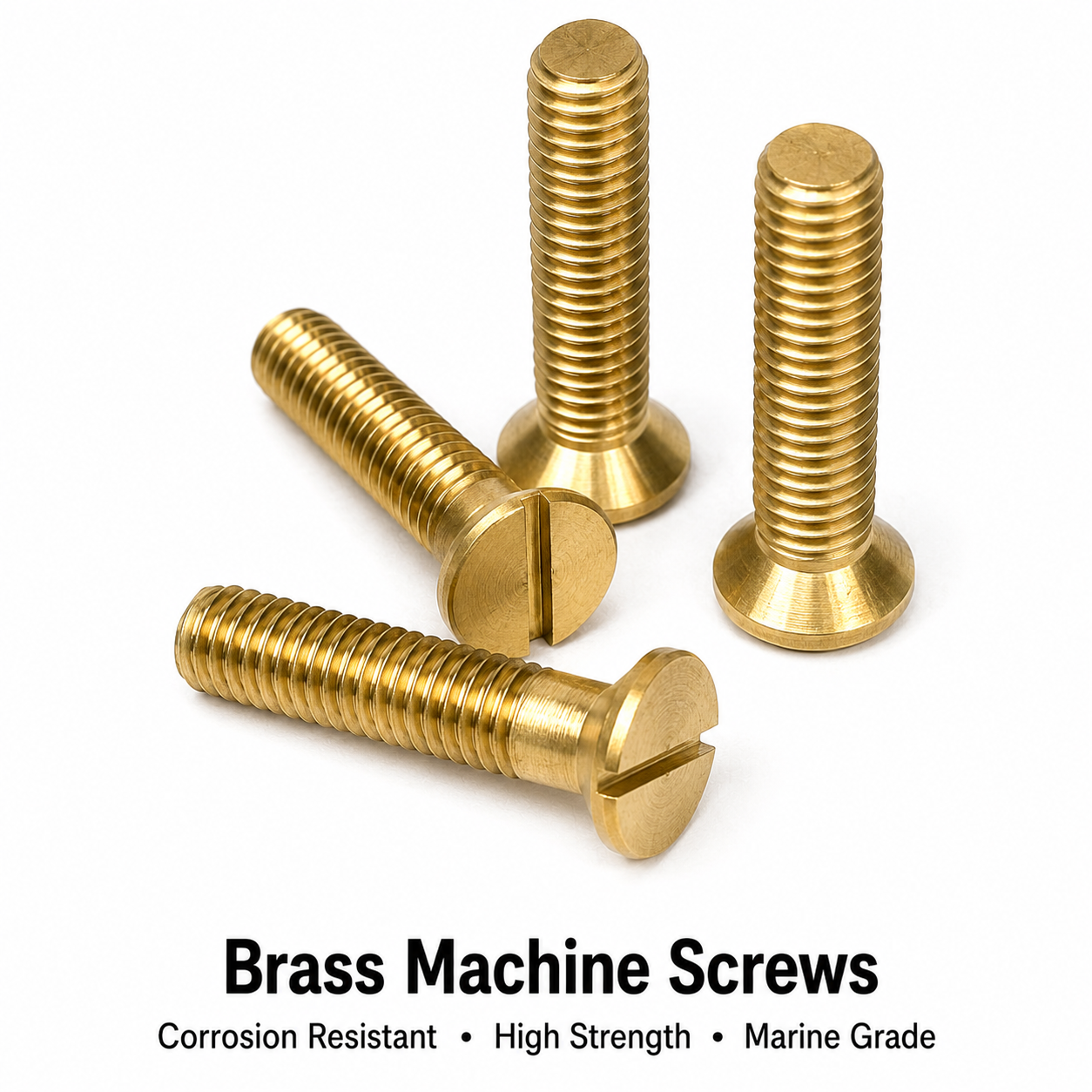
Electrical Accessories India manufactures high-precision brass machine screws for use in electrical panels, switchgear assemblies, control cabinets, instrumentation equipment, printed circuit board (PCB) mounting, and light-duty mechanical assemblies. Brass machine screws offer a unique combination of corrosion resistance, electrical conductivity, non-magnetic properties, and machinability that makes them the fastener of choice for OEMs in the electrical, electronics, telecommunications, and instrumentation industries. Available in a comprehensive range of head profiles, drive types, and thread forms, these screws conform to DIN, ISO, IS, BS, and ASME standards.
Product Overview
Brass Alloy Selection and Material Properties
Our brass machine screws are manufactured from free-cutting brass CZ121 (CW614N / UNS C36000), which contains approximately 58% copper, 39% zinc, and 3% lead – the standard alloy for high-speed automatic screw machining. This alloy delivers excellent machinability rating of 100% (reference standard for all machinability comparisons), combined with adequate corrosion resistance for indoor electrical environments. Lead-free alternatives in CW617N (DZR brass) and CW724R (CuZn21Si3P) are available for RoHS-compliant and drinking water–contact applications. IS 319 Type I (leaded) and Type II (unleaded) brass bars are the Indian standard equivalents.
Head Profiles and Drive Types
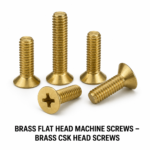
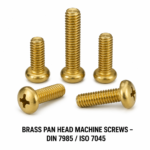
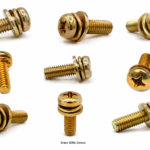
The complete range of brass machine screw head styles includes: Pan Head (DIN 7985 / ISO 7045), Countersunk Flat Head (DIN 963 / ISO 2009), Raised Countersunk Head (DIN 964 / ISO 2010), Round Head (DIN 96), Cheese Head (DIN 84 / ISO 1207), Fillister Head (DIN 14583), Button Head, and Hex Head (DIN 933/931). Drive recess options include Slotted, Phillips (PH), Pozidriv (PZ), Torx (TX), Allen/Hex Socket (HEX), and Combination (Slot + PH). Custom head profiles for specific OEM applications are machined to drawing.
Thread Forms and Dimensional Standards
Brass machine screws are produced in ISO Metric Coarse thread (standard), ISO Metric Fine (for vibration-resistant applications), UNC (Unified National Coarse), UNF (Unified National Fine), and BA (British Association threads, BA0–BA10, widely used in UK-manufactured electrical equipment and instrumentation). Thread tolerance 6g external per ISO 965. BA thread screws are specifically demanded for legacy switchgear, relay panels, protection relay terminal blocks, and UK/Australian electrical equipment maintenance. Thread length: full-thread for M2–M5 up to 30 mm; standard proportional thread for longer lengths per DIN/ISO.
Size Range and Length Availability
Standard metric range: M1.6 × 2 mm through M10 × 60 mm, covering the most common electrical panel and instrumentation requirements. Inch-series range: No.2 (2-56 UNC) through 3/8″-16 UNC / 3/8″-24 UNF. BA range: 0BA through 10BA. Special sizes, non-standard pitches, and extra-long screws (up to 150 mm) manufactured to order. Miniature sizes M1.0 and M1.2 are available for precision instruments and miniature relay assemblies. Thread runout, underhead fillet, and countersink angle (90° or 82°) options are available per customer drawing.
Surface Finishes for Electrical Applications
Standard brass machine screws are supplied in bright natural finish (mill finish). Electroplated finishes available include: nickel plating (3–15 µm, good corrosion resistance, silver appearance), tin plating (3–10 µm, suitable for soldering and PCB applications), chrome plating (decorative and functional), zinc plating (6–12 µm, Fe passivated, economical), and gold plating (0.5–2 µm on nickel undercoat, for aerospace, defence, and precision instrument applications). Tin-plated brass machine screws are particularly important in PCB assembly, cable harness anchors, and connector housing fasteners where lead-free solderability is required.
Applications in Electrical OEM Manufacturing
Brass machine screws find extensive use across multiple electrical OEM segments: terminal block screws in DIN rail-mounted terminal blocks, relay and contactor cover fasteners, current transformer (CT) secondary terminal screws, cable gland locknut fasteners, control panel nameplate fixing screws, PCB standoff screws, meter housing fasteners, earthing label mounting screws, instrument case assembly screws, and pushbutton/selector switch mounting hardware. In switchgear, brass screws are preferred over zinc die-cast or steel screws at high-frequency contact points due to their superior thread durability and corrosion resistance in the operating temperature range −40°C to +120°C.
Mechanical Performance and Torque Data
Brass machine screws (CZ121/CW614N) typical mechanical properties: Tensile strength 380–430 MPa, Proof load 270–310 MPa, Vickers hardness 90–130 HV. These values are adequate for panel assembly clamp loads but are lower than austenitic stainless steel or Grade 8.8 carbon steel. For applications requiring higher clamp load (e.g., busbar termination clamping), silicon bronze or stainless steel screws should be substituted. Recommended tightening torques for M4 brass machine screw (pan head, CZ121): 0.9–1.2 Nm (dry), 0.7–0.9 Nm (lubricated).
Commercial Terms and Pricing
Brass machine screws are priced at USD 13.50 per kilogram (EXW Jamnagar, India). Packaging: bulk polybag (1–5 kg), plastic tray (counted quantities), or reel packaging for automated assembly lines. MOQ: 10 kg per size/style combination. Custom packaging with customer branding available for stocking distributors.
Key Features
- Free-cutting brass CZ121 / CW614N – machinability rating 100%
- Head profiles: Pan, Countersunk, Round, Cheese, Hex, Fillister, Button
- Drive types: Slotted, Phillips, Pozidriv, Torx, Allen, Combination
- Thread: ISO Metric (M1.6–M10), UNC/UNF, BA (0BA–10BA)
- RoHS-compliant lead-free grades available (CW617N, CW724R)
- Surface finishes: bare, nickel, tin, chrome, gold, zinc plated
- Fully dimensioned to DIN, ISO, IS, BS, ASME standards
- EN 10204 3.1 MTR available; REACH / RoHS declarations provided
Corrosion Resistance and Environmental Compatibility
Brass machine screws exhibit good corrosion resistance in dry and mildly humid indoor environments. For salt spray / coastal installations, nickel-plated brass screws provide 200+ hours NSS (Neutral Salt Spray per ASTM B117) resistance. For outdoor or tropical environments, consider silicon bronze or A2 stainless steel alternatives. Brass screws are compatible with brass, copper, bronze, and aluminium substrates with minimal galvanic risk in low-moisture environments.
Thread Self-Locking and Vibration Resistance
Standard brass machine screws can be supplemented with thread-locking features: nylon patch insert (DIN 267 Part 28), pre-applied Loctite thread locker, prevailing torque (distorted thread) design, or pairing with serrated flange nut / spring lock washer assemblies. For high-vibration panel environments (motor control centres, traction control panels, generator control units), specifying nylon-insert prevailing torque brass nuts or Nordlock washers is recommended to prevent loosening.
BA Thread Screws for Legacy Electrical Equipment
British Association (BA) thread screws in brass are specifically supplied for maintenance of legacy UK electrical equipment including: GEC, Reyrolle, AEI, English Electric, Brush, and Siemens UK-manufactured switchgear and protection relays. BA thread screws are also used in postal/telecom equipment, scientific instruments, railway signalling equipment, and vintage electrical equipment restoration. We stock 0BA to 10BA (0BA ≈ M6, 10BA ≈ M1.4) in slotted cheese head, slotted countersunk, and hex head styles.
PCB and Electronics Assembly Applications
For PCB mounting, M2, M2.5, M3 pan head Phillips brass machine screws are the most common choice: they provide adequate clamp force for PCB-to-standoff connections without thread stripping the typically softer PCB-grade brass or aluminium standoffs. Tin-plated M3 machine screws are favoured in PCB assemblies requiring hand-soldering of grounding tabs. Brass screws do not cause ESD risks and are non-magnetic, making them suitable for sensitive measurement and RF equipment enclosures.
Technical Specifications
| Parameter | Specification |
|---|---|
| Material | CZ121 / CW614N (standard); CW617N, CW724R (lead-free) |
| Composition (CW614N) | Cu 57–59%, Zn bal., Pb 2.5–3.5% |
| Tensile Strength | 380–430 MPa |
| Proof Load | 270–310 MPa |
| Hardness | 90–130 HV |
| Machinability | 100% (CZ121 reference) |
| Metric Thread Range | M1.6 to M10 |
| Inch Thread Range | No.2 to 3/8″ UNC/UNF |
| BA Thread Range | 0BA to 10BA |
| Length Range | 2 mm to 150 mm |
| Thread Tolerance | 6g (external) |
| Head Types | Pan, Countersunk, Raised Countersunk, Round, Cheese, Hex, Fillister, Button |
| Drive Types | Slotted, Phillips, Pozidriv, Torx, Allen, Combination |
| Surface Finish | Natural / Nickel / Tin / Chrome / Gold / Zinc plated |
| Density | 8.5 g/cm³ |
Brass Material Grades – International Equivalents
| Designation | EN (Europe) | UNS (USA) | IS (India) | JIS (Japan) | BS (UK) |
|---|---|---|---|---|---|
| Free-Cutting Brass | CW614N | C36000 | IS 319 Type I | C3604 | CZ121 |
| DZR Brass (Pb-free) | CW617N | C35300 | — | — | CZ132 |
| Silicon Brass | CW724R | C69300 | — | — | — |
| Naval Brass | CW712R | C46400 | IS 291 | C4622 | CZ112 |
Product Variants
| Type | Standard | Head Style | Drive | Common Sizes |
|---|---|---|---|---|
| Pan Head Machine Screw | DIN 7985 / ISO 7045 | Pan | Phillips / Slotted | M2–M6 |
| Countersunk Machine Screw | DIN 963 / ISO 2009 | CSK 90° | Slotted | M2–M10 |
| Raised CSK Machine Screw | DIN 964 / ISO 2010 | Raised CSK | Slotted | M2–M8 |
| Round Head Machine Screw | DIN 96 / BS 57 | Round | Slotted | M2–M8 |
| Cheese Head Machine Screw | DIN 84 / ISO 1207 | Cheese | Slotted | M1.6–M8 |
| Hex Head Machine Screw | DIN 933 | Hex | Spanner | M3–M10 |
| BA Cheese Head Screw | BS 57 | Cheese | Slotted | 0BA–10BA |
| Torx Pan Head Screw | ISO 14583 | Pan | Torx TX | M2–M6 |
Applications in Industry
| Segment | Application |
|---|---|
| Electrical Panels & Switchgear | Terminal block screws, cover plate fasteners, DIN rail component screws, earth bar screws |
| Instrumentation & Meters | Meter housing assembly, relay cover screws, instrument panel fasteners, sensor housing screws |
| PCB & Electronics | PCB-to-standoff mounting, grounding tab screws, RF module mounting, EMC earth screws |
| Control Cabinets (MCC/PCC) | Component mounting screws, cable lug clamp screws, nameplate fixing, door hinge screws |
| Telecom & Data Equipment | Rack-mount equipment screws (M6 cage nut), patch panel fasteners, cable management screws |
| Automotive & Marine Electrical | Fuse box screws, junction box fasteners, connector housing screws, vehicle earth screws |
| Legacy UK Switchgear (BA Thread) | Protection relay terminals, GEC/AEI switchgear covers, British instrument panels |
Manufacturing Process
Brass machine screws are manufactured by automatic screw machining (Swiss-type multi-spindle lathes) for sizes M1.6–M6, and by cold heading followed by thread rolling for sizes M5–M10. In automatic screw machining, free-cutting brass bar stock is precision-turned to form the head profile, then slotted, drilled (for Phillips/Torx), or milled (for Allen hex), and finally thread-cut. Cold-headed screws are blanked in multi-stage heading tools, producing a formed head, then thread-rolled for stronger thread flanks and better dimensional consistency. All screws undergo automated optical sorting for head fill, point quality, thread gauging (GO/NO-GO per ISO 1502), and length verification. Batch sampling per ISO 3269 Acceptance Quality Level (AQL) 1.0 is standard.
Quality Standards and Certifications
| Standard | Scope |
|---|---|
| ISO 9001:2015 | Quality Management System |
| DIN 84 / ISO 1207 | Cheese head screws – metric |
| DIN 963 / ISO 2009 | Countersunk head screws – slotted |
| DIN 7985 / ISO 7045 | Pan head screws – cross recess |
| BS 57 | Machine screws – BA series |
| IS 1148 | Hexagon head bolts, screws and nuts (brass) |
| ASTM B16 / B138 | Free-cutting brass rod composition |
| EN 10204 Type 3.1 | Material Test Certificate |
| REACH / RoHS | Hazardous substance declaration |
Why Choose Electrical Accessories India
- ISO 9001:2015 certified manufacturer with in-house multi-spindle screw machines
- Widest range – metric, inch (UNC/UNF), and BA threads from one supplier
- Lead-free grades (CW617N, CW724R) for RoHS/REACH compliant OEM assemblies
- Priced at USD 13.50/kg – competitive for OEM annual requirement contracts
- Custom head profiling, special drive recesses, and unusual thread forms to drawing
- Export experience to UK, USA, UAE, Germany, Australia, South Africa
- AQL inspection with full documentation and batch traceability
Frequently Asked Questions (FAQ)
1. What is the difference between DIN 84 and DIN 963 brass machine screws?
DIN 84 is a cheese head screw (cylindrical head with flat top, slotted drive), while DIN 963 is a countersunk flat head screw (90° sink angle, slotted drive). Cheese head screws have more bearing surface under the head and better resistance to driver cam-out, making them preferred in high-torque panel assembly. Countersunk screws are flush-mounted and used where a smooth panel surface is required.
2. Can brass machine screws be used in outdoor electrical enclosures?
Standard bare brass machine screws have limited outdoor corrosion resistance. For outdoor IP54/IP65 enclosures, nickel-plated or stainless steel screws are recommended. If brass is required (e.g., for conductivity/grounding), nickel-plated CW614N screws provide adequate protection for weatherproof but not immersed environments.
3. Do you supply BA thread brass screws for UK switchgear maintenance?
Yes. We stock and manufacture BA thread screws in 0BA to 10BA sizes, cheese head slotted (BS 57) and countersunk slotted profiles in CZ121 brass. These are used for maintenance of legacy UK-manufactured switchgear, protection relays (GEC, AEI, Reyrolle, English Electric brands), and British instrumentation equipment.
4. What is the minimum order quantity for brass machine screws?
MOQ is 10 kg per size/style combination. For special sizes (custom length, non-standard thread, special drive), MOQ may be 25–50 kg depending on the setup requirements.
5. Are lead-free brass machine screws available for RoHS compliance?
Yes. We supply machine screws in CW617N (DZR brass, Pb-free, ≤0.09% Pb) and CW724R (silicon brass, Pb-free), which comply with RoHS Directive 2011/65/EU. REACH SVHC declaration and RoHS compliance certificate provided on request.
6. What drive type is most common for electrical panel assembly?
Phillips (PH2) pan head M3 and M4 screws are the most common in production-line panel assembly because they allow power screwdriver use. Slotted screws are preferred for site/field maintenance (screwdrivers always available). Torx head screws are increasingly specified for tamper-resistance in public electrical enclosures.
7. Can you supply tapping screws in brass?
Yes, we manufacture brass self-tapping screws (Type AB, Type B – thread-forming) and thread-cutting screws (Type F) for direct-drive into sheet metal, thermoplastic, and PCB laminates. Contact us with your application details.
8. What surface finish is suitable for soldering applications?
Tin-plated brass screws (3–8 µm electrodeposited tin) are recommended for soldering applications. The tin layer acts as a flux-compatible, solderable surface compatible with both lead-based (Sn63/Pb37) and lead-free (SAC305) solder alloys used in PCB and harness assembly.
Equivalent Terms and Multilingual Reference
| Language | Term 1 | Term 2 | Term 3 |
|---|---|---|---|
| Spanish | Tornillos de máquina de latón | Tornillos de latón para máquinas | Tornillos métricos de latón |
| Russian | Латунные машинные винты | Латунные метрические болты | Крепёжные латунные винты |
| French | Vis machines en laiton | Vis métriques laiton | Vis à tête bombée laiton |
| Portuguese | Parafusos de máquina em latão | Parafusos métricos de latão | Parafusos de latão para painéis |
| Italian | Viti di macchina in ottone | Viti metriche in ottone | Viti testa piana in ottone |
Related Products and Linked Terms
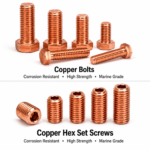
- Copper Bolts, Copper Hex Set Screws
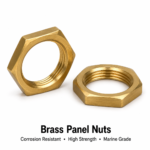
- Brass Panel Nuts
- Brass DIN 934 Hex Nuts
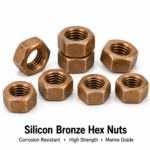
- Silicon Bronze Hex Nuts
- Brass Standoffs
- Brass Spacers
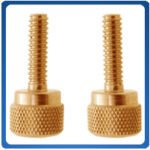
- Brass Thumb Screws
- Brass wood screws, brass self-tapping screws, brass socket head screws, brass washers, brass hex nuts, brass insert nuts, DIN rail fasteners
Request a Quote
Electrical Accessories India supplies brass machine screws to electrical OEMs, EPC contractors, distributors, and maintenance organisations worldwide. Pricing: USD 13.50 per kilogram (EXW Jamnagar, India). Bulk pricing, OEM tooling development, and annual supply agreements available.
Email: info@elecaccs.com | Location: Jamnagar, Gujarat, India | Export Markets: USA, UK, UAE, Germany, Australia, South Africa, Brazil, Southeast Asia