

Product
Product Details
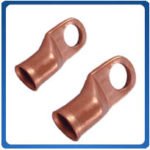
Copper Mechanical Lugs & Copper Offset Tongue Lugs
Copper Mechanical Lugs & Copper Offset Tongue Lugs
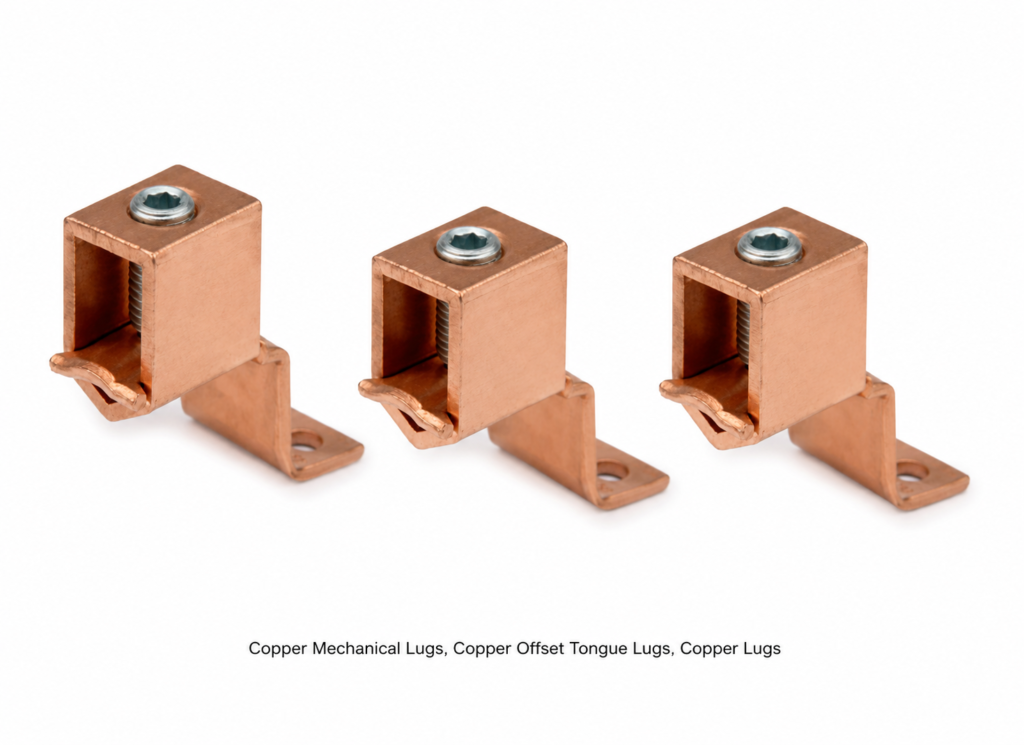
Copper Mechanical Lugs and Copper Offset Tongue Lugs from Electrical Accessories India are precision-engineered terminal connectors manufactured from Electrolytic Tough Pitch (ETP) copper conforming to IS 1897 / C11000 (99.9% Cu). Designed for bolted, screw-clamped, or compression-assisted connections in panel boards, switchgear assemblies, busbars, motor control centres (MCC), and transformer terminals, these lugs provide low-resistance, maintenance-free connections across conductor sizes from 1.5 mm² to 630 mm². The offset tongue (bent palm) variant addresses spatial constraints inside enclosures where a straight barrel-to-tongue geometry is impractical. Both types are produced at our ISO-compliant facility in Jamnagar, India, and exported to electrical OEMs, EPC contractors, power utilities, and distributors across 30+ countries.
Product Overview
Copper Mechanical Lugs — Construction & Geometry
A copper mechanical lug consists of a tubular barrel that accepts a stranded or solid conductor, and a flat tongue (palm) drilled with one or two bolt holes for bus bar or terminal stud connection. The barrel is split longitudinally (split-barrel type) or fully closed (tubular type). Mechanical clamping is achieved by one or more set-screws (hex socket or slotted head) made from tinned brass or stainless steel that bite into the conductor without requiring a crimping tool. This makes mechanical lugs particularly suitable for field wiring, retrofit work, and applications where re-termination is frequent. The palm thickness, bolt-hole diameter (M6 to M20), and barrel bore are dimensionally standardized to DIN 46235, BS 4579, and IS 8309 for interchangeability across panel builders worldwide.
Copper Offset Tongue Lugs — Geometry & Application Logic
The offset tongue lug features the same barrel-and-palm construction as a standard mechanical lug, but the palm is bent at a defined offset angle — typically 45° or 90° — relative to the barrel axis. This offset geometry is mandated by IEC 61439-1 compliant switchgear assemblies where bus bars run parallel to enclosure walls, leaving insufficient straight-line clearance for a flat-face palm. Offset lugs eliminate cable strain, reduce eddy current loops, and maintain creepage/clearance distances inside low-voltage and medium-voltage cubicles (up to 36 kV). They are widely specified in power distribution boards, motor starters, transformer LT terminals, capacitor bank connections, and earthing systems.
Raw Material & Electrical Performance
All mechanical and offset tongue lugs are produced from ETP copper (C11000 / IS 1897 Grade ETP) with a minimum copper content of 99.90% and electrical conductivity ≥98% IACS (International Annealed Copper Standard). This ensures contact resistance values that are consistent with IEC 60947-7-1 requirements for cable management accessories. The material is hot-forged or cold-pressed depending on cross-section, then machine-drilled and tin-plated (electroplated, 5–10 µm) on request to inhibit oxidation in humid or chemically aggressive environments. The annealed state of ETP copper ensures the lug barrel retains ductility under repeated conductor insertion cycles.
Size Range & Cross-Section Coverage
Copper mechanical lugs are manufactured in conductor cross-sections from 1.5 mm² to 630 mm², covering cable sizes per IEC 60228 Class 1, 2, 5, and 6 conductors. Barrel bore tolerances are maintained within ±0.05 mm for conductor sizes up to 35 mm² and ±0.10 mm for larger sizes, ensuring gas-tight contact. Tongue (palm) dimensions conform to bolt-hole pitches standardized in DIN 46235 for 1-hole and 2-hole palms. Custom cross-sections (e.g., AWG cable compatibility for export to North America or Middle East) are available on request with standard lead times of 4–6 weeks.
Tin Plating, Surface Finish & Corrosion Resistance
Standard finish is bright bare copper with a protective lacquer coat. For coastal, marine, and tropical industrial environments, EAI offers tin plating (electrolytic, bright tin, 5–15 µm per IEC 60068-2-20), which dramatically reduces contact resistance drift in salt-laden atmospheres. Nickel plating is available for high-temperature applications up to 200°C. The tongue (palm) face maintains a flatness tolerance of ≤0.05 mm per 25 mm to ensure full-face contact on bus bars. Surface roughness Ra ≤1.6 µm is maintained on contact surfaces.
Manufacturing Process for Copper Mechanical Lugs
Raw ETP copper rod (8 mm diameter, per IS 1897) is cut to billets, hot-forged or cold-forged in hardened tool-steel dies to form the blank, then CNC-machined for barrel bore, palm drilling, and set-screw threads. The palm is coined flat to ensure uniform contact area. Offset tongue variants are formed in a separate bending operation using calibrated press tooling set to the specified offset angle. All parts undergo deburring, pickling, ultrasonic cleaning, and dimensional inspection per control plans before surface treatment. Final inspection includes go/no-go gauge checks on barrel bore, bolt-hole position, and palm flatness.
Compliance with International Standards
EAI’s copper mechanical lugs and offset tongue lugs are manufactured and tested against: IS 8309:2000 (Indian Standard for power cable accessories), DIN 46235 (German/European standard for cable lugs), BS 4579 (British standard for compression and mechanical lugs), IEC 61238-1 (compression and mechanical connectors for power cables), and UL 486A-486B (wire connectors and terminals for use with copper conductors). Material certificates (EN 10204 3.1) are available for all shipments. RoHS compliance and REACH declaration available on request.
Linked Products & Related Parts
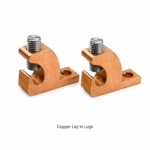
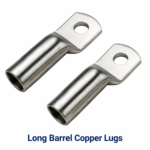
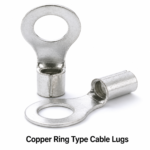
These lugs are commonly used alongside: copper cable lugs (tubular / compression type), copper lay-in lugs, copper long barrel tubular lugs, copper stamped lugs for transformers, copper ring terminal lugs, busbar connectors, earth clamps, cable gland assemblies, copper bonded grounding rods, and panel board fittings.
Key Features
- Tool-free installation via set-screw clamping — no hydraulic crimp tool required
- Conductor range: 1.5 mm² to 630 mm² (IEC 60228 / AWG compatible)
- ETP copper C11000 / IS 1897, ≥99.90% Cu, ≥98% IACS conductivity
- Offset angles: 45° and 90° offset tongue variants available
- Bolt-hole diameters: M6, M8, M10, M12, M16, M20
- Temperature range: −60°C to +105°C (continuous service)
- Optional tin-plated or nickel-plated finish for harsh environments
- Compliant: DIN 46235, BS 4579, IS 8309, IEC 61238-1, UL 486A
- Price: US$16.80/kilogram
High Electrical Conductivity
The ETP copper alloy delivers a minimum electrical conductivity of 98% IACS, ensuring minimal voltage drop across the lug junction. Thermal imaging on live installations shows junction temperatures within 5–8°C of the cable body — well within IEC 60947-7-1 limits. Low contact resistance reduces energy losses in large distribution networks and MCC panels where hundreds of lugs operate simultaneously. For utilities managing high-voltage feeders and large cable terminations, this translates directly to reduced lifecycle losses and lower total cost of ownership.
No-Tool Mechanical Connection
Unlike compression lugs that require calibrated hydraulic crimping tools and trained technicians, mechanical lugs are torque-wrench driven and can be installed, retightened, or removed by any qualified electrician. The set-screw design maintains clamping force over the cable’s thermal expansion and contraction cycles (≥10,000 cycles per IEC 61238-1 fatigue test). This feature is particularly valued in retrofit and maintenance projects in operating substations, ship electrical systems, and emergency generator sets where downtime is critical.
Offset Geometry for Space-Constrained Enclosures
The 45° and 90° offset tongue configurations are designed to the IEC 61439-1 internal clearance requirements for low-voltage switchgear assemblies. By routing the cable away from the palm face, offset lugs reduce electromagnetic interference loops, avoid contact with adjacent live parts, and allow tighter packing of circuit breakers and contactors. This is especially relevant in compact motor control centres (MCC), distribution boards (DB), and ring main units (RMU) where enclosure depth is limited to 200–400 mm.
Custom Sizes & OEM Supply
EAI’s 15,000 sq.ft. machining facility in Jamnagar maintains a standard inventory of 120+ SKUs across mechanical lug sizes. Custom conductor bore dimensions (for unusual cable diameters or rectangular busbar systems), non-standard palm lengths, dual-hole configurations, and specific plating specifications are undertaken against drawings. OEM supply with private labelling, custom packaging, and barcode labelling is available for panel builders, transformer manufacturers, switchgear OEMs, and cable harness companies.
Corrosion Resistance & Plating Options
Standard bare copper lugs are suitable for dry indoor environments. For offshore platforms, chemical plants, coastal substations, and tropical climates, tin-plated variants (IEC 60068-2-11 salt spray 96 hours) provide a protective intermetallic barrier. Nickel-plated lugs resist temperatures to 200°C and are approved for marine grade installations. Silver-plated options (2–5 µm) are available for high-frequency applications above 1 kHz where skin-effect resistance reduction is important.
Quality Control & Testing
Each production batch undergoes dimensional verification using Mitutoyo CMM (Coordinate Measuring Machine), contact resistance testing per IEC 61238-1 (≤1.2 × cable resistance), pull-out load testing, and visual inspection per AQL 1.0. Material traceability is maintained from copper rod to finished part. EN 10204 3.1 material test certificates, dimensional inspection reports, and surface coating thickness reports are available on request. EAI holds ISO 9001:2015 certification for copper and brass parts manufacturing.
Technical Specifications
| Parameter | Specification |
|---|---|
| Product Type | Copper Mechanical Lug / Copper Offset Tongue Lug |
| Material | ETP Copper C11000 / IS 1897 (≥99.90% Cu) |
| Conductivity | ≥98% IACS |
| Conductor Size Range | 1.5 mm² – 630 mm² (IEC 60228 Cl.1, 2, 5, 6) |
| Bolt Hole Sizes | M6, M8, M10, M12, M16, M20 |
| Offset Angles Available | 45°, 90° (standard); custom angles on request |
| Temperature Range | -60°C to +105°C |
| Voltage Rating | Up to 36 kV (MV insulated variants) |
| Surface Finish | Bare copper / Tin-plated / Nickel-plated / Silver-plated |
| Tin Plating Thickness | 5–15 µm (electrolytic, bright tin) |
| Tensile Strength | 220–250 MPa (annealed ETP copper) |
| Standards | DIN 46235, BS 4579, IS 8309, IEC 61238-1, UL 486A-486B |
| Pricing | US$ 16.80/kilogram |
Raw Material Grades & International Equivalents
| Standard | Grade / Designation | Country / Region |
|---|---|---|
| IS 1897 | ETP Copper | India |
| ASTM B170 / B187 | C11000 | USA |
| EN 13601 | Cu-ETP (CW004A) | Europe |
| BS 6017 | C101 (ETP Copper) | United Kingdom |
| DIN 1787 | E-Cu 57 / E-Cu 58 | Germany |
| JIS H3100 | C1100P | Japan |
| GB/T 5585 | T2 Copper | China |
| GOST 434 | М0, М1 | Russia |
Product Types & Variants
| Type | Description | Typical Application |
|---|---|---|
| Straight Mechanical Lug | Standard barrel + flat palm, single or double bolt-hole | Panel boards, MCC, cable trunking |
| Offset 45° Tongue Lug | Palm bent 45° to barrel axis | Compact switchgear, DIN rail systems |
| Offset 90° Tongue Lug | Palm bent 90° to barrel axis | Transformer LT terminals, bus riser connections |
| Split-Barrel Mechanical Lug | Split barrel for easy conductor insertion | Field wiring, retrofit applications |
| Two-Hole Tongue Lug | Double bolt-hole palm for high-current applications | Busbars above 400A, generator terminals |
| Insulated Mechanical Lug | PVC/PA shroud over barrel (coloured by size) | Low-voltage consumer panels |
Applications in Industry
| Industry / Sector | Specific Application |
|---|---|
| Power Generation | Generator output terminals, AVR connections, excitation panel wiring |
| Power Distribution | LT panel boards, distribution boards, switchgear bus risers |
| Oil & Gas | Hazardous area panels, motor control centres (Ex-rated enclosures) |
| Marine & Offshore | Ship switchboards, offshore platform MCC, marine distribution panels |
| Railways & Metro | Traction panel terminations, auxiliary converter connections |
| Industrial Automation | VFD (Variable Frequency Drive) input/output terminals, servo drive panels |
| Renewable Energy | Solar inverter DC/AC terminations, wind turbine main control panels |
| Transformer Manufacturing | LT terminal pad connections, off-load tap changer wiring |
| Data Centres | UPS output busbars, PDU (Power Distribution Unit) cabling |
| Building Construction | Main distribution board (MDB) incoming terminals, riser cable terminations |
Manufacturing Process
EAI manufactures copper mechanical and offset tongue lugs through a controlled multi-stage process. Stage 1 – Raw Material Procurement: ETP copper rod (8 mm, IS 1897) is procured from LME-certified refineries with material test certificates (MTC). Stage 2 – Billet Cutting: Copper rod is cut to precision billets using CNC sawing to weight tolerances of ±1%. Stage 3 – Forging/Pressing: Billets are either hot-forged (for sizes above 35 mm²) or cold-pressed in multi-stage dies to form the blank incorporating barrel, shoulder, and palm sections. Stage 4 – CNC Machining: Barrel bore is CNC-drilled to H7 tolerance; palm is faced flat; bolt holes are drilled and deburred; set-screw threads are CNC-tapped. Stage 5 – Offset Forming: For offset tongue variants, palms are hydraulic-pressed in calibrated angular tooling (±0.5° angular tolerance). Stage 6 – Surface Treatment: Parts are chemically cleaned, pickled in dilute H₂SO₄, rinsed, and either lacquer-coated (bare copper) or electroplated (tin/nickel/silver) to specified thickness. Stage 7 – Inspection & Packing: 100% dimensional gauging, contact surface roughness check (Ra ≤1.6 µm), visual AQL 1.0 inspection, and certified packing in polybags + cartons with product labels showing size, material, and batch number.
Quality Standards & Certifications
| Standard / Certification | Scope |
|---|---|
| ISO 9001:2015 | Quality Management System – manufacturing facility |
| IS 8309:2000 | Power cable accessories (Indian standard) |
| IEC 61238-1 | Compression & mechanical connectors for power cables up to 36 kV |
| DIN 46235 | Cable lugs for aluminium and copper conductors |
| BS 4579 | Mechanical and compression cable lugs |
| UL 486A-486B | Wire connectors for copper conductors (US market) |
| RoHS 2011/65/EU | Restriction of hazardous substances |
| EN 10204 Type 3.1 | Material test certificate (chemical + mechanical) |
Why Choose Electrical Accessories India
- 35+ years of copper and brass parts manufacturing in Jamnagar, India’s precision metals hub
- In-house CNC machining, forging, and electroplating — end-to-end quality control
- Export experience to 30+ countries: USA, UK, Germany, Australia, UAE, South Africa, Singapore
- Custom OEM supply: private labelling, special sizes, non-standard materials (bronze, aluminium alloy)
- ISO 9001:2015 certified; EN 10204 3.1 MTCs on every shipment
- Competitive pricing: US$16.80/kg with MOQ starting at 50 kg per size
- Technical support: engineering drawings, dimensional specifications, and application guidance provided free
Frequently Asked Questions
- Q1. What is the difference between a mechanical lug and a compression lug?
- A mechanical lug uses set-screws to clamp the conductor inside the barrel — no special tool is required. A compression lug is crimped permanently onto the conductor using a hydraulic die. Mechanical lugs allow re-termination; compression lugs provide higher vibration resistance and are preferred for permanent joints per IEC 61238-1.
- Q2. What conductor types are compatible with copper mechanical lugs?
- Copper mechanical lugs accept stranded copper conductors (IEC 60228 Class 2, 5, 6), solid copper conductors (Class 1), and flexible copper cables. Aluminium conductors require a dedicated aluminium mechanical lug with anti-oxide compound application.
- Q3. Why is an offset tongue lug used instead of a straight lug?
- Offset tongue lugs are used when straight-line geometry from cable to bus bar connection cannot be maintained due to physical obstructions inside the enclosure. The 45° or 90° offset allows the cable to enter the barrel at an angle while the palm still lies flat on the bus bar contact surface, maintaining full contact area and required creepage distances.
- Q4. What is the pricing for copper mechanical lugs?
- EAI’s copper lugs are priced at US$16.80 per kilogram. Specific piece-weight and per-unit price depends on the cross-section and palm configuration. Contact our sales team for a detailed price list by size and quantity.
- Q5. Are these lugs suitable for use up to 36 kV?
- Bare mechanical lugs are generally used in LV (up to 1 kV) applications. For MV applications up to 36 kV, heat-shrink insulated or cold-shrink insulated versions are required. EAI supplies the copper lug body; the insulation system is applied by cable accessory manufacturers per IEC 61238-1 / IEC 60502-4.
- Q6. What surface finish is recommended for tropical or coastal environments?
- Tin-plated copper lugs (electrolytic bright tin, 10–15 µm) are recommended for tropical and coastal environments. They pass IEC 60068-2-11 salt spray testing at 96 hours and prevent the formation of cupric oxide which increases contact resistance over time.
- Q7. Can EAI supply lugs with two bolt holes (double-hole palm)?
- Yes. Two-hole (double-hole) palm lugs are standard inventory items for conductor sizes from 150 mm² upwards. Double-hole palms are required for busbars carrying currents above 400A to ensure adequate contact area and prevent palm overheating.
- Q8. What is the minimum order quantity (MOQ)?
- The standard MOQ is 50 kg per size/finish combination. For sample orders (evaluation and type testing), a minimum of 5 kg per size is acceptable with a sample surcharge. Custom OEM sizes require a minimum production run of 200 kg.
- Q9. Do you provide material test certificates (MTC)?
- Yes. EN 10204 Type 3.1 material test certificates showing chemical composition and mechanical properties of the copper raw material are provided as standard on all commercial shipments. NABL-accredited third-party test reports are available on request.
- Q10. What are the international equivalent terms for these products?
- See the multilingual terminology section below.
International Equivalent Terms
| Language | Term 1 | Term 2 | Term 3 |
|---|---|---|---|
| Spanish | Terminal de cobre mecánico | Orejeta de cobre con lengüeta offset | Conector de cable de cobre atornillado |
| Russian | Медный механический наконечник | Медный кабельный наконечник с офсетным язычком | Зажимной медный кабельный наконечник |
| French | Cosse mécanique en cuivre | Cosse cuivre à languette déportée | Terminal de câble cuivre à vis |
| Portuguese | Terminal mecânico de cobre | Olhal de cobre com lingueta offset | Conector de cabo de cobre por parafuso |
| Italian | Capicorda meccanico in rame | Terminale in rame con occhiello sfalsato | Connettore a vite per cavi in rame |
Related Products — Copper Lugs Category
- Copper Lugs Category Overview
- Copper Lugs Ring Type (From Sheet Metal)
- Copper Long Barrel Tubular Lugs
- Copper Stamped Lugs for Transformers
- Transformer Cable Lugs Copper
- Copper Lay In Lugs
Request a Quote
Contact Electrical Accessories India for a detailed quotation on Copper Mechanical Lugs and Copper Offset Tongue Lugs. Specify conductor size (mm²), number of bolt holes, offset angle (if applicable), surface finish, and required quantity. Our engineering team will respond with a dimensional drawing, material data sheet, and competitive price within 24 hours.
Jamnagar, Gujarat, India | Export to USA, Europe, Middle East, Africa, Southeast Asia | Price: US$16.80/kg
📧 Email: info@elecaccs.com | 🌐 Contact Us