

Product
Product Details
C26000 Brass Stamping (Cartridge Brass)
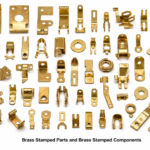
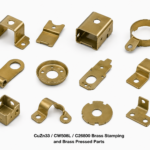
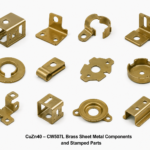
C26000 Brass Stamping – Cartridge Brass Stamped Parts and Components
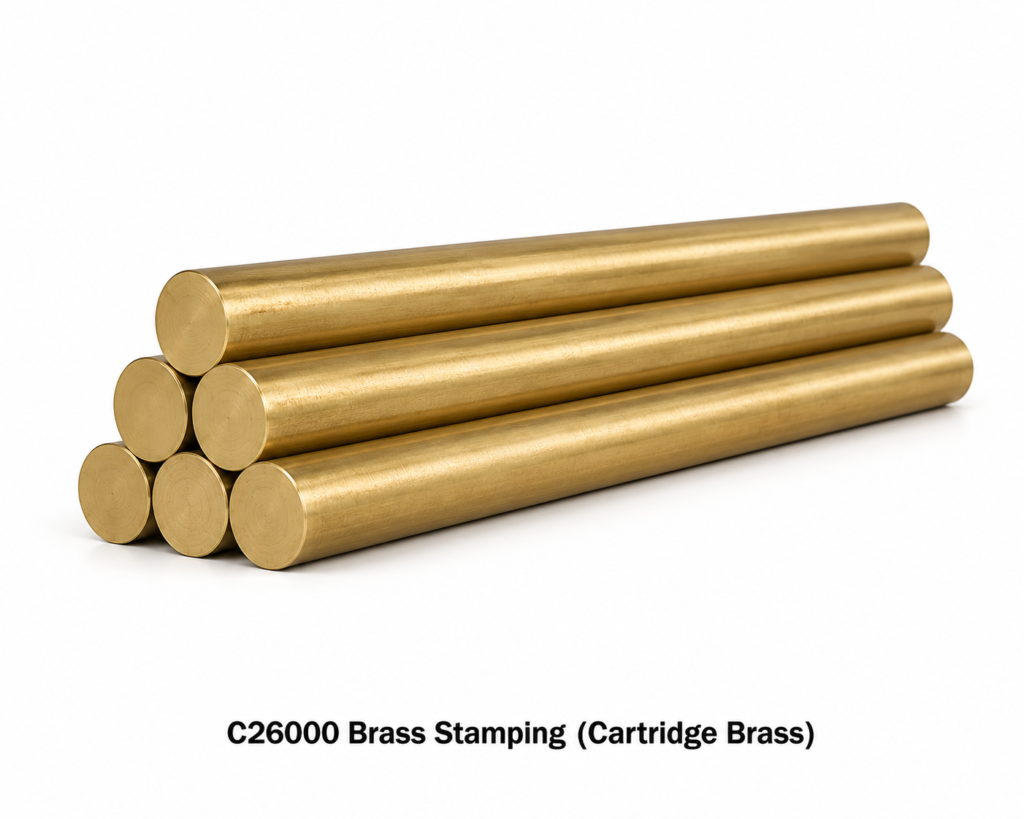
C26000 Brass Stamping (Cartridge Brass)
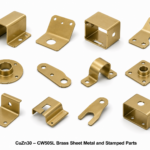
C26000 brass (UNS C26000, CDA 260, ASTM B36 Cartridge Brass, EN CW505L, DIN CuZn30, IS 407 Grade 2) is the most widely specified deep-drawing brass alloy in the world, containing nominally 70% copper and 30% zinc. Its exceptional combination of deep-drawability, cold-formability, moderate strength, and good electrical conductivity makes it the alloy of choice for precision progressive die stampings, deep-drawn shells, and compound-blanked electrical components. Electrical Accessories India manufactures C26000 cartridge brass stampings at our Jamnagar, Gujarat facility using power presses, progressive dies, and compound dies, supplying electrical OEMs, switchgear manufacturers, panel board builders, and industrial hardware distributors across India and 30+ export markets.
Product Overview
C26000 Alloy Profile – Metallurgy of Cartridge Brass
C26000 (70/30 brass, Cartridge Brass) contains 68.5–71.5% copper and the balance zinc (nominally 30% Zn), with trace lead and iron not exceeding 0.07% each. The high copper content gives C26000 a face-centred cubic (FCC) alpha-phase microstructure throughout, which is responsible for its outstanding cold-formability and deep-drawability. The alloy exhibits a high normal anisotropy ratio (R-value) that resists thinning and tearing during deep-draw forming – a critical property for cup, shell, and drawn housing stampings. Tensile strength in the annealed condition is 300–360 MPa, elongation 50–65%, and Vickers hardness 65–80 HV. In half-hard temper, tensile strength increases to 380–430 MPa with elongation of 30–45%. Electrical conductivity is approximately 26–28% IACS, and thermal conductivity is approximately 120 W/m·K. The alloy has excellent resistance to atmospheric corrosion and dezincification in most service environments.
Deep Drawing and Progressive Die Capabilities
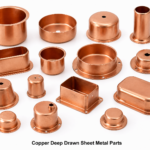
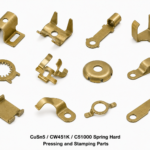
C26000 is the benchmark alloy for deep-drawn brass parts. Electrical Accessories India produces deep-drawn C26000 shells, cups, housings, and capsules with draw ratios up to 2.2 (first draw), and multi-stage draws extending to limiting draw ratios (LDR) of 4.0–5.5 with intermediate annealing. Wall thicknesses from 0.3 mm to 3.0 mm are routinely produced in drawn configurations. Progressive die stamping of C26000 strip (0.2–3.0 mm thickness, 5–200 mm width) is the primary production route for connector contacts, terminal blades, earth tags, spring contacts, fuse clips, and cable entry components. The alloy’s predictable spring-back (lower than free-cutting brass grades) enables precision forming of complex multi-bend profiles with tight dimensional repeatability across high-volume production runs.
Electrical and Electronic Applications
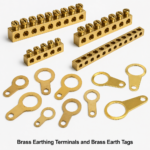
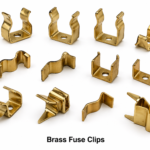
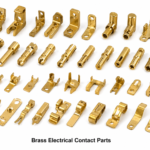
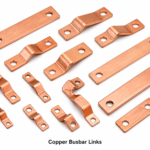
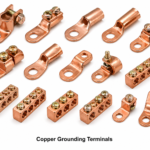
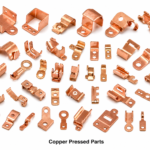
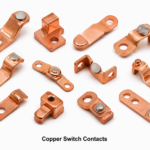
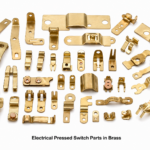
C26000 cartridge brass stampings are fundamental components in the electrical and electronics industries. Key applications include: spring contacts and connector contacts for terminal blocks, industrial connectors, and PCB-mounted connectors (exploiting the alloy’s spring-back consistency and fatigue resistance); earth tags, grounding clips, and bonding washers for LV switchgear and distribution panels; fuse clips for cartridge fuse holders (originally driving the alloy’s “Cartridge Brass” name); switch contact blades for domestic and industrial switching devices; cable connector shells drawn from strip; busbar clips and links for panel board assemblies; and decorative switch cover plates in polished and lacquered finish. C26000’s electrical conductivity of 26–28% IACS makes it suitable for moderate current-carrying applications where forming requirements exceed what is practical in higher-conductivity copper alloys.
Formability Comparison – C26000 vs Other Brass Grades
Among commercial brass strip alloys, C26000 (70/30) offers the best deep-drawability and the lowest spring-back of any standard brass grade. Compared to C27000 (65/35 Yellow Brass), C26000 has better elongation (65% vs 55% annealed), higher R-value, and lower tendency to crack on deep draws. Compared to C26800 (66/34 Yellow Brass), C26000 provides slightly better ductility and corrosion resistance. Compared to C36000 (Free-Cutting Brass CW614N), C26000 has far superior formability – C36000’s 3% lead content makes it unsuitable for deep drawing but ideal for machining. For applications requiring both excellent formability and spring properties, C26000 in hard or spring temper (as defined in ASTM B36) is used for connector contacts and spring-loaded terminals.
Technical Specifications
| Property | Value / Range | Standard |
|---|---|---|
| UNS Designation | C26000 | ASTM / CDA |
| Common Names | Cartridge Brass, 70/30 Brass, CDA 260 | – |
| Copper (Cu) | 68.5–71.5% | ASTM B36 |
| Zinc (Zn) | Balance (~28.5–31.5%) | ASTM B36 |
| Lead (Pb) max | 0.07% | ASTM B36 |
| Iron (Fe) max | 0.05% | ASTM B36 |
| Tensile Strength (Annealed) | 300–360 MPa | ASTM E8 |
| Tensile Strength (Half-Hard) | 380–430 MPa | ASTM E8 |
| Elongation (Annealed) | 50–65% | ASTM E8 |
| Hardness (Annealed) | 65–80 HV | ASTM E92 |
| Electrical Conductivity | 26–28% IACS | ASTM B193 |
| Thermal Conductivity | ~120 W/m·K | – |
| Density | 8.53 g/cm³ | – |
| Melting Range | 915–955°C | – |
| Strip Thickness Range | 0.2–3.0 mm | ASTM B36 |
| Strip Width Range | 5–200 mm | – |
International Equivalent Grades – C26000 Cartridge Brass
| Standard | Designation | Common Name |
|---|---|---|
| USA (UNS/ASTM) | C26000 / CDA 260 | Cartridge Brass, 70/30 Brass |
| Europe (EN) | CW505L | CuZn30, Brass EN 1652 |
| UK (BS) | CZ106 | 70/30 Brass Strip |
| Germany (DIN) | CuZn30 / WNr 2.0265 | Messing 70/30 |
| ISO | CuZn30 | ISO 426/1 |
| India (IS) | IS 407 Grade 2 | Brass Strip 70/30 |
| Japan (JIS) | C2600 | 黄銅 (Brass 70/30) |
| China (GB) | H70 | 黄铜 (70/30 Brass) |
Product Types and Variants
| Product Type | Description | Typical Size Range |
|---|---|---|
| Deep-Drawn Shells / Cups | Multi-stage drawn housings and capsules | Dia 5–100 mm, H 5–80 mm |
| Progressive Die Contacts | Connector contacts, spring blades, terminal pins | Strip 0.2–1.5 mm, width 5–60 mm |
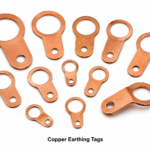
| Earth Tags & Bonding Clips | Flat-blanked grounding tags with mounting holes | 0.5–2.0 mm thick |
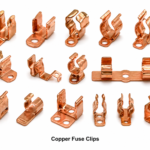
| Fuse Clips | Spring-formed cartridge fuse clips | For 3AG, 5×20 mm, 6×32 mm fuses |
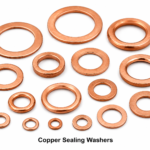
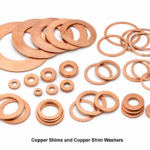
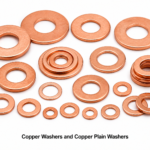
| Blanks & Washers | Circular or profiled flat blanks for further processing | Dia 5–150 mm, 0.3–3 mm thick |
| Terminal Plates | Bus links and terminal plates for LV switchgear | 1–3 mm thick, custom hole pattern |
| Drawn Cable Connector Shells | Deep-drawn shells for cable connectors | Dia 8–50 mm |
Key Features
- Best deep-drawability of any standard brass alloy – LDR up to 5.5 with intermediate annealing
- Alpha-phase (FCC) microstructure: no dezincification, excellent cold-formability
- Electrical conductivity 26–28% IACS – suitable for current-carrying terminals and contacts
- Available in annealed, quarter-hard, half-hard, hard, and spring temper per ASTM B36
- RoHS compliant: lead content ≤0.07% – suitable for all EU RoHS applications
- ISO 9001:2015 certified production; IS 407 Grade 2 and EN 1652 CW505L certified strip
- Full batch traceability from coil heat number to finished stamped component
- Secondary operations: deburring, tin/nickel/silver plating, tapping, annealing, sub-assembly
Manufacturing Process
Coil Receipt and Inspection: C26000 brass strip coil received with EN 10204 2.2 MTR or 3.1 mill certificate. Width, thickness, temper (hardness), surface condition, and coil ID verified against specification and purchase order. OES chemical spot check on first coil of each heat number.
Tooling Setup: Progressive die or compound die mounted in power press. Roll feeder set to correct strip pitch. Press speed, tonnage, and lubrication set to recommended parameters for C26000 at the specified strip thickness and drawing depth.
First Article Inspection (FAI): First 10–20 pieces inspected against drawing for all critical dimensions, hole positions, formed geometries, and edge condition. FAI report issued before production release. Deep-drawn parts: wall thickness, OD/ID, height, and flange flatness checked.
Production Run: Continuous automatic production with roll feed. Die stations inspected at intervals (10,000–50,000 strokes) for punch and die wear on critical features. Lubricant application monitored for consistent draw quality.
In-Process QC: Dimensional check every 2,000–5,000 parts. Spring contact and connector parts 100% gauged for contact geometry. Deep-drawn parts checked for wall thinning and height consistency every 1,000 pieces.
Deburring: Vibratory tumble deburring or barrel polishing. Burr height verified by optical microscope at AQL 2.5.
Secondary Operations: Tapping, thread rolling, nickel/tin/silver plating, annealing, sub-assembly as specified.
Final Inspection and Packing: AQL sampling per ISO 2859. Dimensional report on critical features. Anti-tarnish paper and moisture-barrier bags for sea freight export.
Quality Standards and Certifications
| Standard / Certification | Applicability |
|---|---|
| ISO 9001:2015 | Quality Management System |
| ASTM B36 | C26000 brass strip specification |
| IS 407 Grade 2 | Indian standard brass strip (70/30) |
| EN 1652 CW505L | European standard brass plate, sheet, strip |
| ISO 2768 | General tolerances for sheet metal stampings |
| RoHS 2011/65/EU | Compliant – Pb ≤0.07% (below 0.1% limit) |
| EN 10204 2.2 | Material test report with every coil batch |
| ISO 2859-1 | AQL inspection sampling plan |
Pricing
C26000 Cartridge Brass Stampings: US$ 15.90 per kilogram (indicative, subject to order quantity, part complexity, temper, surface finish, and secondary operations). MOQ: 50 kg per part number. Contact us with drawings or specifications for a firm quotation within 24 hours.
Frequently Asked Questions
1. Why is C26000 called “Cartridge Brass”?
The name originates from its original primary application: the manufacture of ammunition cartridge cases (bullet casings). The alloy’s exceptional deep-drawability was ideal for forming thin-walled, high-precision cartridge cases. Today it is used broadly in electrical, electronics, and hardware stampings.
2. What is the difference between C26000 and C26800?
C26000 (70% Cu, 30% Zn) has slightly higher copper content than C26800 (66–68.5% Cu, 31.5–34% Zn). C26000 offers better deep-drawability, higher elongation (65% vs 55% annealed), and superior corrosion resistance. C26800 is slightly lower in cost and adequate for most stamping applications not requiring extreme draw severity.
3. What temper of C26000 strip is used for spring contacts?
For spring contacts and connector contacts, hard or spring temper C26000 (H04 or H06 per ASTM B36) is specified. These tempers provide tensile strengths of 450–560 MPa with adequate elongation for forming. Annealed temper (O60) is used for deep drawing operations.
4. Is C26000 RoHS compliant?
Yes. C26000 contains a maximum of 0.07% lead, which is well below the RoHS 2 threshold of 0.1% for homogeneous materials. No exemptions are required.
5. What is the minimum strip thickness you can stamp in C26000?
We regularly stamp C26000 strip from 0.2 mm thickness for precision micro-contacts and thin spring elements, up to 3.0 mm for heavier terminal plates and earth tags.
Related Products and Linked Terms
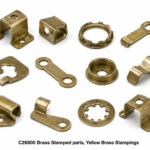
- C26800 Brass Stamped Parts – Yellow Brass Stampings
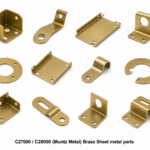
- C27000 / C28000 (Muntz Metal) Brass Sheet Metal Parts
- Brass Stampings – Brass Stamped Parts and Components
- Electrical Pressed Switch Parts in Brass
- Brass CNC Machined Parts
Request a Quote
Electrical Accessories India manufactures C26000 Cartridge Brass stampings – deep-drawn shells, progressive die contacts, earth tags, fuse clips, and custom stamped components – for global OEM, EPC, and distribution customers. Indicative pricing: US$ 15.90/kilogram. Contact us with drawings or specifications for a formal quotation within 24 hours.
Email: info@elecaccs.com | Website: www.elecaccs.com