

Product
Product Details
Brass Conduit Thread Reducers Bushes
Brass Conduit Thread Reducers Bushes
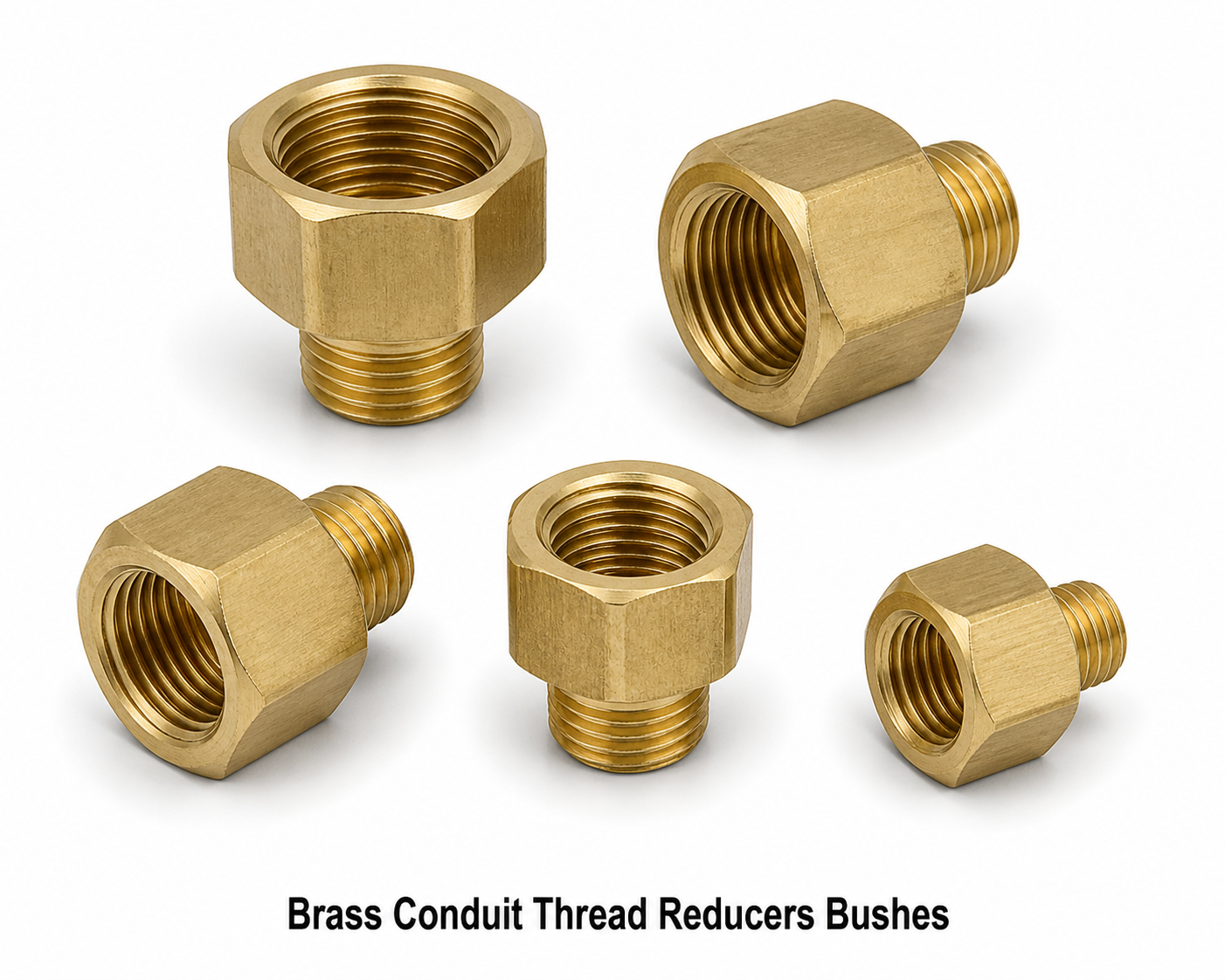
Brass Conduit Thread Reducer Bushes are precision-machined fittings used to reduce or adapt conduit entry threads from one size to another within electrical enclosures, junction boxes, distribution boards, cable trays, motor control centres (MCC), switchgear panels, and industrial machinery. Manufactured from free-machining brass (IS 319, CuZn39Pb3, CW614N), these thread reducing bushes are available in Metric to Metric and NPT to Metric configurations, supporting M16, M20, M32, M40, M50, M63, and M75 entries (all 1.5 mm pitch). Electrical Accessories India supplies these bushes to electrical OEMs, EPC contractors, power utilities, panel builders, and cable management distributors across India, the Middle East, Southeast Asia, Europe, and Africa.
Indicative Pricing
Brass Items: US$ 11.50 per kilogram, CIF US Port / Major Indian Port. Price varies by size, specification, alloy grade, and order quantity. Contact us with your RFQ for a firm quotation.
Product Overview
What Are Brass Conduit Thread Reducer Bushes?
A conduit thread reducer bush (also called a reducing bush, conduit reducer fitting, thread step-down adaptor, or cable entry reducer) is a hollow externally-threaded insert with an internal thread of a smaller size. It threads into the knockout or entry hole of an electrical enclosure and accepts a conduit, cable gland, or PG gland of a smaller thread size. The bush bridges the dimensional mismatch between the punched entry in the enclosure and the conduit fitting being installed. Available in metric ISO 965-1 threads (M16×1.5 through M75×1.5) and in hybrid NPT × Metric configurations, they eliminate the need for separate reducing plates or custom enclosure modifications.
Metric to Metric Thread Reducer Bushes
Metric-to-metric reducing bushes feature identical thread forms on both external and internal threads—ISO metric fine thread at 1.5 mm pitch. Common size combinations include M20 female × M16 male, M25 female × M20 male, M32 female × M25 male, M40 female × M32 male, M50 female × M40 male, M63 female × M50 male, and M75 female × M63 male. The body is turned from brass bar or rod, with a serrated or knurled flange to prevent loosening under vibration. Thread tolerances conform to ISO 965-1 (6H/6g), ensuring interchangeability with European DIN and British BS standards. These components are widely used in conduit system assemblies involving armoured cable glands, flexible conduit connectors, swivel connectors, locknut sets, and conduit couplers.
NPT × Metric Reducer Bushes (Metric × NPT)
NPT × Metric reducer bushes adapt American National Pipe Thread Tapered (NPT per ANSI/ASME B1.20.1) entries to accept metric cable glands, conduit locknuts, or conduit fittings, or vice versa. This configuration is critical in plants using NEMA-rated enclosures with NPT knockouts that need to accept metric conduit systems—common in petrochemical plants, offshore platforms, refineries, and LNG facilities that mix American and European electrical standards. Standard NPT sizes handled include ½” NPT, ¾” NPT, 1″ NPT, 1¼” NPT, 1½” NPT, and 2″ NPT, cross-referenced to their metric equivalents M16, M20, M25/M32, M40, M50, and M63 respectively.
Materials and Alloy Grades
The standard material is free-cutting brass conforming to IS 319 Type I (Indian standard), equivalent to CuZn39Pb3 / CW614N (European EN 12164), BS 2874 CZ121, and ASTM B16 (UNS C36000). For aggressive environments (marine, coastal, chemical plants), dezincification-resistant (DZR) brass conforming to CW602N / CuZn35Pb2Al / BS 2874 CZ132 is available. For higher corrosion resistance or food-grade applications, stainless steel SS 316 and brass with electroless nickel plating are offered. The combination of high machinability, electrical conductivity, corrosion resistance, and thread accuracy makes brass the material of choice for conduit fittings globally.
Flange and Body Design
The reducer bush is designed with a large hexagonal or round flanged head that seats flush against the inside face of the enclosure wall, providing a secure mechanical stop and vibration-resistant retention. The external male thread inserts through the knockout, while the internal female thread accepts the conduit or fitting from the outside. Sealing is achieved via a neoprene or EPDM compression washer (optional) or a brass locknut threaded onto the male body from outside. The flange is available in standard, reduced-profile (low-profile), and extended-collar versions to suit different enclosure wall thicknesses from 1.5 mm to 6 mm.
Thread Standards and Compatibility
All metric threads are cut to ISO 965-1, pitch 1.5 mm, tolerance class 6H (internal) and 6g (external). NPT threads comply with ANSI/ASME B1.20.1 taper pipe thread standard. PG (Panzer-Gewinde) thread variants conforming to DIN 40430 are also manufactured for legacy European switchgear. The bushes are fully interchangeable with cable glands conforming to BS EN 50262, IEC 62444, and IS 12943. They work with armoured (SWA/AWA) and unarmoured cable gland types, flexible conduit fittings, conduit couplings, and EMC cable glands used in data centres, rail traction, and defence electronics.
Corrosion Resistance and Surface Finish
Natural brass provides inherent corrosion resistance adequate for IP65 and IP66 enclosures in standard industrial environments. For aggressive or marine environments, electroless nickel plating (ENP) or hot-dip tin plating adds a protective barrier. DZR brass variants withstand chloride ion attack common in coastal and offshore installations. The hexagonal flange can be provided in bright machined, satin, or black oxide finish. All surfaces are deburred and thread-gauged before despatch. UV resistance and salt-fog testing per IEC 60068-2-52 are available on request for export orders.
Electrical Continuity and EMC Performance
When used with metal conduit systems and metal enclosures, brass reducer bushes maintain electrical continuity of the conduit earthing path, contributing to the equipotential bonding required by IEC 60364-5-54 and NEC Article 250. For EMC-sensitive installations (control panels for variable frequency drives, servo systems, medical equipment, and defence electronics), the brass bush combined with an EMC cable gland and metal conduit provides a continuous metallic shield termination. The low contact resistance of the brass-to-brass threaded joint ensures high-frequency shielding effectiveness above 100 MHz.
Key Features
- Metric to Metric (M16–M75, 1.5 mm pitch) and NPT × Metric configurations
- Material: Free-cutting brass IS 319 / CuZn39Pb3 / CW614N; DZR brass CW602N available
- Thread tolerance: ISO 965-1 (6H/6g) for metric; ANSI B1.20.1 for NPT
- Hexagonal flanged head for tool-tightening and anti-rotation
- Compatible with IP65/IP66/IP67 and IECEx/ATEX cable gland assemblies
- Interchangeable with DIN, BS, and IEC conduit fitting standards
- Available with neoprene/EPDM sealing washers
- Surface options: Natural brass, ENP nickel plating, tin plating, black oxide
- RoHS and REACH compliant raw materials
- Custom sizes and thread combinations on request
Hexagonal Flanged Design for Tool-Based Installation
The hexagonal profile on the reducer bush flange allows use of a standard open-end spanner, adjustable wrench, or socket set for installation. This is critical in panel-shop and field applications where consistent torque application prevents thread stripping and ensures gas-tight or IP-rated sealing. The flange diameter is engineered to overlap the knockout edge adequately, preventing pull-through under cable pull tension. Flat-to-flat (A/F) dimensions follow standard spanner sizing for ease of stock tool use.
Anti-Vibration Retention
Serrations or knurling on the underside of the flange bite into the powder-coated or bare metal surface of the enclosure wall, resisting loosening caused by vibration in pump skids, compressor houses, conveyor systems, generator sets, and marine engine rooms. Combined with a brass locknut threaded from outside, the assembly achieves a clamping force that holds the reducer securely throughout the service life of the installation.
Wide Compatibility with Enclosure Types
Brass reducer bushes are compatible with mild steel (GI), stainless steel (SS 304/316), aluminium die-cast, GRP (glass fibre reinforced polyester), and polycarbonate enclosures. They accommodate enclosure wall thicknesses from 1.5 mm (light-gauge sheet metal panels) to 6 mm (heavy-duty cast aluminium Ex-d enclosures). Extended-body versions are available for thicker walls or when mounting through gland plates, sub-plates, or enclosure flanges.
ATEX and IECEx Ready Variants
For hazardous area zone 1, zone 2, zone 21, and zone 22 installations (ATEX Directive 2014/34/EU and IECEx Scheme), reducer bushes are supplied in DZR or nickel-plated brass with certified dimensional tolerances to support Ex-e (increased safety) and Ex-d (flameproof) cable gland assemblies. The dimensional accuracy of the internal thread is critical for maintaining the ingress protection and flameproof integrity of the cable entry system. Batch certificates and material test reports (MTR) are provided on request.
RoHS and Environmental Compliance
All brass alloys used conform to RoHS Directive 2011/65/EU restricting hazardous substances including lead content within permissible limits for copper alloys. REACH SVHC compliance declarations are available. Conflict minerals declarations (IPC-1755, Dodd-Frank Section 1502) can be provided for customers supplying defence, aerospace, or US federal government procurement chains.
Custom Thread Combinations and OEM Supply
Electrical Accessories India manufactures non-standard thread reducer combinations including M16×1.5 female × M12×1.5 male, M20×1.5 female × M12×1.5 male, ¾” NPT female × M20×1.5 male, and other combinations for OEM panel builders and custom enclosure manufacturers. Minimum order quantities for custom sizes, part marking (laser or dot-peen engraving), and custom packaging (poly bags, blister packs, bulk cartons) can be arranged.
Technical Specifications
| Parameter | Specification |
|---|---|
| Material (Standard) | Free-Cutting Brass IS 319 / CuZn39Pb3 / CW614N |
| Material (DZR Option) | DZR Brass CuZn35Pb2Al / CW602N / BS 2874 CZ132 |
| Thread Standard (Metric) | ISO 965-1, Pitch 1.5 mm, Tolerance 6H/6g |
| Thread Standard (NPT) | ANSI/ASME B1.20.1 Tapered Pipe Thread |
| Metric Sizes (Female/External) | M16, M20, M32, M40, M50, M63, M75 |
| Pitch | 1.5 mm (all metric sizes) |
| NPT Sizes | ½”, ¾”, 1″, 1¼”, 1½”, 2″ NPT |
| Surface Finish (Standard) | Natural bright machined brass |
| Surface Finish (Options) | Electroless Nickel Plating (ENP), Tin Plating, Black Oxide |
| Sealing | Neoprene / EPDM compression washer (optional) |
| IP Rating (with locknut + washer) | Up to IP66 / IP67 |
| Temperature Range | -40°C to +120°C |
| Hardness (Brass) | 80–120 HV |
| Tensile Strength | 380–420 MPa |
| RoHS Compliance | Yes |
| Country of Origin | Jamnagar, Gujarat, India |
International Alloy Equivalent Table
| Standard | Designation | Description |
|---|---|---|
| Indian IS 319 | IS 319 Type I | Free-cutting brass bar |
| European EN 12164 | CuZn39Pb3 / CW614N | Free-machining brass rod |
| British BS 2874 | CZ121 | Leaded brass rod |
| American ASTM B16 | UNS C36000 | Free-cutting brass |
| German DIN 17660 | CuZn39Pb3 | Brass machining rod |
| Japanese JIS H3250 | C3604 | Free-cutting brass rod |
| DZR Option (EN) | CuZn35Pb2Al / CW602N | DZR brass rod |
Size Range and NPT/Metric Cross-Reference
| NPT Size | Nominal Bore (mm) | Metric Equivalent | Thread OD (mm) |
|---|---|---|---|
| ½” NPT | 15 | M16×1.5 | 16.0 |
| ¾” NPT | 20 | M20×1.5 | 20.0 |
| 1″ NPT | 25 | M25×1.5 / M32×1.5 | 25.0 / 32.0 |
| 1¼” NPT | 32 | M40×1.5 | 40.0 |
| 1½” NPT | 40 | M50×1.5 | 50.0 |
| 2″ NPT | 50 | M63×1.5 | 63.0 |
Product Types and Variants
- Type A – Standard Hex Flange Reducer Bush: Male external metric thread, female internal metric thread (smaller size), hexagonal flange. Used in standard industrial enclosures.
- Type B – Metric × NPT Adapter Bush: Male NPT external, female metric internal (or vice versa). Used for cross-standard panel wiring.
- Type C – DZR Brass Reducer Bush: Dezincification-resistant brass for marine, chemical, and outdoor installations.
- Type D – Nickel-Plated Reducer Bush: Electroless nickel-plated for corrosive atmospheres, offshore platforms, and coastal installations.
- Type E – Low-Profile (Thin Flange) Bush: Reduced flange height for installation in limited-space panel interiors.
- Type F – Extended Body Bush: Long body for thick enclosure walls (4–6 mm) or through gland-plate installation.
Applications in Industry
- Power Distribution: LV/MV switchgear, MCCs, distribution boards, transformer terminal boxes, busduct enclosures
- Oil & Gas / Petrochemical: Ex-d and Ex-e junction boxes, field instrumentation panels, hazardous area zone 1 and zone 2 cable entries
- Infrastructure / EPC: Metro rail traction systems, tunnel lighting panels, airport electrical rooms, road lighting feeder pillars
- Marine and Offshore: Ship deck junction boxes, HVAC panels, engine room wiring systems, offshore platform control panels
- Renewable Energy: Solar string inverter enclosures, wind turbine nacelle panels, EV charging station assemblies
- Data Centre and Telecom: Cable management troughs, UPS panels, BMS control panels, server room cabling
- Automotive Manufacturing: Robot controller enclosures, welding machine panels, press control panels
- Defence and Railways: Railcar wiring, defence vehicle panels, radar shelter wiring, naval switchboards
Manufacturing Process
Brass conduit thread reducer bushes are manufactured by CNC multi-spindle automatic turning (Swiss-type or Davenport-type) from precision brass bar stock conforming to IS 319 / CW614N. The process sequence is: (1) bar loading and stock feeding, (2) external profile turning and knurling of the flange, (3) drilling and boring of the internal through-hole, (4) external thread cutting (metric or NPT) by die-head or single-point threading, (5) internal thread cutting by tapping or thread milling, (6) parting and deburring, (7) ultrasonic cleaning and passivation, (8) thread gauging (Go/No-Go gauges) per ISO 965-1 and ANSI B1.20.1, (9) dimensional inspection, (10) surface treatment (if specified), (11) lot tagging and packaging. Production capacities exceed 50,000 pieces per day on standard sizes. Custom thread profiles can be produced using CNC thread whirling or thread grinding for precision applications.
Quality Standards and Certifications
- ISO 9001:2015 Quality Management System
- Thread inspection: ISO 965-1 Go/No-Go gauges (metric); ANSI B1.20.1 (NPT)
- Dimensional inspection per drawing with CMM and optical comparator
- Material compliance: RoHS 2011/65/EU; REACH SVHC declarations available
- Salt-spray testing per IEC 60068-2-52 / ASTM B117 (on request)
- Cable gland compatibility: IEC 62444 / BS EN 50262 / IS 12943
- ATEX/IECEx component certification available for hazardous area grades
- Factory approvals from Lloyd’s Register, DNV GL, and BV for marine supply
Why Choose Electrical Accessories India
- Jamnagar Manufacturing Base: Jamnagar, Gujarat is the world’s largest brass parts manufacturing hub. Deep supplier integration ensures consistent raw material quality and competitive pricing.
- Full-Range Conduit Fitting Supply: Reducer bushes, locknuts, cable glands, flexible conduit connectors, swivel connectors, and conduit adaptors—all from one source.
- Custom Thread Capability: Non-standard metric, NPT, PG, Pg, BSP, and UNF thread combinations available.
- Export Experience: Regular export to Middle East, Europe, Southeast Asia, Africa, and South America with the required documentation (COO, MSDS, MTR, test certificates).
- Competitive MOQ: Sample quantities available. Bulk orders at competitive per-kg pricing.
- Rapid Lead Times: Standard sizes ex-stock; custom sizes in 2–4 weeks.
Frequently Asked Questions (FAQ)
Q1: What is a brass conduit thread reducer bush used for?
A brass conduit thread reducer bush is used to fill a larger threaded knockout in an electrical enclosure and provide a smaller internal thread to accept a conduit or cable gland of a smaller size. It avoids the need for costly enclosure modifications or blanking plates.
Q2: What is the difference between Metric × Metric and NPT × Metric reducer bushes?
Metric × Metric bushes have ISO metric threads (1.5 mm pitch) on both external and internal sides but in different sizes. NPT × Metric bushes have a tapered NPT thread (ANSI B1.20.1) on one end and a metric thread on the other, used to interconnect American and European conduit systems.
Q3: What sizes are available in metric for conduit reducer bushes?
Standard metric sizes are M16, M20, M32, M40, M50, M63, and M75, all with 1.5 mm pitch per ISO 965-1. Custom intermediate sizes such as M25 and M50 are also available.
Q4: What material is used for conduit reducer bushes and what is the price?
Standard material is free-cutting brass IS 319 / CuZn39Pb3 / CW614N. Price: US$ 11.50 per kilogram, CIF US Port. DZR brass, nickel-plated, and stainless steel versions are available at different pricing.
Q5: Are these bushes compatible with ATEX cable glands?
Yes. Reducer bushes can be supplied with the dimensional tolerances and material certifications required for ATEX (Directive 2014/34/EU) and IECEx certified cable gland assemblies for zone 1 and zone 2 hazardous areas.
Q6: What is the IP rating of a conduit reducer bush assembly?
When used with a sealing washer and locknut, the assembly achieves up to IP66 or IP67 per IEC 60529. The enclosure IP rating is maintained subject to correct installation torque and cable gland sealing.
Q7: Can I get NPT to Metric reducer bushes for oil and gas applications?
Yes. NPT × Metric configurations (e.g., ¾” NPT × M20, 1″ NPT × M32) are available in standard and DZR brass for petrochemical and offshore applications.
Q8: What is the delivery lead time for standard and custom sizes?
Standard sizes (M16–M75 metric to metric) are available ex-stock or within 1–2 weeks. Custom thread combinations (NPT × Metric, PG × Metric) typically require 2–4 weeks from confirmed order.
Q9: Do you supply test certificates and material reports?
Yes. Material Test Reports (MTR), RoHS declarations, REACH SVHC compliance letters, and dimensional inspection certificates are issued with each lot. Third-party inspection by SGS, Bureau Veritas, or Intertek can be arranged.
Q10: What is the minimum order quantity (MOQ)?
Sample quantities of 50–100 pieces are available for trial orders. Commercial MOQ is typically 500–1000 pieces per size for standard items; custom items require a minimum of 500 pieces per variant.
Equivalent Terms in European Languages
| Language | Equivalent Terms |
|---|---|
| Spanish | Buje reductor de rosca para conduit; Reductor de entrada roscada; Casquillo reductor de conducto; Adaptador de rosca métrica a NPT |
| Russian | Переходная муфта для кабельных вводов; Редукционная втулка для кондуита; Переходник метрической резьбы; Втулка-переходник NPT–метрическая |
| French | Réducteur de filetage pour conduit; Bague réductrice de presse-étoupe; Adaptateur métrique à NPT; Réducteur de presse-câble laiton |
| Portuguese | Bucha redutora de rosca para eletroduto; Redutor de entrada de cabo; Adaptador métrico para NPT; Luva redutora de conduíte latão |
| Italian | Boccola riduttrice filettata per conduit; Riduttore di filettatura per pressacavi; Adattatore metrico NPT; Boccola riduttrice in ottone |
Related / Linked Parts and Terms
- Brass Conduit Bushes (Standard Entry)
- Conduit Fittings – Full Range
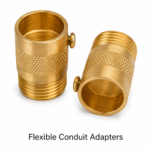
- Flexible Conduit Adapters
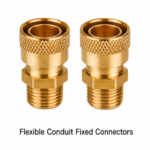
- Flexible Conduit Fixed Connectors
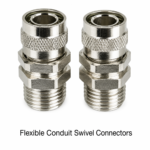
- Flexible Conduit Swivel Connectors
- Brass Conduit Locknuts (Metric and NPT)
- Brass Thread Adapters and Enlargers
- Cable Glands (A2, E1W, BW, CW, W type)
- PG Thread Reducer Bushes (PG11 to PG21)
- Conduit Couplers and Adaptors
- Metal Cable Trunking and Conduit Systems
- Electrical Enclosure Gland Plates
Comprehensive Thread Comparison Chart for Conduit Fittings
The following reference chart compares all major thread standards used in conduit fittings, cable glands, and electrical enclosure entries supplied by Electrical Accessories India. Use this chart to identify equivalent sizes across Metric (ISO 965-1), NPT (ANSI/ASME B1.20.1), PG (DIN 40430), and BSP (BS 2779 / ISO 228) thread systems—critical for cross-standard adapter selection in international projects.
Chart 1 – Metric ISO Conduit Threads (ISO 965-1, 1.5 mm Pitch)
| Thread Designation | Nominal OD (mm) | Pitch (mm) | Thread Form | Tolerance Class | Max Cable OD (approx.) | Typical Cable Gland Size | Conduit OD (mm) | Typical Application |
|---|---|---|---|---|---|---|---|---|
| M16×1.5 | 16.0 | 1.5 | ISO Metric Fine | 6H/6g | 7–10 mm | M16 cable gland | 16 | Small control cables, sensor wiring |
| M20×1.5 | 20.0 | 1.5 | ISO Metric Fine | 6H/6g | 10–14 mm | M20 cable gland | 20 | Control cables, instrument cables |
| M25×1.5 | 25.0 | 1.5 | ISO Metric Fine | 6H/6g | 14–18 mm | M25 cable gland | 25 | Power and control cables |
| M32×1.5 | 32.0 | 1.5 | ISO Metric Fine | 6H/6g | 18–25 mm | M32 cable gland | 32 | Medium power cables, armoured SWA |
| M40×1.5 | 40.0 | 1.5 | ISO Metric Fine | 6H/6g | 25–32 mm | M40 cable gland | 40 | Armoured cables, motor feeders |
| M50×1.5 | 50.0 | 1.5 | ISO Metric Fine | 6H/6g | 32–42 mm | M50 cable gland | 50 | Large power cables, VFD output cables |
| M63×1.5 | 63.0 | 1.5 | ISO Metric Fine | 6H/6g | 42–55 mm | M63 cable gland | 63 | HV/LV feeder cables, busbars |
| M75×1.5 | 75.0 | 1.5 | ISO Metric Fine | 6H/6g | 55–67 mm | M75 cable gland | 75 | Extra-large power cables, transformer entries |
Chart 2 – NPT Thread Sizes (ANSI/ASME B1.20.1) for Conduit Fittings
| NPT Size | Thread OD at Entry (mm) | Threads per Inch (TPI) | Thread Pitch (mm) | Taper | Nearest Metric Equivalent | Nominal Pipe Size (inches) | Typical Conduit Use |
|---|---|---|---|---|---|---|---|
| ½” NPT | 21.3 | 14 | 1.814 | 1:16 (3/4″ per ft) | M16 / M20 | ½” | Small junction box entries, instrument panels |
| ¾” NPT | 26.7 | 14 | 1.814 | 1:16 | M20 / M25 | ¾” | Control panels, NEMA 4X enclosures |
| 1″ NPT | 33.4 | 11.5 | 2.209 | 1:16 | M32 / M40 | 1″ | Motor terminal boxes, MCC panels |
| 1¼” NPT | 42.2 | 11.5 | 2.209 | 1:16 | M40 / M50 | 1¼” | Power cables, armoured cable glands |
| 1½” NPT | 48.3 | 11.5 | 2.209 | 1:16 | M50 | 1½” | Large feeder cables, oil & gas panels |
| 2″ NPT | 60.3 | 11.5 | 2.209 | 1:16 | M63 | 2″ | Heavy power cables, transformer LV panels |
| 2½” NPT | 73.0 | 8 | 3.175 | 1:16 | M75 | 2½” | Extra-large cables, substation entries |
Chart 3 – NPT × Metric Cross-Reference for Thread Adapters and Reducer Bushes
| NPT Thread (External / Male) | NPT OD at Entry (mm) | Metric Equivalent (Internal / Female) | Metric OD (mm) | Adapter Part Type | Available from EAI | Typical Use Case |
|---|---|---|---|---|---|---|
| ½” NPT | 21.3 | M16×1.5 or M20×1.5 | 16 / 20 | NPT × Metric Bush | ✔ Yes | NEMA enclosure to small metric gland |
| ¾” NPT | 26.7 | M20×1.5 or M25×1.5 | 20 / 25 | NPT × Metric Bush | ✔ Yes | Control panel retrofit, NEMA to IEC |
| 1″ NPT | 33.4 | M32×1.5 or M40×1.5 | 32 / 40 | NPT × Metric Bush | ✔ Yes | Petrochemical Ex-d junction boxes |
| 1¼” NPT | 42.2 | M40×1.5 or M50×1.5 | 40 / 50 | NPT × Metric Bush | ✔ Yes | Oil & gas feeder panels, offshore |
| 1½” NPT | 48.3 | M50×1.5 | 50 | NPT × Metric Bush | ✔ Yes | Power cable entries, LNG plant panels |
| 2″ NPT | 60.3 | M63×1.5 | 63 | NPT × Metric Bush | ✔ Yes | Large cable entries, substation panels |
| M20×1.5 | 20.0 | ½” NPT | 21.3 | Metric × NPT Bush | ✔ Yes | Metric enclosure to American NPT gland |
| M32×1.5 | 32.0 | ¾” NPT | 26.7 | Metric × NPT Bush | ✔ Yes | European panel to US spec gland |
| M40×1.5 | 40.0 | 1″ NPT | 33.4 | Metric × NPT Bush | ✔ Yes | Cross-standard MCC, power panels |
Chart 4 – PG Thread Sizes (DIN 40430) vs Metric Equivalents
PG (Panzer-Gewinde / Armoured Thread) threads per DIN 40430 are a legacy European standard still found in older switchgear and enclosures. The table below cross-references PG sizes to nearest metric equivalents for use when adapter bushes are needed.
| PG Thread Size | PG Thread OD (mm) | PG Pitch (mm) | Nearest Metric (ISO 965-1) | Metric OD (mm) | Max Cable OD for PG | Notes |
|---|---|---|---|---|---|---|
| PG7 | 12.5 | 1.27 | M12×1.5 | 12.0 | 3–6.5 mm | Very small sensor/signal cables |
| PG9 | 15.2 | 1.41 | M16×1.5 | 16.0 | 4–8 mm | Signal and small control cables |
| PG11 | 18.6 | 1.41 | M20×1.5 | 20.0 | 5–10 mm | Most common small entry size |
| PG13.5 | 20.4 | 1.41 | M20×1.5 | 20.0 | 6–12 mm | Control and instrument cables |
| PG16 | 22.5 | 1.41 | M25×1.5 | 25.0 | 10–14 mm | Mid-size control cables |
| PG21 | 28.3 | 1.41 | M25×1.5 / M32×1.5 | 25/32 | 13–18 mm | Standard power cable entry |
| PG29 | 37.0 | 1.41 | M32×1.5 / M40×1.5 | 32/40 | 18–25 mm | Armoured cables, larger entries |
| PG36 | 47.0 | 1.41 | M40×1.5 / M50×1.5 | 40/50 | 22–32 mm | Large power cables |
| PG42 | 54.0 | 1.41 | M50×1.5 | 50.0 | 30–38 mm | Heavy power cables |
| PG48 | 59.3 | 1.41 | M63×1.5 | 63.0 | 34–44 mm | Extra-large cable entries |
Chart 5 – BSP (British Standard Pipe) Threads vs Metric for Conduit Applications
BSP threads (BSPP – parallel, BSPT – taper) per BS 2779 / ISO 228 are used in older British and Commonwealth enclosures and some hydraulic-rated cable entry systems. The chart below cross-references BSP to nearest metric equivalents.
| BSP Size | Thread OD (mm) | TPI | Pitch (mm) | Thread Form | Nearest Metric Equiv. | Nearest NPT Equiv. | Application |
|---|---|---|---|---|---|---|---|
| ⅛” BSP | 9.73 | 28 | 0.907 | 55° Whitworth | M10×1.5 | ⅛” NPT | Very small cable entries |
| ¼” BSP | 13.16 | 19 | 1.337 | 55° Whitworth | M14×1.5 | ¼” NPT | Instrument and signal cables |
| ⅜” BSP | 16.66 | 19 | 1.337 | 55° Whitworth | M16×1.5 | ⅜” NPT | Small control cables |
| ½” BSP | 20.96 | 14 | 1.814 | 55° Whitworth | M20×1.5 | ½” NPT | Control panel entries, British std. |
| ¾” BSP | 26.44 | 14 | 1.814 | 55° Whitworth | M25×1.5 | ¾” NPT | Mid-size cable entries |
| 1″ BSP | 33.25 | 11 | 2.309 | 55° Whitworth | M32×1.5 | 1″ NPT | Power cables, BS std. enclosures |
| 1¼” BSP | 41.91 | 11 | 2.309 | 55° Whitworth | M40×1.5 | 1¼” NPT | Armoured cable entries |
| 1½” BSP | 47.80 | 11 | 2.309 | 55° Whitworth | M50×1.5 | 1½” NPT | Large power cables |
| 2″ BSP | 59.61 | 11 | 2.309 | 55° Whitworth | M63×1.5 | 2″ NPT | Extra-large cable entries |
Chart 6 – Thread Tightening Torque Guide for Brass Conduit Fittings
The following torque values are recommended guidelines for tightening brass conduit locknuts, reducer bushes, and adapters. Over-tightening can strip threads on thin enclosure walls; under-tightening compromises IP rating and vibration resistance. Always use calibrated torque tools for ATEX/IECEx certified assemblies.
| Thread Size | Locknut Tightening Torque (N·m) | Reducer Bush Torque (N·m) | Spanner A/F (mm) | Enclosure Wall (mm) | Notes |
|---|---|---|---|---|---|
| M16×1.5 | 5–8 | 4–6 | 22 | 1.5–3.0 | Hand-tight + ¼ turn spanner |
| M20×1.5 | 8–12 | 6–10 | 27 | 1.5–3.0 | Most common size; verify IP seal |
| M25×1.5 | 12–18 | 10–15 | 32 | 2.0–4.0 | Check washer compression |
| M32×1.5 | 18–25 | 15–20 | 41 | 2.0–4.0 | Use pin spanner for serrated type |
| M40×1.5 | 25–35 | 20–30 | 50 | 2.5–5.0 | Pin spanner recommended |
| M50×1.5 | 35–50 | 30–45 | 60 | 2.5–5.0 | Use locknut wrench, large sizes |
| M63×1.5 | 50–70 | 45–60 | 75 | 3.0–6.0 | Double locknut for Ex-d assemblies |
| M75×1.5 | 65–90 | 55–75 | 90 | 3.0–6.0 | Verify enclosure wall integrity |
| ½” NPT | 8–12 | 6–10 | 27 | 1.5–3.0 | NPT taper; hand-tight + 1–2 turns |
| ¾” NPT | 10–18 | 8–15 | 32 | 2.0–4.0 | Sealant tape optional on taper |
| 1″ NPT | 18–28 | 15–22 | 41 | 2.0–4.0 | PTFE tape on NPT recommended |
| 1½” NPT | 30–45 | 25–38 | 55 | 2.5–5.0 | Check enclosure wall clamping face |
| 2″ NPT | 45–65 | 38–55 | 70 | 3.0–6.0 | Power torque tool for large sizes |
Chart 7 – Thread Standard Summary: Conduit Fittings Global Reference
| Thread Standard | Standard Reference | Thread Angle | Thread Form | Profile | Taper / Parallel | Primary Markets | Common Conduit Use |
|---|---|---|---|---|---|---|---|
| Metric ISO Fine | ISO 965-1 | 60° | V-thread | Metric mm | Parallel | Europe, Asia, India, Middle East, Africa | Cable glands, conduit fittings, locknuts (M16–M75) |
| NPT (National Pipe Taper) | ANSI/ASME B1.20.1 | 60° | V-thread | Inches (TPI) | Taper 1:16 | USA, Canada, Saudi Arabia, some Middle East | NEMA enclosures, American conduit systems (½”–2″) |
| NPS (National Pipe Straight) | ANSI/ASME B1.20.1 | 60° | V-thread | Inches (TPI) | Parallel | USA (less common in conduit) | Straight-thread cable entry connectors |
| PG (Panzer-Gewinde) | DIN 40430 | 80° | Rounded (Rd) | mm nominal | Parallel | Germany, legacy European equipment | Old switchgear, legacy enclosures (PG7–PG48) |
| BSP Parallel (BSPP) | BS 2779 / ISO 228 | 55° | Whitworth | Inches (TPI) | Parallel | UK, Commonwealth, Australia, Middle East | British std. enclosures, BSPP cable glands |
| BSP Taper (BSPT) | BS 21 / ISO 7-1 | 55° | Whitworth | Inches (TPI) | Taper 1:16 | UK, Commonwealth | Hydraulic-rated cable entry, legacy BS panels |
| Metric Coarse (Standard) | ISO 261 / ISO 965 | 60° | V-thread | Metric mm | Parallel | Global (fasteners, not conduit) | Fixing screws, not for cable gland entries |
| UNF (Unified Fine) | ANSI/ASME B1.1 | 60° | V-thread | Inches (TPI) | Parallel | USA, Canada (aerospace, defence) | Defence panel fittings, specialist connectors |
Note: Thread dimensions shown are nominal. Always verify with calibrated Go/No-Go thread gauges before installation. For cross-standard adapter sizing, contact Electrical Accessories India with the enclosure thread standard, knockout size, cable gland thread, and enclosure wall thickness for a precise product recommendation. All brass fittings: US$ 11.50 per kilogram, CIF US Port.
Call to Action
Request a Quote for Brass Conduit Thread Reducer Bushes
Electrical Accessories India – Manufacturer and Exporter, Jamnagar, Gujarat, India.
We supply brass conduit thread reducer bushes in all metric sizes (M16–M75, 1.5 mm pitch) and NPT × Metric configurations to electrical OEMs, EPC contractors, panel builders, and distributors worldwide.
Contact us with your thread size combination, quantity, and destination port for a competitive CIF quotation.
Email: info@elecaccs.com | Website: www.elecaccs.com