


Product
Product Details
Brass Forging Parts
Brass Forging Parts
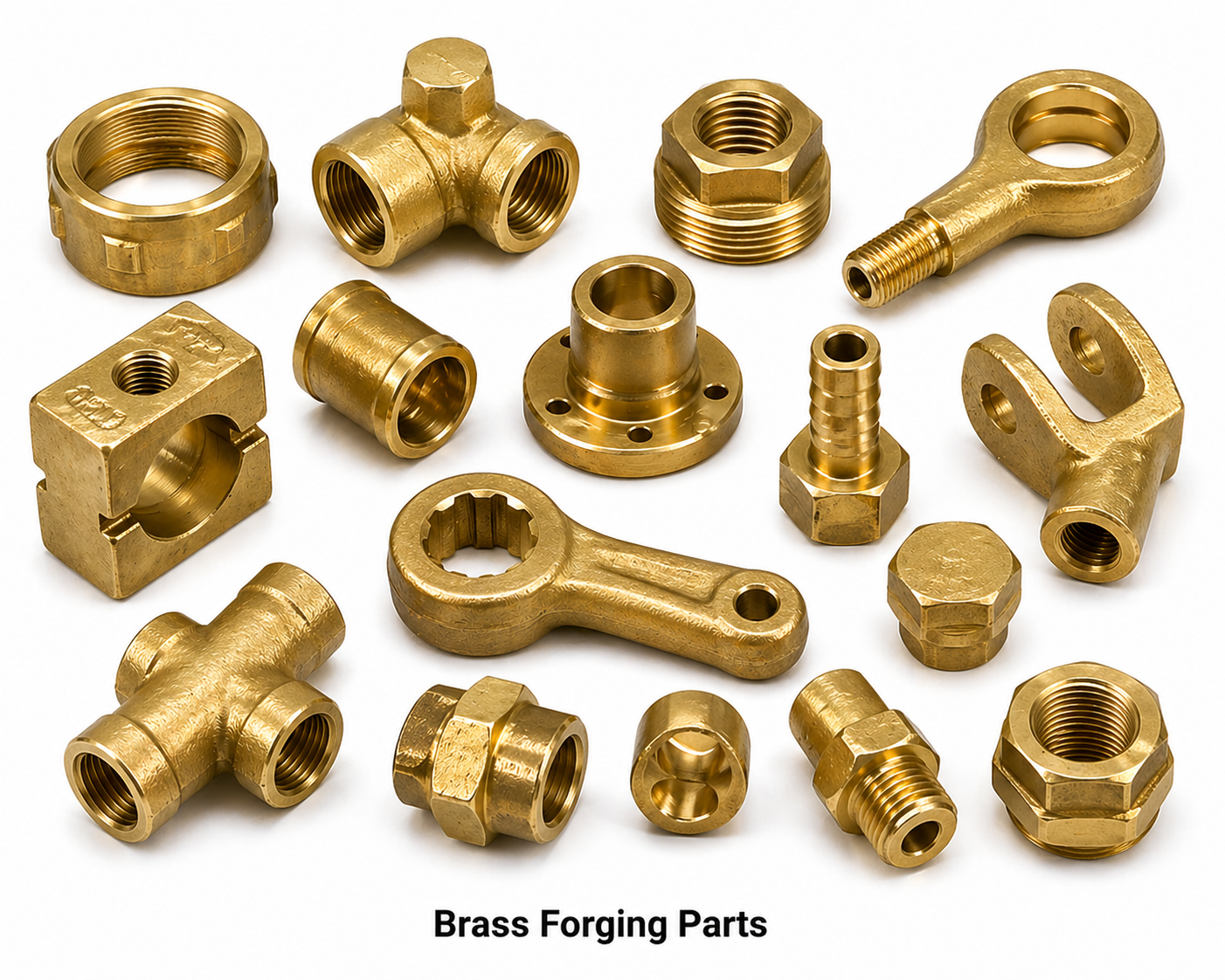
Brass forging parts — also called brass forged components, brass die forgings, brass drop forgings, or brass pressed parts — are near-net-shape metal components produced by hot-pressing heated brass billets into closed steel dies to form complex three-dimensional geometries with superior mechanical properties. Distinct from the “hot stamped parts” description used for flat or simple geometry forgings, brass forged components typically refer to the full range of closed-die and open-die brass forgings used in valve manufacturing, gas fittings, plumbing, pneumatic fittings, electrical enclosures, and structural hardware. Electrical Accessories India (Jamnagar, Gujarat) manufactures brass forging parts from CW617N (CuZn40Pb2, IS 319 Grade 2, ASTM B124 C37700) with full CNC finish machining, covering forging weights from 50 g to 5 kg and exporting to 30+ countries.
Product Overview
Closed-Die and Open-Die Brass Forgings
Brass forgings are produced by two primary die forging methods. Closed-die (impression die) forging is the standard for precision brass components: a pre-heated CW617N billet is pressed between two matched die halves (male and female impression dies), forcing metal to fill the die cavity completely. Excess metal forms a thin flash at the die parting line, which is trimmed in a separate operation. Closed-die forgings achieve tight dimensional consistency (part-to-part variation ±0.5 mm on forged surfaces) and are used for all commercial brass fittings, valve bodies, and connector bodies. Open-die forging (free forging) is used for producing simple flat or round blanks where die costs are not justified. Related terms: closed die brass forging, impression die brass, brass drop forging, brass die cavity, brass parting line, flash trimming brass forging.
Brass Forging for Valve Bodies and Plumbing Fittings
The largest application of brass forged components is the production of valve bodies and plumbing fitting bodies. Ball valves, gate valves, globe valves, butterfly valve bodies, compression tee fittings, elbow fittings, and cross fittings are all produced as forged blanks in CW617N brass, then CNC-machined to final dimensions. Forged valve bodies have lower porosity than cast brass valve bodies (no casting defects), higher pressure ratings, and superior pressure/temperature performance for gas and water service. Standard pressure class: PN10, PN16, PN25 (EN 1092 / IS 1538). Standard sizes: DN8 (1/4″) to DN100 (4″) BSP or NPT. All valve body forgings are hydrostatically tested at 1.5× rated pressure before shipment. Related terms: forged brass ball valve body, brass gate valve forging, brass compression tee forged, CW617N valve body, C37700 brass valve.
Brass Forgings for Gas Fittings and Meters
Brass forgings are the preferred material for natural gas and LPG fitting bodies, meter components, and regulator bodies due to their leak-tight structure (no porosity), pressure resistance, and compliance with gas safety standards. Gas fitting forgings are manufactured from CW617N brass to BS EN 331 (manually operated gas valves), BS EN 1254-2 (compression fittings for copper pipe), and IS 8737 (brass fittings for gas appliances). For corrosion-resistant gas fittings in aggressive environments, DZR brass (CW602N) forgings are specified. Gas valve body forgings require 100% pressure testing per EN ISO 15848 or EN 1513 standards. Related terms: brass gas valve forging, LPG fitting forging, gas meter component brass forged, EN 331 brass forging, IS 8737 forged brass fitting.
Brass Forgings for Electrical Applications
Electrical industry applications of brass forgings include: cable gland bodies (for large-bore glands where machining from bar would be wasteful), conduit fitting bodies, switch gear enclosure components, junction box bodies, connector housings, and neutral link bodies. Large brass cable gland bodies (M63 and above) and flanged electrical conduit fittings are economically produced as forgings. Forged brass cable gland bodies have superior strength to cast alternatives and eliminate the porosity risk that can cause IP rating failures in cast components. Brass electrical forgings may be finished by CNC turning and milling, with threads cut to IP65/IP66 sealing standards per IEC 60529. Related terms: forged brass cable gland body, brass conduit forging, brass switchgear forging, forged brass junction box.
Surface Finishing of Brass Forgings
Brass forged components are supplied with a range of surface finishes after CNC finish machining: natural bright brass (standard for plumbing and gas fittings), polished (decorative plumbing), nickel-plated (hardware and exposed fittings), chrome-plated (decorative plumbing fixtures), tin-plated (electrical applications), and lacquered (anti-tarnish for display items). For potable water applications in the UK and EU, WRAS approval requires either DZR brass forgings or standard brass forgings with WRAS-approved nickel or chrome plating. For the German market, DVGW approval (Worksheet W543) applies to water fitting forgings. Related terms: nickel-plated brass forging, WRAS approved brass forging, DVGW Messing Schmiedestück, chrome brass forging, tin-plated brass electrical forging.
Quality Control: Pressure Testing, NDT, and Dimensional Inspection
Brass forging quality control for pressure-rated components includes: dimensional inspection per drawing (CMM or attribute gauging); pressure (hydrostatic) testing at 1.5× rated PN class pressure; visual inspection for surface defects (cracks, cold shuts, unfilled impressions); and material verification (XRF, EN 10204 3.1 MTC). For valve bodies, 100% hydrostatic shell test and seat test per EN 12266-1 or API 598. For gas fitting forgings, pressure test per BS EN 331 or IS 8737. For electrical forgings, IP (ingress protection) test per IEC 60529 on completed assemblies. SPC monitoring of critical forging dimensions (wall thickness, port diameter, flange face flatness) at each die change. Related terms: hydrostatic test brass forging, EN 12266 valve test, 100% pressure test brass, NDT brass forging, XRF brass forging verification.
Key Features
- Brass forged parts and components from CW617N (CuZn40Pb2 / IS 319 Gr.2 / C37700)
- Near-net-shape closed-die forgings: superior grain structure vs cast or machined-from-bar
- Forging weight range: 50 g to 5 kg; standard and custom die geometries
- 100% hydrostatic pressure testing for valve and gas fitting forgings
- CNC finish machining to drawing: ±0.01–0.05 mm on all functional surfaces
- Standards: CW617N / ASTM B124 / IS 319 Gr.2; EN 1092, PN10/16/25
- Certifications: WRAS / DVGW / NSF on request for potable water applications
- Surface finishing: nickel, chrome, tin, lacquer, natural brass
- EN 10204 3.1 MTCs; ISO 9001:2015; export to 30+ countries
Material Grades and International Equivalents
| Material | India (IS) | USA (ASTM/UNS) | UK/EU (BS EN) | DIN | Forging Temp (°C) | UTS (MPa) |
|---|---|---|---|---|---|---|
| Hot-Forging Brass | IS 319 Gr.2 | C37700 (ASTM B124) | CW617N (BS EN 12167) | CuZn40Pb2 (DIN 17660) | 650–750 | 360–440 |
| DZR Forging Brass | IS 319 DZR | C35330 (ASTM B283) | CW602N (BS EN 12167) | CuZn36Pb2As | 630–720 | 330–380 |
| Free-Cutting Brass | IS 319 Gr.1 | C36000 (ASTM B16) | CW614N (BS EN 12164) | CuZn39Pb3 (DIN 17660) | — | 340–420 |
Technical Specifications
| Parameter | Specification |
|---|---|
| Forging Alloy | CW617N (CuZn40Pb2) primary; DZR CW602N for water fittings |
| Forging Process | Closed-die hot forging; 2–3 stage (preform + finish + trim) |
| Forging Temperature | 650–750°C (induction heating) |
| Press Capacity | 400T to 2000T |
| Part Weight | 50 g to 5 kg standard; enquire for larger |
| Forging Tolerance | ±0.5–1.0 mm on forged surfaces; ±0.01–0.05 mm CNC-machined |
| Pressure Testing | 100% hydrostatic 1.5× PN rating for valve and gas bodies |
| Standards | CW617N / ASTM B124 / IS 319 Gr.2; EN 1092; PN10/16/25 |
Product Types and Variants
- Brass forged ball valve bodies (1/4″ to 4″ BSP/NPT)
- Brass forged gate and globe valve bodies
- Brass forged compression fitting bodies: tee, elbow, cross, union
- Brass forged gas valve and regulator bodies
- Brass forged flange bodies (BS EN 1092, ASME 150#)
- Brass forged electrical enclosure and cable gland bodies
- Custom brass forgings to customer drawing/sample
Applications in Industry
- Plumbing and HVAC: forged brass compression and push-fit fittings, valve bodies
- Gas distribution: forged brass gas valve and regulator bodies
- Water treatment: forged brass valve bodies for treatment plant piping
- Electrical: forged brass cable gland bodies, junction box enclosures
- Pneumatics: forged brass compressed air valve and fitting bodies
- Hydraulics: forged brass manifold blocks and pressure fitting bodies
- Marine: forged naval brass (CW712R) seacock and sea valve bodies
Manufacturing Process
- CW617N billet cut to precise weight ±2% for consistent die fill
- Induction heating to 680–720°C; temperature uniformity ±15°C
- Closed-die pressing: preform → intermediate → finish in 2–3 stages
- Flash trimming on trim press; shot blasting for scale removal
- CNC finish machining: turning, milling, threading, and boring to drawing
- 100% hydrostatic pressure testing for pressure-rated components
- XRF material verification; dimensional inspection; AQL sampling
- Surface finishing: plating or polishing as specified
- Packing with EN 10204 3.1 MTC, test certificate, and customs documentation
Quality Standards and Certifications
- BS EN 12167 / ASTM B124 – CW617N Forging Brass Billet
- IS 319 Grade 2 – Hot Stamping Brass (India)
- EN 10204 Type 3.1 – Material Test Certificates
- EN 1092 – Flanges for Pipes, Valves and Fittings
- BS EN 331 – Manually Operated Gas Valves
- EN 12266-1 / API 598 – Pressure Testing Valves
- ISO 9001:2015 | RoHS / REACH
- WRAS / DVGW / NSF approval on request for potable water applications
Why Choose Electrical Accessories India
- In-house forging (400T–2000T presses), trimming, and CNC finish machining
- Full range: valve bodies, fitting bodies, gas components, electrical housings
- 100% hydrostatic pressure testing for all pressure-rated forgings
- WRAS/DVGW/NSF approvals available for potable water markets
- Jamnagar brass forging centre — India’s leading hub for brass valve and fitting production
- Export to 30+ countries with EN 10204 3.1 documentation and test certificates
- Tooling design and manufacture in-house; competitive tooling cost
- ISO 9001:2015 certified quality system
Frequently Asked Questions (FAQ)
What is the difference between brass hot forged parts and brass castings?
Hot forged brass has aligned grain structure, higher density, no porosity, and superior mechanical properties (20–30% higher fatigue life). Cast brass allows more complex internal geometry but may have porosity, shrinkage, and lower mechanical properties. For pressure-rated valves and fittings, forged brass is preferred. For complex internal geometry (e.g., multi-port valve bodies), casting may be used.
Can brass forgings be used for gas (natural gas and LPG) fittings?
Yes. CW617N brass forgings are standard for gas valve and fitting bodies to BS EN 331 and IS 8737 standards. 100% pressure testing per the relevant gas safety standard is performed before shipment.
What brass alloy is used for forging?
CW617N (CuZn40Pb2, IS 319 Grade 2, C37700) is specifically designed for hot forging. Its beta-phase structure at forging temperature provides excellent plastic flow in dies. DZR brass CW602N is used where dezincification resistance is required (WRAS/DVGW-approved water fittings).
Are brass forgings approved for WRAS potable water use?
WRAS approval requires DZR brass (CZ132/CW602N) for components in prolonged contact with potable water in the UK. Standard CW617N brass forgings are not WRAS approved for water contact. DZR brass forgings with WRAS approval are available — please specify at inquiry.
What is the tooling cost for a new brass forging die?
Tooling for standard fitting bodies (up to 200g): USD 500–1,500. Medium valve bodies (200g–1kg): USD 1,500–4,000. Complex large forgings (1–5kg): USD 3,000–8,000. Tooling amortised into unit price at standard commercial volumes (3,000+ pieces).
What pressure class are your brass valve body forgings rated for?
Standard pressure classes: PN10, PN16, PN25 per EN 1092. ANSI 150# equivalent. Higher pressure classes (PN40) available on request with heavy-wall forging design. All forgings hydrostatic tested at 1.5× rated pressure.
Can you supply ATEX-rated brass forgings for hazardous area valve bodies?
Yes. Brass (CW617N) is a non-sparking, non-magnetic alloy and is suitable for ATEX Zone 1/2 applications. ATEX documentation can be provided for brass valve and fitting bodies intended for explosive atmosphere use.
Do you provide sample forgings before mass production?
Yes. First article forgings are produced after die manufacture for dimensional approval, pressure testing, and surface finish sign-off before commencing production quantities.
Equivalent Terms – Multilingual Reference
| Language | Term 1 | Term 2 | Term 3 |
|---|---|---|---|
| Spanish | Piezas forjadas de latón | Componentes de latón forjado en caliente | Partes de latón forjado a matriz cerrada |
| Russian | Кованые детали из латуни | Латунные штампованные компоненты | Горячекованые изделия из латуни |
| French | Pièces en laiton forgées | Composants en laiton forgés à matrice fermée | Pièces laiton estampées de précision |
| Portuguese | Peças de latão forjadas | Componentes de latão forjado a quente | Partes de latão forjado em matriz fechada |
| Italian | Pezzi in ottone forgiati | Componenti in ottone fucinati a caldo | Parti in ottone stampate a matrice chiusa |
Related Products and Linked Terms
- Brass Hot Stamped Parts
- Brass Castings
- DZR Brass Machined Parts
- Brass CNC Machined Parts
- CW614N Brass Components
- Aluminum Bronze Casting
- Silicon Bronze Castings
- Brass A2 Cable Glands
- Brass BW Cable Glands
- Copper Casting and Copper Machined Parts
Request a Quote
Submit your forging drawing, sample, or description. Specify: alloy (CW617N or DZR CW602N), part weight (g), annual volume, CNC finish requirements, thread standards, pressure class (if valve/fitting), surface finish, and any approval requirements (WRAS, DVGW, NSF). Tooling cost estimate and unit pricing provided within 48 hours.
Contact us: Electrical Accessories India, Jamnagar, India. Brass forgings exported to UK, USA, Germany, UAE, Australia, Italy, Spain, and 30+ countries. EN 10204 3.1 documentation, hydrostatic test certificates, and full shipping paperwork provided.
Indicative Pricing
Brass Items: US$ 11.50 per kilogram, CIF US Port
Prices are indicative and subject to change based on quantity, specification, alloy grade, and market conditions. Contact us with your RFQ for a firm quotation.
Also See – Alloy-Specific Machined Parts
- C69300 ECO Brass Machined Parts – Low-Lead Screw Machine Components
- C87850 Brass Fittings and Brass Machined Parts – Lead-Free NSF 61
- C360 Brass Screw Machine Parts – CDA 360 Free-Cutting Brass Machining
- Stainless Steel 304 Parts – CNC Machined AISI 304 Parts
- Stainless Steel 316 Parts and AISI 316 Fittings – Marine Grade SS