


Product
Product Details
C95500 Bronze Casting
C95500 Bronze Casting
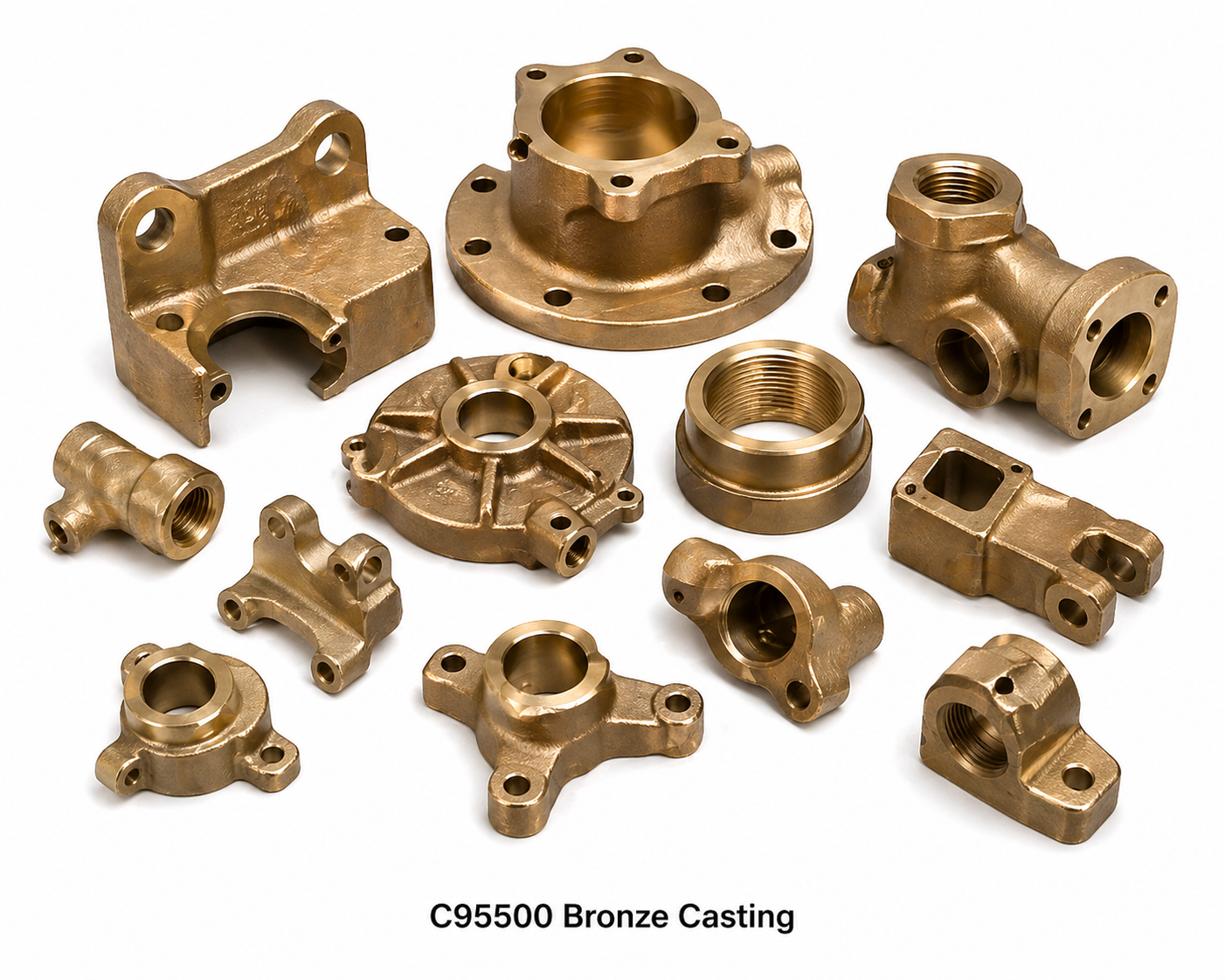
C95500 is the ASTM UNS designation for Nickel Aluminum Bronze (NAB) grade AB2C – a copper-aluminium-iron-nickel alloy containing approximately 10.0–11.5% aluminium, 3.0–5.0% iron, 3.5–5.5% nickel, with the balance copper. This is the highest-performance commercial aluminum bronze casting grade, combining the best seawater corrosion resistance, cavitation resistance, and elevated temperature mechanical properties available in the aluminum bronze family. Cable Glands India manufactures C95500 bronze castings for marine engineers, offshore oil and gas contractors, defence equipment manufacturers, aerospace component suppliers, power utility equipment builders, and electrical OEMs. C95500 is specified by ASTM B148, BS EN 1982 (CC333G), Lloyd’s Register, Bureau Veritas, and MIL-B-21230 for the most demanding marine and industrial applications where lesser aluminum bronze grades or stainless steel are found inadequate.
Product Overview
Why C95500 is the Premium Aluminum Bronze Grade
The C95500 alloy achieves its exceptional combination of properties through a precisely controlled four-component metallurgy. Aluminium at 10–11.5% forms both alpha (ductile, FCC) and kappa (hard, intermetallic) phases in the microstructure. Iron at 3–5% refines grain size and forms Fe-rich nucleating particles that produce a fine, uniform kappa phase distribution rather than the coarse kappa of lower grades – dramatically improving toughness. Nickel at 3.5–5.5% is the critical addition that differentiates C95500 (AB2C) from C95400 (AB2): nickel stabilizes the beta phase against decomposition to the brittle eutectoid at elevated temperatures, and significantly enhances corrosion resistance in seawater by forming a more stable passive surface film. The result is a casting alloy with tensile strength of 620 MPa minimum, yield strength of 280 MPa minimum, and elongation of 10% minimum – mechanical properties approaching those of medium-strength carbon steel while maintaining full non-magnetic and non-sparking characteristics.
Seawater Corrosion and Cavitation Resistance
C95500 (NAB) is the recognized benchmark for seawater corrosion resistance among copper alloy castings. The nickel-enhanced aluminium oxide passive film formed on C95500 is more stable and adherent than that on C95400 or AB1, resisting breakdown in high-chloride seawater, polluted harbour water, and tropical seawater at temperatures up to 60°C. C95500 castings exhibit negligible dezincification (no zinc present), minimal pitting corrosion in seawater at flow velocities up to 4 m/s, and excellent crevice corrosion resistance in bolted joints – the last being a critical advantage over 316L stainless steel which fails by crevice attack in stagnant seawater. Cavitation erosion resistance – the ability to resist pitting caused by the collapse of vapour cavities in high-velocity fluid – is 3–5 times greater for C95500 than for cast iron and significantly better than cast stainless steel (CA6NM), making C95500 the first-choice alloy for marine propellers, pump impellers, and control valves in high-velocity seawater service.
High-Temperature Mechanical Properties
C95500 retains useful mechanical properties at elevated temperatures: at 200°C, UTS remains above 500 MPa and yield strength above 220 MPa. At 300°C, UTS exceeds 420 MPa. This elevated-temperature strength is significantly superior to C95400 (AB2), which softens substantially above 200°C due to beta-phase decomposition – a process inhibited in C95500 by the nickel content. This makes C95500 the preferred grade for steam valve bodies, high-temperature hydraulic valve bodies, and pump components in process plants where operating temperatures exceed 150°C. For electrical applications, C95500’s stability at elevated temperatures makes it superior for high-temperature busbar connector castings, transformer terminal blocks operating near hot-spot temperatures, and motor terminal housings in ambient-temperature installations above 85°C.
Non-Magnetic and Non-Sparking Properties
C95500 is non-magnetic (relative permeability ≈ 1.0), making it indispensable for components near magnetic field-sensitive instruments: compass binnacle hardware, degaussing system components, sonar transducer housings, MRI-adjacent equipment hardware, and non-magnetic tool components for explosive ordnance disposal. As a copper-base alloy, C95500 is classified non-sparking per EN 13463-1, suitable for use in ATEX Zone 0, Zone 1, and Zone 2 classified areas for atmospheric group IIA and IIB gases. Certificate of conformity to non-sparking requirements is supplied on request. This combination of non-magnetic and non-sparking properties makes C95500 uniquely valuable for submarine internal machinery castings, minesweeper hull fittings, and hazardous area electrical components.
Comparison with Other Bronze and Stainless Steel Grades
C95500 occupies a unique engineering position: stronger and harder than gunmetal (LG2/CC491K, UTS 240 MPa), phosphor bronze (PB1, UTS 280 MPa), and admiralty brass (UTS 350 MPa); better seawater corrosion resistance than duplex stainless steel (2205) in crevice environments; better cavitation resistance than 316L stainless steel; non-magnetic unlike any grade of stainless; and better machinability than nickel-aluminium superalloys. Against 17-4 PH stainless steel (UTS 1000 MPa), C95500 offers lower strength but dramatically superior corrosion resistance in seawater and eliminates the risk of hydrogen stress cracking. The premium cost of C95500 over standard gunmetal or C95400 is typically recovered within 2–3 years of service life in marine applications through elimination of replacement and maintenance costs.
Heat Treatment – Quench Anneal
As-cast C95500 may contain microstructural variations and residual beta phase that reduce toughness and corrosion resistance. Cable Glands India applies quench anneal heat treatment (solution anneal at 850–900°C followed by rapid water quench) as standard for marine and offshore castings, transforming the microstructure to a uniform alpha + kappa structure with optimized corrosion resistance and toughness. Tempering at 580–650°C for 2–4 hours follows quench anneal for applications requiring maximum impact resistance. Heat-treated C95500 achieves Charpy impact values of 20–40 J versus 5–15 J for as-cast material. All heat treatment is performed in calibrated furnaces with time-temperature records supplied with each casting.
Machining and Fabrication
C95500 has a machinability rating of 20% (relative to free-cutting brass = 100%), requiring sharp carbide or PCD tooling, moderate cutting speeds, and flood coolant. Despite lower machinability than brass, C95500 machines to consistent tolerances and good surface finishes (Ra 1.6 µm achievable on bearing bores). Cable Glands India operates CNC turning centres with capacity to 600 mm turning diameter and 2000 mm length, enabling machining of large marine castings (propeller hubs, valve bonnets, pump casings) in-house without sub-contracting. Post-machining NDT includes liquid penetrant testing (LPT) per ASTM E165 and ultrasonic testing (UT) per ASTM E114 on critical pressure-containing surfaces.
Key Features
- UTS 620 MPa minimum – the highest strength standard aluminum bronze casting grade
- Seawater corrosion resistance superior to 316L stainless steel in crevice environments
- Cavitation erosion resistance 3–5× greater than cast iron
- Non-magnetic (µr ≈ 1.0) – essential for magnetic-sensitive instrument environments
- Non-sparking – ATEX Zone 0/1/2 certified, Group IIA and IIB gases
- Elevated temperature stability – useful properties to 300°C (vs. 200°C for C95400)
- Quench anneal heat treatment standard for marine and offshore supply
- Compliant with ASTM B148, BS EN 1982 CC333G, IS 318 Gr.3, MIL-B-21230
- Lloyd’s Register, Bureau Veritas, DNV-GL, IRS type approval available
- Full material traceability: EN 10204 3.1 Mill certificates, NABL-accredited mechanical testing
Material Grades and International Equivalents
| Designation | India (IS) | USA (ASTM/UNS) | UK (BS EN) | Germany (DIN) | Europe (EN) | Military | ISO | Al% | Fe% | Ni% | UTS (MPa) |
|---|---|---|---|---|---|---|---|---|---|---|---|
| C95500 / AB2C | IS 318 Gr.3 | C95500 / UNS C95500 | BS EN 1982 CC333G | DIN 1714 CuAl10Fe5Ni5 | EN CC333G | MIL-B-21230 | ISO 428 CuAl10Fe5Ni5 | 10.0–11.5 | 3.0–5.0 | 3.5–5.5 | 620 |
| C95800 / NAB | IS 318 Gr.4 | C95800 / UNS C95800 | BS EN 1982 CC334G | DIN 1714 CuAl10Ni5Fe4 | EN CC334G | — | ISO 428 CuAl10Ni5Fe4 | 8.5–9.5 | 3.5–4.5 | 4.5–5.5 | 690 |
| C95400 / AB2 | IS 318 Gr.2 | C95400 / UNS C95400 | BS EN 1982 CC331G | DIN 1714 CuAl10Fe3 | EN CC331G | MIL-C-15345 | ISO 428 CuAl10Fe3 | 10.0–11.5 | 3.0–5.0 | — | 570 |
| C95200 / AB1 | IS 318 Gr.1 | C95200 / UNS C95200 | BS EN 1982 CC330G | DIN 1714 CuAl9Fe2 | EN CC330G | — | ISO 428 CuAl9Fe2 | 8.5–9.5 | 2.5–4.0 | — | 500 |
| C95700 / HT NAB | — | C95700 / UNS C95700 | — | DIN 1714 CuAl11Fe6Ni6 | EN CC335G | — | — | 10.5–12.0 | 5.0–7.0 | 5.0–7.0 | 750 |
Technical Specifications – C95500
| Property | As-Cast | Quench Annealed | Q/A + Tempered |
|---|---|---|---|
| Tensile Strength (MPa) | 620 min | 620 min | 580 min |
| 0.2% Yield Strength (MPa) | 280 min | 260 min | 240 min |
| Elongation (%) | 10 min | 12 min | 15 min |
| Hardness (HB) | 160–210 | 150–200 | 140–180 |
| Charpy Impact (J) | 5–15 | 15–30 | 20–40 |
| Density (g/cm³) | 7.53 | 7.53 | 7.53 |
| Electrical Conductivity (%IACS) | 7–9 | 7–9 | 7–9 |
| Thermal Conductivity (W/m·K) | 50 | 50 | 50 |
| Max. Useful Service Temp. (°C) | 300 | 350 | 350 |
| Magnetic Permeability (µr) | ~1.0 | ~1.0 | ~1.0 |
| Machinability Rating (%) | 20 | 20 | 20 |
Product Types and Variants
- Sand Castings – Pump casings, valve bodies, manifold bodies, propeller hubs (0.5–500 kg)
- Investment Castings – Precision connector bodies, valve components, precision marine hardware (±0.1 mm)
- Centrifugal Castings – Bearing rings, bushing sleeves, flanges (OD up to 600 mm)
- Fully Machined Castings – CNC-finished to drawing, hydrostatic tested where applicable
- Quench Annealed and Tempered – Heat-treated to MIL-B-21230 and BS EN 1982 requirements
- Class Society Approved – With Lloyd’s, BV, DNV-GL, IRS certificate on request
Applications in Industry
- Marine & Naval: Ship propellers and propeller hubs, rudder bearings, stern tube bushings, seawater pump impellers, sea chest valves, seacock bodies, hull penetration fittings, submarine machinery castings
- Offshore Oil & Gas: Subsea valve bodies, manifold castings, non-sparking tools and hardware, riser clamp bodies, umbilical termination hardware
- Defence: Minesweeper hull fittings (non-magnetic), torpedo component castings, gun bushing components, explosive ordnance disposal equipment
- Power Utilities: High-temperature busbar connector castings, switchgear terminal bodies, earthing clamp bodies for coastal and offshore substations
- Chemical Plant: Non-sparking valve bodies for explosive gas service, pump castings for corrosive process streams, ATEX Zone 1 electrical equipment bodies
- Aerospace: Hydraulic valve bodies, non-magnetic instrument brackets, actuator component castings
Manufacturing Process
1. Charge Preparation: High-purity copper cathode, aluminium ingot (99.9%), electrolytic iron, and nickel pellets or shot are weighed to target composition within ±0.1% on all elements.
2. Melting: Induction furnace, 1150–1200°C maximum. Aluminium added last to minimize oxidation loss. Charcoal cover layer throughout.
3. Spectrometric Analysis: Full OES analysis – Cu, Al, Fe, Ni, Mn, Si, Sn, Pb, Zn verified. Reject criteria: any element outside ASTM B148 / BS EN 1982 composition limits.
4. Casting: Bottom-pour ladle for sand casting. Shell mould for investment casting. Centrifuge at 300–500 rpm for centrifugal casting. All at 1100–1150°C.
5. Heat Treatment: Quench anneal at 850–900°C × 2 hours min, water quench within 15 seconds. Tempering at 620°C × 2–6 hours as specified.
6. NDT: Liquid penetrant test (LPT) per ASTM E165; radiographic test (RT) per ASTM E272 on critical sections; UT per ASTM E114 on machined surfaces.
7. Machining: CNC turning and milling with flood coolant and carbide/PCD tooling. 100% dimensional gauging of critical features.
8. Hydrostatic Test: Pressure-containing castings tested to 1.5× MAWP minimum with test report.
Quality Standards and Certifications
- ASTM B148 – Aluminum-Bronze Sand Castings (C95500)
- BS EN 1982 – Copper Alloy Castings (CC333G)
- IS 318 – Indian Standard Copper Alloy Castings (Grade 3)
- MIL-B-21230 – Military Specification Bronze, Aluminum (for Defence supply)
- DIN 1714 – CuAl10Fe5Ni5 Casting Alloy
- Lloyd’s Register, Bureau Veritas, DNV-GL Type Approval
- Indian Register of Shipping (IRS) Certification
- NABL-Accredited Mechanical Testing Laboratory
- ISO 9001:2015 Quality Management System
- ATEX / IECEx Non-Sparking Certificate (EN 13463-1) on request
- RoHS 3 Directive 2015/863/EU compliant
Why Choose Cable Glands India
- Class Society Approvals: Lloyd’s, BV, DNV-GL, IRS material and product certificates available for marine and offshore orders
- MIL-Spec Compliance: Defence supply capability per MIL-B-21230 with full audit trail documentation
- In-House Heat Treatment: Calibrated quench anneal and tempering furnaces with chart records; no sub-contracting
- ATEX Non-Sparking Certification: Certificates of conformity for ATEX Zone 0/1/2 electrical component castings
- Large Casting Capability: Sand castings up to 500 kg; centrifugal castings up to 600 mm OD
- NDT In-House: LPT, UT, and RT available without sub-contracting delays
- Export Track Record: Supply to naval shipyards, offshore contractors, and petrochemical plants in 25+ countries
Frequently Asked Questions (FAQ)
Q1: What is the difference between C95500 and C95800 (NAB)?
Both are nickel aluminum bronzes. C95500 (CuAl10Fe5Ni5, AB2C) has higher aluminium (10–11.5%) and iron (3–5%), giving higher strength (UTS 620 MPa). C95800 (CuAl10Ni5Fe4) has lower aluminium (8.5–9.5%), giving superior cavitation resistance and the best-in-class seawater corrosion resistance – it is the standard marine propeller alloy. For structural castings requiring maximum strength with good corrosion resistance, C95500 is specified. For propellers and high-velocity seawater applications, C95800 is the first choice.
Q2: Why is C95500 preferred over 316L stainless steel in seawater service?
316L stainless steel forms a passive film that is susceptible to breakdown by chloride ions in stagnant seawater, leading to crevice corrosion and pitting, particularly in bolted joints and threaded connections. C95500 does not form chloride-susceptible passive films – its corrosion resistance is maintained in both flowing and stagnant seawater. Additionally, C95500 is non-magnetic and non-sparking, properties unavailable in stainless steel, and has better cavitation resistance than cast stainless steel grades.
Q3: Is quench anneal heat treatment always required?
For marine and offshore applications, quench anneal is standard and specified by ASTM B148, Lloyd’s Register, and most class society material requirements. For general engineering applications (non-seawater, ambient temperature), as-cast C95500 meets the minimum mechanical property requirements and heat treatment may be omitted to reduce cost. Cable Glands India recommends quench anneal for all corrosion-critical applications.
Q4: Can C95500 castings be supplied with class society certificates?
Yes. Cable Glands India produces C95500 castings with witnessed inspection and material certification from Lloyd’s Register (LR), Bureau Veritas (BV), DNV-GL, and Indian Register of Shipping (IRS) surveyors. Class society material certificates (Form 2 or equivalent) are issued directly by the surveyor. Advance arrangement for surveyor attendance requires 2–4 weeks notice.
Q5: Is C95500 truly non-sparking for ATEX Zone 0 use?
Yes. C95500 is a copper-base alloy and classified non-sparking per EN 13463-1 and IEC 60079-0 for surface temperatures and impact sparking. Certificates of conformity for non-sparking classification are supplied on request. For Zone 0 use in gas groups IIA and IIB, C95500 castings used as cable gland bodies or connector housings comply with ATEX Directive 2014/34/EU Group II Category 1G.
Q6: What NDT methods are available for C95500 castings?
Cable Glands India performs: Liquid Penetrant Testing (LPT) per ASTM E165, Level II technician; Radiographic Testing (RT) per ASTM E272 for internal soundness; Ultrasonic Testing (UT) per ASTM E114 for wall thickness verification and internal defects on machined surfaces; Positive Material Identification (PMI) by OES/XRF to verify alloy grade. Third-party NDT by SGS, Bureau Veritas, or TÜV can be arranged.
Q7: What is the lead time for C95500 sand castings?
Standard C95500 sand castings without class society certification: 3–5 weeks. With quench anneal heat treatment: add 1 week. With class society witnessed inspection: add 2–4 weeks for surveyor scheduling. Investment castings with existing tooling: 2–3 weeks. Rush orders for prototype castings (small size, <20 kg): 10–15 working days.
Q8: Can C95500 replace manganese bronze for marine propellers?
C95500 is used for propeller hubs, propeller shaft nuts, and structural propulsion components, while C95800 (NAB) is the standard for propeller blades and impellers due to its higher cavitation resistance. Manganese bronze (CuZn27Al4Mn3Fe3, C86500) is specified for some commercial ship propellers due to lower cost and adequate performance in less corrosive conditions. For naval, offshore, and high-performance marine applications, C95500 and C95800 are the engineering choices.
Q9: Do you supply C95500 to MIL-B-21230 for defence applications?
Yes. Cable Glands India produces C95500 sand castings to MIL-B-21230 (Military Specification for Bronze, Aluminum, Castings) with full documentation trail including composition certification, mechanical test reports, heat treatment records, and NDT reports. Defence supply requires additional quality plan documentation and may include Government Quality Assurance (GQA) inspection depending on the contracting authority’s requirements.
Q10: What is the price difference between C95500 and standard gunmetal?
C95500 is approximately 2.5–3.5× more expensive than standard gunmetal (LG2/CC491K) on a per-kilogram basis, reflecting the higher nickel and iron content and the more complex melting practice. However, in marine seawater service, C95500 components typically last 3–5× longer than gunmetal, providing a lower total lifecycle cost over 20–30 year equipment design lives. For non-seawater engineering applications, gunmetal or phosphor bronze may provide better value.
Equivalent Terms – Multilingual Reference
| Language | Term 1 | Term 2 | Term 3 |
|---|---|---|---|
| Spanish | Fundición de bronce níquel-aluminio | Bronce aluminio níquel C95500 | Aleación CuAl10Fe5Ni5 fundida |
| Russian | Литьё из никель-алюминиевой бронзы | Бронза C95500 литая | Сплав CuAl10Fe5Ni5 литой |
| French | Pièces moulées en bronze aluminium nickel | Bronze C95500 coulé | Alliage CuAl10Fe5Ni5 moulé |
| Portuguese | Fundição de bronze alumínio-níquel | Bronze C95500 fundido | Liga CuAl10Fe5Ni5 fundida |
| Italian | Fusione in bronzo alluminio-nichel | Bronzo C95500 fuso | Lega CuAl10Fe5Ni5 fusa |
Related Products and Linked Terms
- Aluminum Bronze Casting (C95400, AB2, NAB)
- Phosphor Bronze Casting and Phosphor Bronze Machined Parts
- Brass DZR Casting and DZR Brass Machined Parts
- Copper Casting and Copper Machined Parts
- Silicon Bronze Castings
- Bronze Ground Rod Clamps
- Bronze Transformer Ground Connectors
- Marine Cable Glands
- Bronze Copper Grounding Clamps
Request a Quote
Cable Glands India engineers respond to C95500 bronze casting enquiries within 24 hours. Provide your drawing (PDF/DXF/STEP), heat treatment requirement (as-cast or quench annealed), NDT level, class society certification requirement, quantity, and delivery destination. We supply from prototype castings (1 piece) to large production orders, with full ASTM B148, BS EN 1982, MIL-B-21230, and class society documentation. Export to 30+ countries with complete commercial and technical documentation.
Contact us today for your C95500 Nickel Aluminum Bronze casting requirements – marine, defence, offshore, or electrical.